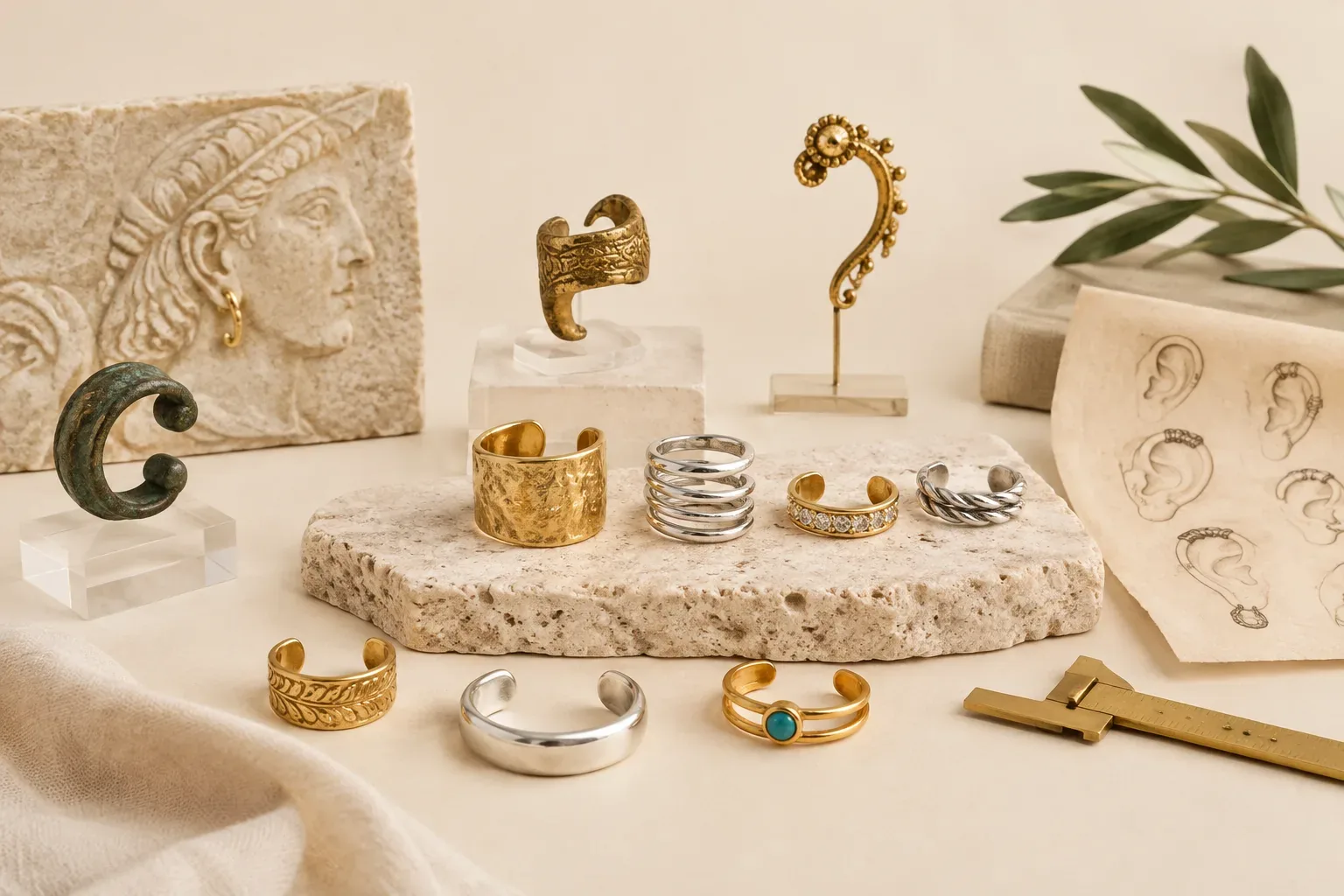
Meaning at a glance
This ear cuff size and fit guide explains which measurements matter for comfort and security, summarizes museum-documented historical uses, distinguishes documented historical meanings from contemporary personal symbolism, describes how motifs and gemstones are used in cuff designs, and offers practical, respectful selection and gifting advice.
Quick answer
Measure the thickness of the ear cartilage at the point where the cuff will sit, the length of the visible helix where a cuff might grip, and note overall ear shape; choose an ear cuff whose inner diameter and opening match those measurements and whose metal and finish suit your skin sensitivity and style. This guide explains why those three measurements matter, shows how museums and gem reference works document the changing contexts of ear-worn ornaments, separates documented historical meanings from modern interpretations, and offers practical selection and gifting tips.
How ear cuffs work: the practical anatomy of fit
Ear cuffs rely on a simple mechanical principle: they grip or cradle the outer ear (usually the helix, antihelix, or concha) without requiring a piercing. Fit depends on three related measurements: the thickness of the cartilage where the cuff contacts the ear, the circumference or inner diameter of the cuff where it will sit, and the visible length of the ear edge that the cuff can engage. A cuff that is too tight will pinch and become uncomfortable; one that is too loose may spin or fall off.
Manufacturers achieve fit through different designs: closed-band cuffs, open-band cuffs with a gap to slide over the ear, hinged cuffs with a small clip, and adjustable cuffs that can be gently squeezed or expanded. Each design interacts with the ear’s shape differently, so accurate measurement and an understanding of the cuff’s mechanics are the most reliable ways to predict comfort and retention.
Documented historical evidence and cultural contexts
Museum surveys and exhibitions that cover jewellery history show that non-pierced ear ornaments and cuff-like pieces appear in multiple periods and places. Curators and historical overviews at institutions such as the Victoria and Albert Museum describe how jewellery forms and how they were worn changed with social context, technology, and fashion. These museum resources document that a range of ear-worn devices—some used without piercing—have existed across historical periods and as part of different clothing and status systems.
When historians and museums record these objects, they focus on form, materials, construction, and documented uses rather than universal symbolic claims. The Victoria and Albert Museum's work on jewellery history places pieces in social and technical contexts, showing how a single form can have different meanings or no assigned meaning depending on period and place. Use museum catalogues and curatorial notes to understand how a particular cuff-like object was made and displayed in its original context rather than assuming a modern symbolic continuity.
Separating documented historical meanings from modern personal interpretation
Documented meanings come from contemporary records, inventories, burial contexts, inscriptions, or curator notes that explicitly link an object to a use or belief. The Victoria and Albert Museum emphasizes that historians base interpretations on surviving records and material evidence. If a museum catalogue records an object as a status marker, funerary offering, or part of ceremonial dress, that is a documented historical meaning tied to evidence.
Modern interpretations—what people today feel a cuff represents—are often personal, stylistic, or political and are not the same as historically documented meanings. Many contemporary wearers adopt ear cuffs for fashion, comfort, or as expressions of identity; these uses are valid but are not the same kind of documented historical evidence that museums cite. Treat historical claims carefully: do not assume a single symbolic meaning carried unchanged across centuries or cultures.
How motifs, gemstones, and traditions appear in ear-cuff jewellery
Design motifs for ear cuffs range from plain metal bands to detailed figural work, botanically inspired scrolls, and geometric forms. Cuffs frequently use the same small-scale ornamentation popular in other types of jewellery, because the ear is a visible but limited surface and demands compact, balanced designs. Museum studies of jewellery forms, including resources by the Victoria and Albert Museum, document how motifs migrate between brooches, rings, necklaces, and ear ornaments as tastes and techniques evolve.
Gemstones appear in ear cuffs in settings similar to other small-scale jewellery: bead-set, bezel-set, prong-set, or pavé arrangements. The V&A's reference on gemstones explains how different stones have been chosen for color, hardness, and availability, and how treatments and cuts affect appearance. When buying gemstone-set cuffs, follow consumer guidance about disclosure: the Federal Trade Commission requires that treatments, synthetics, and imitations be disclosed so buyers know what they are purchasing. Designers use a wide range of gems—from diamonds and pearls to colored stones—selected for contrast with the metal and longevity against skin contact.
Measurements that matter: step-by-step sizing for a reliable fit
1) Measure cartilage thickness: Using a soft measuring tape or a strip of paper, measure the thickness of the ear where the cuff will contact it (helix or upper rim). Wrap the tape or paper snugly but not tightly, mark, and measure that mark against a ruler. Typical cuff designs list internal gap or diameter tolerances; compare your measurement to these to select an appropriate size.
2) Measure the visible rim length: If the cuff is designed to clip along a stretch of the helix, measure the length of the visible rim from the earlobe’s top edge to the highest point where the cuff will sit. This helps when choosing cuffs that extend around a portion of the ear or when layering multiple cuffs.
3) Note ear curvature and slope: Look at your ear’s profile. A strongly curved helix may need a cuff with a larger internal diameter or an adjustable hinge so the cuff does not pinch, while a flatter helix benefits from narrower, closer-fitting cuffs. Photographs from multiple angles or a visit to a jeweller for a test fit can be helpful.
4) Match mechanism to anatomy: For sensitive ears or uncertain sizing, choose a hinged or adjustable cuff that can be tried on and gently adjusted. Avoid forcing a closed, rigid cuff over cartilage; gentle shaping by a professional jeweller is safer than repeated bending at home.
Practical and respectful selection and gifting guidance
When selecting an ear cuff as a gift, prioritize fit, material, and the recipient’s style. If you can, measure discreetly or choose a design with an adjustable fitting. Metals are a crucial choice for comfort: hypoallergenic metals such as surgical steel, titanium, or nickel-free gold alloys reduce the chance of skin reaction. If the recipient has allergies, confirm metal content before purchase.
Respect cultural and religious practices when gifting. Museums like the Victoria and Albert Museum show that jewellery forms have been used in many ways; some items hold ritual or communal significance in particular cultures. If you know a design is connected to a living tradition, ask about appropriate etiquette or choose a neutral design. When buying gemstone-set pieces, use FTC guidance to ensure that sellers disclose treatments, synthetics, and imitation materials; transparent disclosure is also a respectful way to gift, particularly for pieces presented as meaningful or valuable.
Provide a modest care note with the gift: explain whether the metal is plated (which can wear), whether stones are treated, and whether the cuff is adjustable. A simple instruction to try the cuff on over clean skin and to gently adjust rather than force it shows thoughtfulness and reduces risk of damage or discomfort.
Care, adjustments, and safety
Avoid repeatedly forcing a tight cuff into place; repeated bending of base metals or plated pieces can weaken joints and remove plating. For adjustable cuffs, make small, incremental adjustments and test comfort at each stage. If a cuff requires notable reshaping, have it adjusted by a professional jeweller who can work with the metal without compromising settings or finishes.
Clean cuffs according to the metal and gemstone type. Follow fabric-care-like caution: avoid harsh chemicals on delicate stones, and remove cuffs before swimming in chlorinated pools or using strong cleaning agents. If the cuff contains glued components or treated gemstones, disclose this to wearers and use gentle cleaning to avoid loosening adhesives or harming treatments.
Frequently asked questions
How do I measure my ear for an ear cuff?
Measure the thickness of the cartilage where the cuff will sit using a soft tape or a strip of paper, measure the visible rim length if the cuff will span part of the helix, and note whether your ear is strongly curved or relatively flat; compare these dimensions to the cuff’s internal diameter and opening.
Can I wear an ear cuff if I have a pierced ear?
Yes. Ear cuffs are designed to be worn without piercing and can be worn in addition to pierced earrings; choose placement that does not interfere with existing studs or hoops and ensure the cuff’s grip does not press on pierced posts.
What metals are best for sensitive skin?
Hypoallergenic metals such as titanium, niobium, and nickel-free gold alloys are safer options for sensitive skin; if you are unsure, confirm metal content with the seller and look for jewellery labeled as hypoallergenic.
How tight should a cuff feel?
A cuff should feel snug enough to stay in place without pinching; it should not cause prolonged redness, numbness, or pain—if it does, remove it and slightly loosen or choose a larger size or adjustable design.
Are gemstone treatments or imitations important when buying a cuff?
Yes. The Federal Trade Commission recommends sellers disclose treatments, synthetics, and imitations; ask the seller about any treatments or whether gems are lab-grown so you know what you are buying and can care for the piece appropriately.
Can I resize or reshape an ear cuff at home?
Avoid forceful reshaping of plated or delicate cuffs at home; small adjustments can sometimes be made gently, but significant reshaping is best done by a professional jeweller to avoid weakening the metal or damaging settings.
Sources and further reading
- Bedazzled: A History of Jewellery — Victoria and Albert Museum
- An A-Z of Gemstones — Victoria and Albert Museum
- Buying Gemstones, Diamonds, and Pearls — Federal Trade Commission