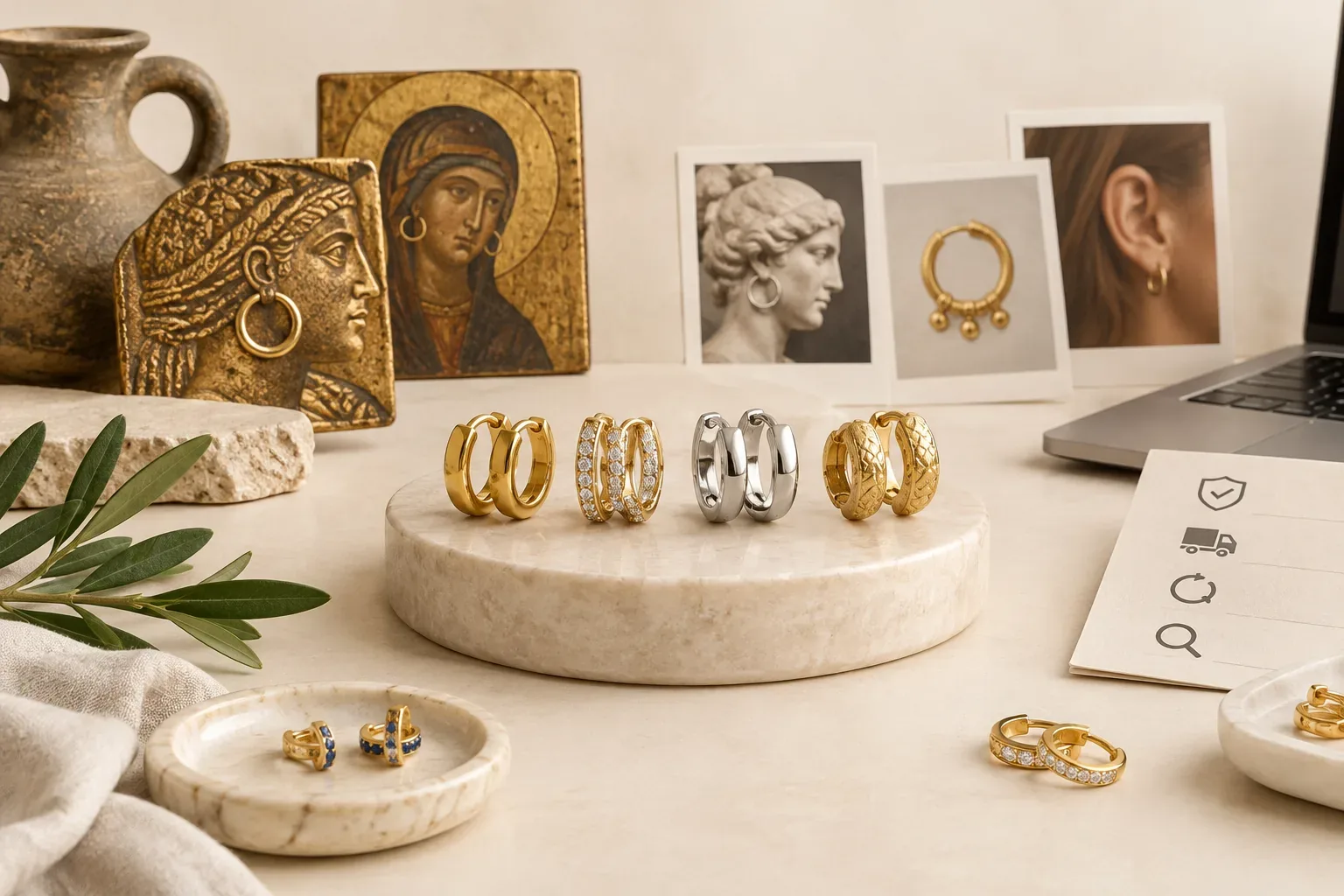
Meaning at a glance
This guide explains the documented history and changing contexts of small close-fitting hoops using museum scholarship, separates historical meanings from modern interpretations, describes how common motifs and gemstones appear on huggies, and gives concrete advice for selecting, gifting, and avoiding red flags when buying huggie earrings online.
What the historical evidence actually says
The Victoria and Albert Museum (V&A) presents jewellery as a material culture that changes in meaning across periods and places rather than an unbroken symbolic system. The V&A's overview of jewellery history shows that forms such as hoops, studs, and close-fitting earrings recur in many cultures but acquire different social meanings depending on time, place, and materials. Use the V&A's scholarship to understand how a style's social role changed rather than to assume a single, fixed meaning.
The V&A's resources on gemstones summarize how particular stones have been used and valued in different periods. Gemstones mounted on small hoops or huggies often reflect the availability and fashionable preferences of their moment—for example, certain coloured gems cycle in popularity—rather than carrying a single universal symbolic content. Rely on V&A descriptions to anchor any historical claims about materials, techniques, and changing fashions.
Documented historical meanings versus modern personal interpretations
Documented historical meanings come from surviving objects, inventories, and museum research. The V&A emphasizes that jewellery's uses and meanings shifted: pieces could signal status, wealth, marital status, political allegiance, or personal sentiment in different periods. When a museum labels an object as "sentimental" or "status" jewellery, that statement is based on contextual evidence such as inscriptions, portraits, or written records.
Modern personal interpretations—what a wearer feels a huggie represents today—are valid but distinct. Contemporary wearers treat huggies as functional, fashionable, or intimate because they sit close to the ear. These modern meanings are shaped by individual taste, social media, and current trends rather than by continuous historical proof. Make that distinction clear when you present a huggie as a gift or write a product note: cite historical evidence where it exists, and acknowledge personal meaning where it does not.
How motifs, gemstones, and traditions appear on huggie earrings
Huggies are small hoops designed to 'hug' the earlobe. Makers commonly apply motifs—such as engraved bands, tiny pavé-set stones, milgrain edges, or small dangling charms—to that compact form. These techniques are continuations of broader jewellery practices recorded by the V&A: settings, engraving, and surface decoration are standard ways artisans adapt larger traditions to a smaller scale.
Gemstones on huggies appear in a few typical ways: single bezel-set stones embedded in the hoop, rows of small pavé diamonds or coloured gems along the outer surface, or tiny charm drops that include gem accents. The V&A's A–Z of Gemstones provides background on common gem types and their historical uses; that resource can help you identify likely materials and understand why certain stones (for example, durable gems for daily-wear earrings) are chosen for close-to-skin pieces.
Metal choices, clasp types, and finish also reflect technical traditions. Huggies often use hinged or snap closures engineered for frequent opening and closing; these functional details are part of the object's design history and affect comfort, durability, and repairability.
Practical and respectful selection and gifting guidance
Start with fit and comfort. Because huggies sit close to the ear, check the internal diameter, hoop width, and weight in the product description. If the seller lists only vague terms like "small" or "dainty," ask for millimetres and grams. For gifting, consider the recipient's daily activities and metal sensitivities: lightweight designs and hypoallergenic metals reduce the chance of irritation.
Insist on clear material disclosure. If the item contains gold, silver, vermeil, plated base metal, or an alloy, it should be stated. For gemstones, ask whether stones are natural, lab-grown, or simulated and whether any treatments have been applied. The Federal Trade Commission recommends sellers disclose treatments, imitations, and the nature of materials used; follow that guidance when evaluating listings.
Respect cultural and religious motifs. If a huggie incorporates a symbol with a clear cultural or religious meaning, research that meaning before gifting or wearing. Use museum resources and cultural guides to verify significance; if you cannot confirm respectful usage, choose a neutral design. When in doubt, consult the recipient or a knowledgeable source rather than assuming a symbol is decorative only.
Personalize thoughtfully. Engraving an initial or adding a birthstone can make a huggie meaningful, but ensure the customization fits the scale of the piece and that the seller performs engraving cleanly. Check whether resizing or repairs are offered and whether warranties cover manufacturing defects.
Photos, policies, and a practical online-shopping checklist
Photos: Look for multiple high-resolution photos showing the huggie front, side, inner diameter with a scale (millimetres or a ruler), clasp mechanism open and closed, and close-ups of any gemstones or hallmarks. Ask for macro images of any markings if they are not visible. A 360-degree or video clip of the clasp in action is especially useful for hinge-style huggies.
Descriptions and disclosures: Product copy should list metal type and purity (for example, 14k gold), gemstone type and whether stones are natural or lab-grown, and any known treatments. If the seller follows FTC guidance, they will disclose simulants, dyeing, heating, fracture filling, or other treatments when relevant.
Policies and credentials: Verify the return, repair, and shipping policies before purchase. Look for stated processing times, insured shipping for valuable pieces, and whether the seller uses third-party grading or gemological reports for higher-value gemstones. For high-value items, independent certification adds confidence.
Seller reputation: Review feedback and cross-check reviews across platforms. Contact the seller with specific questions before buying; responsiveness is a practical indicator of service quality. If a listing has extensive positive feedback and clear policies, it is generally less risky than one with minimal information or unverifiable reviews.
Red flags to watch for
Extremely low prices with vague material descriptions are a common warning sign. If a listing advertises "gold" but gives no karat information, or offers precious stones at prices far below market without certification, ask for clarification and documentation.
No photos of the actual item is another red flag. Stock photos or CGI-only images make it hard to judge condition and finish. Avoid purchases when the seller refuses to provide close-up photos or a video of the clasp working.
Unclear or restrictive return and repair policies increase risk. If a seller's return policy is "final sale" for cosmetic or fit issues, consider buying from a seller that accepts returns within a reasonable window. For heirloom-level purchases, check whether the seller offers post-sale repair or resizing.
Missing hallmarks and missing disclosure of gemstone treatments are practical concerns. Many jurisdictions require accurate descriptions of materials; sellers who omit these details may be cutting corners. Follow the FTC's guidance and request disclosure when necessary.
Bringing it together
Treat the huggie earrings online shopping process like any small but wearable technical object: inspect photos, confirm measurements and materials, verify policies, and treat cultural meanings with care. Use museum resources such as the Victoria and Albert Museum for historical context and the Federal Trade Commission's consumer guidance for questions about material disclosure and treatments. Combining that evidence-based background with the practical checklist above will reduce risk and help you choose a pair that fits both physically and culturally.
Frequently asked questions
What exactly are huggie earrings and how do they differ from small hoops?
Huggies are small hoop-style earrings designed to sit close to the earlobe; they usually have a small internal diameter and secure hinged or snap closures. Some small hoops are larger and hang or swing more freely, so confirm internal diameter and weight when shopping.
What measurements should I ask for when buying huggies online?
Request the internal diameter, external diameter, width of the hoop, and the weight per earring. These dimensions let you compare fit and comfort more reliably than subjective terms like "dainty."
How can I tell if a gemstone on a huggie is natural, treated, or lab-grown?
Ask the seller to state whether stones are natural, lab-grown, or simulants, and whether any treatments (heating, dyeing, fracture filling) were applied. For high-value stones, request independent certification. The Federal Trade Commission advises sellers to disclose treatments and imitations.
What metal disclosures are important for huggie earrings?
Look for metal type and purity (for example, 14k gold, sterling silver, gold vermeil). If a listing only says "gold plated" or "metal," ask for specifics about the base metal and plating thickness.
What return and repair policies should I expect?
Prefer sellers who offer a clear return window for fit and satisfaction, insured shipping for valuables, and available repairs or a warranty against manufacturing defects. Avoid purchases with strict "final sale" policies for fit or comfort issues.
Are there cultural or religious considerations I should check before gifting huggies with symbols?
Yes. If a design includes a cultural or religious symbol, research its meaning using reputable sources such as museum research or consult the recipient. Avoid assuming decorative intent when a symbol may carry significant meaning.
What are quick red flags that indicate a risky listing?
Red flags include extremely low price without material disclosure, stock or no photos of the actual item, no hallmarks or treatment disclosure for gemstones, and sellers who do not answer material questions or refuse to provide close-up images.
Sources and further reading
- Bedazzled: A History of Jewellery — Victoria and Albert Museum
- An A-Z of Gemstones — Victoria and Albert Museum
- Buying Gemstones, Diamonds, and Pearls — Federal Trade Commission