Meaning at a glance
Explain the documented history and changing contexts of the huggie earrings quality checklist motif, separate cultural or religious evidence from later popular interpretations, and give practical guidance for choosing and wearing the motif in modern jewelry.
Quick answer
Concise answer: A reliable huggie earrings quality checklist focuses on three areas—construction, comfort, and durability—while recognizing that the form’s meanings have shifted over time; documented museum research describes how small hoops and jeweled fastenings evolved with changing fashions, and practical quality checks (hinge fit, metal mark, setting security, finish, and disclosed treatments) protect wearer safety and long-term enjoyment.
What are huggie earrings and why check quality?
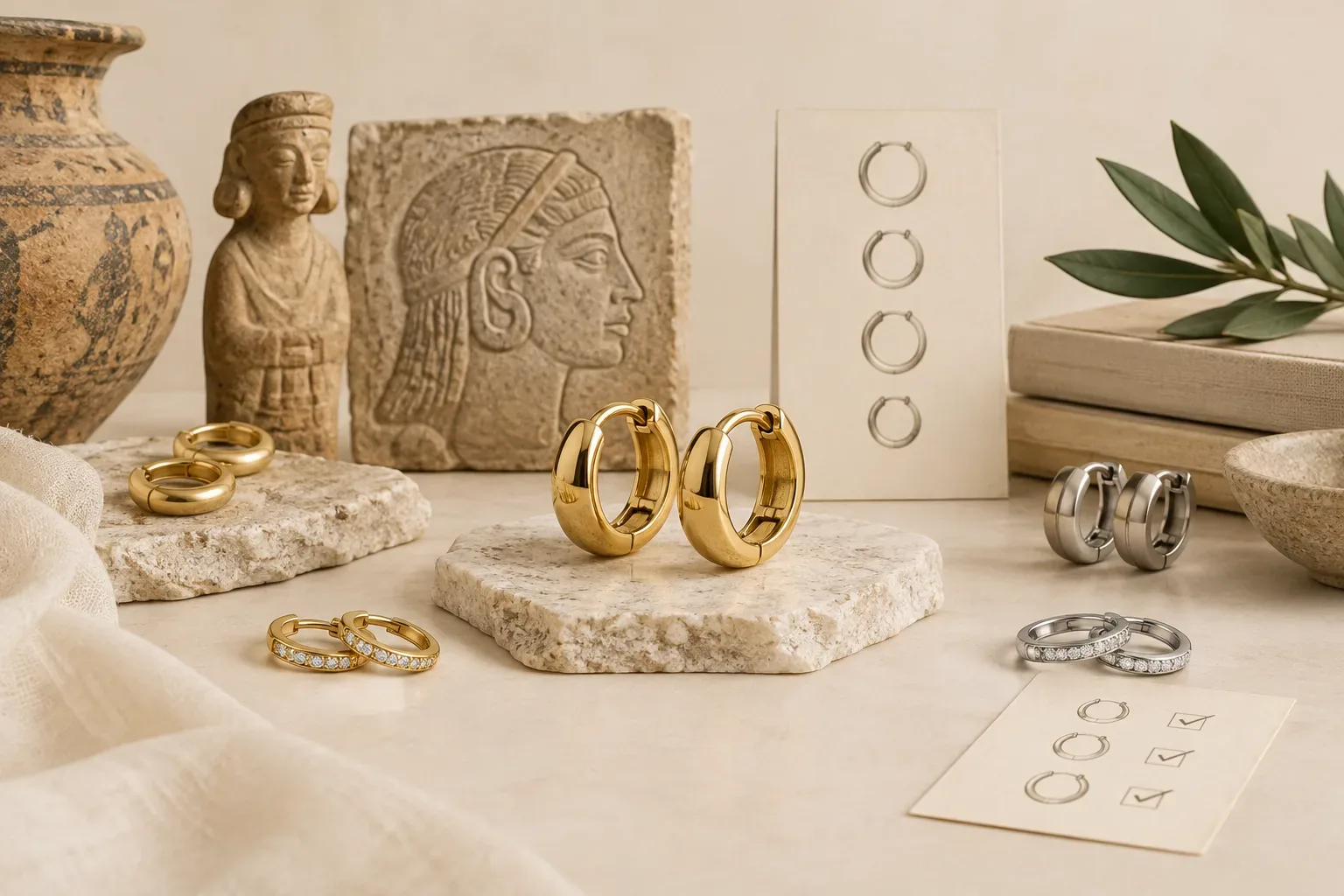
Huggie earrings are small hoop-style earrings designed to sit close to the earlobe and commonly feature a hinge or click-closure. Their compact shape makes them a staple for everyday wear, layering with studs or larger hoops, and often leads people to wear them continuously. Because they are worn so near the skin and often for long periods, small faults in construction, metal purity, or gemstone security have an outsized effect on comfort and longevity. A focused checklist helps buyers and gift-givers spot strong construction and honest disclosure before purchase.
Documented history and changing contexts
Museum research emphasizes that jewelry forms and meanings change with social context rather than remaining fixed. The Victoria and Albert Museum describes jewelry history as a series of changing social contexts where forms are adapted, reused, and reinterpreted across periods and cultures. Small hoops and close-fitting ear ornaments have appeared in many eras, but their social uses and symbolic associations vary by time and place, from status signals to practical adornment.
For example, archaeological and historical records show that hoop-like ear ornaments were worn in ancient Mediterranean and Near Eastern contexts, but the V&A frames these findings as part of a broader narrative about evolving fashion and material culture rather than a single continuous tradition. In later periods, including the 19th century, the shape and function of ear ornaments changed again as technologies for metalworking and gemstone cutting evolved. The V&A's work on jewelry history underlines that the same basic form—small hoops—can carry different meanings in different contexts, and museum scholarship discourages assuming a single, unchanging symbolism.
Documented historical meanings versus modern personal interpretations
Where there is documentary evidence of meaning—ritual use, status display, or trade value—museums and catalogues record those contexts carefully. The V&A's exhibition materials and catalogue entries identify particular pieces and the contexts in which they were used, enabling historians to link form, material, and social role. Those documented meanings apply to specific cultures and periods and should not be generalized beyond that evidence.
Modern personal or popular interpretations—such as reading a contemporary pair of tiny gold huggies as a sign of a particular lifestyle, political stance, or spiritual protection—are valid at the personal level but are not the same as historically documented meanings. Modern designers and wearers frequently reinterpret motifs, and these new meanings are part of contemporary culture. The important distinction is that documented historical meanings are tied to evidence about use in a named culture or period, whereas modern interpretations are individual or collective creative acts that build on, modify, or repurpose earlier forms.
How motifs, gemstones, and traditions appear in huggie earrings
Motifs and gemstones historically used in jewelry appear in huggies in straightforward ways: a motif can be engraved, chased, or cast into the metal of the hoop; a pendant motif can hang within the hoop; or a motif may be suggested by the arrangement of gemstones. The Victoria and Albert Museum’s overview of gemstones explains how particular stones have been prized in many eras for color, rarity, or cut, and how gem choices historically communicated wealth, taste, or other socially meaningful distinctions.
In contemporary huggies, diamonds, sapphires, pearls, and synthetic or treated stones are common. The same V&A resources that describe gemstone histories also help identify historically meaningful uses—for instance, pearls often appear in mourning and sentiment pieces in certain European contexts—while modern designers may use the same stones for purely aesthetic reasons. The Federal Trade Commission provides practical guidance relevant to buyers here: sellers should disclose treatments, imitations, or whether a gem is lab-grown, because those facts affect value and care needs.
A practical huggie earrings quality checklist
Construction: Inspect the hinge and clasp. A well-made huggie has a tight, flush closure with minimal play when closed. The hinge should open smoothly without wobble and latch securely so the earring does not spring open in wear. Check solder joints or the area where the hoop is joined; clean, neat soldering or a well-made seamless join indicates better manufacturing.
Material and marks: Look for metal hallmarks or maker’s marks that indicate metal type and purity. For precious metals, a stamped mark (for example, 14k, 18k, 925) is a basic indicator, though marks can be faked, so buy from reputable sellers. Ask about plating thickness if the piece is vermeil or gold-plated because thin plating wears quickly on a huggie that rubs against the skin.
Stone security and disclosure: For set gemstones, check that settings (bezels, prongs, pavé) hold stones securely with no visible gaps or loose stones. Ask the seller whether stones have been treated, filled, or are lab-grown; the Federal Trade Commission recommends disclosure of material treatments and imitations and requires sellers to avoid misleading claims. Confirm whether any adhesives were used in settings and whether the seller provides guidance on care.
Comfort: Feel the edge finishes and internal profile. The inside of a huggie that contacts the ear should be smoothly finished without sharp edges. Consider diameter and thickness: very thick huggies can pinch delicate earlobes, while oversized weight can pull. Try them on for movement—without earrings, mimic how much the lobe moves and whether the earring keeps a comfortable, close fit.
Durability tests: Gently open and close the hinge several times to test fatigue; a good hinge will not loosen quickly. Look for consistent finishing—plating should be even, solder should be hidden, and any enamel or surface decoration should be intact. Ask about warranties, repair policies, and whether the seller offers hinge or clasp repair; quality huggies are meant to be wearable every day and should be serviceable.
Maintenance considerations: Ask about recommended cleaning and whether ultrasonic cleaning or steam is safe for any stones or glues used. If the piece contains soft gems, organic materials, or certain treatments, these will influence how often it can be cleaned and what methods are safe.
Respectful selection and gifting guidance
Consider the wearer’s style, sensitivities, and cultural context before selecting a huggie. If the piece incorporates a cultural motif or religious symbol, learn its specific meaning and appropriate uses in the originating culture; do not assume symbols are universally appropriate. Museum documentation can point you to original contexts for motifs, but for respectful gifting you should consult community sources or specialists if the motif has ongoing cultural or religious significance.
Think practically about daily wear. For someone who sleeps, exercises, or showers with jewelry, prioritize sturdy hinges, solid metal construction, and secure settings rather than delicate filigree or fragile hanging elements. For sensitive ears select nickel-free alloys or known hypoallergenic metals such as high-karat gold or surgical-grade steel. If you cannot confirm metal purity, choose options with clear manufacturer disclosure or a return policy.
Gifting etiquette: When giving a piece meant to carry personal meaning, accompany it with a note explaining your intention and any reliable background about the motif or stones. If the piece uses heirloom stones or reproduces a culturally specific design, communicate provenance and, if possible, permission or blessing from source communities. If you are unsure whether a symbol is appropriate as a gift, opt for a neutral, well-made design that respects both the recipient and the cultural origins of any motifs.
Putting the checklist into practice
At purchase, run through the checklist: examine hinge fit, test the clasp, read markings, ask for written information on gem treatments, and try the earrings for comfort and movement. For online purchases, rely on clear photos, material disclosure, and seller guarantees. If buying vintage or antique huggies, seek provenance or at least cataloguing information; museum resources like those at the Victoria and Albert Museum can help identify stylistic features typical of certain periods but will not replace a formal appraisal.
Care for huggies as daily-wear pieces: clean according to the materials involved, check settings periodically, and have a trusted jeweller service hinges and settings when needed. Long-term enjoyment depends on both initial construction quality and regular care.
Final note on meaning and practice
Huggie earrings are a small form with a long history of reinvention. The scholarly record, as summarized by museum research, shows that forms are reused in different eras and contexts and that documented meanings bind to specific times and cultures. Contemporary wearers create new meanings through personal use and styling choices. For quality assessment, combine historical understanding with the practical checklist above so that you choose huggies that are comfortable, durable, and respectfully selected or gifted.
Frequently asked questions
How can I tell if huggie earrings are good quality?
Check hinge and clasp action for a secure, flush closure; look for neat soldering or a seamless join; verify metal marks or seller disclosure on metal type; ensure stones are snug in their settings; and ask about plating thickness or treatments. Test by opening and closing the hinge several times and trying the earrings for comfort.
Are huggie earrings safe for sensitive ears?
They can be, if made from appropriate metals. Choose known hypoallergenic metals (high-karat gold, platinum, or surgical-grade stainless steel) or pieces sold as nickel-free. If in doubt, ask for material disclosure and a return policy or select a design with a solid post and minimal alloys.
What should I ask about gemstones in huggies?
Request written disclosure on whether gems are natural, lab-grown, or treated, and whether any fillers or adhesives were used. The Federal Trade Commission advises sellers to be transparent about treatments and imitations because these affect value and care.
Can I sleep or shower with huggie earrings?
Many people sleep and shower with sturdy huggies, but doing so increases wear on hinges, plating, and settings. For pieces with delicate stones, soft gems, or thin plating, remove them before showering or sleeping to extend life and avoid accidental loss.
Should I consider cultural meaning when gifting huggies?
Yes. If a design uses a culturally specific motif or religious symbol, research its contemporary appropriateness before gifting. Museum resources can help identify origins, but consult community sources or specialists when a symbol has ongoing cultural or spiritual significance.
Sources and further reading
- Bedazzled: A History of Jewellery — Victoria and Albert Museum
- An A-Z of Gemstones — Victoria and Albert Museum
- Buying Gemstones, Diamonds, and Pearls — Federal Trade Commission