Meaning at a glance
This hoop earrings online shopping guide lays out documented historical contexts of hoop earrings, separates cultural and religious evidence from later popular meanings, explains how the motif and gemstones appear in jewelry, and gives practical guidance for evaluating photos, seller policies, and red flags when buying or gifting hoops online.
What the historical evidence actually shows
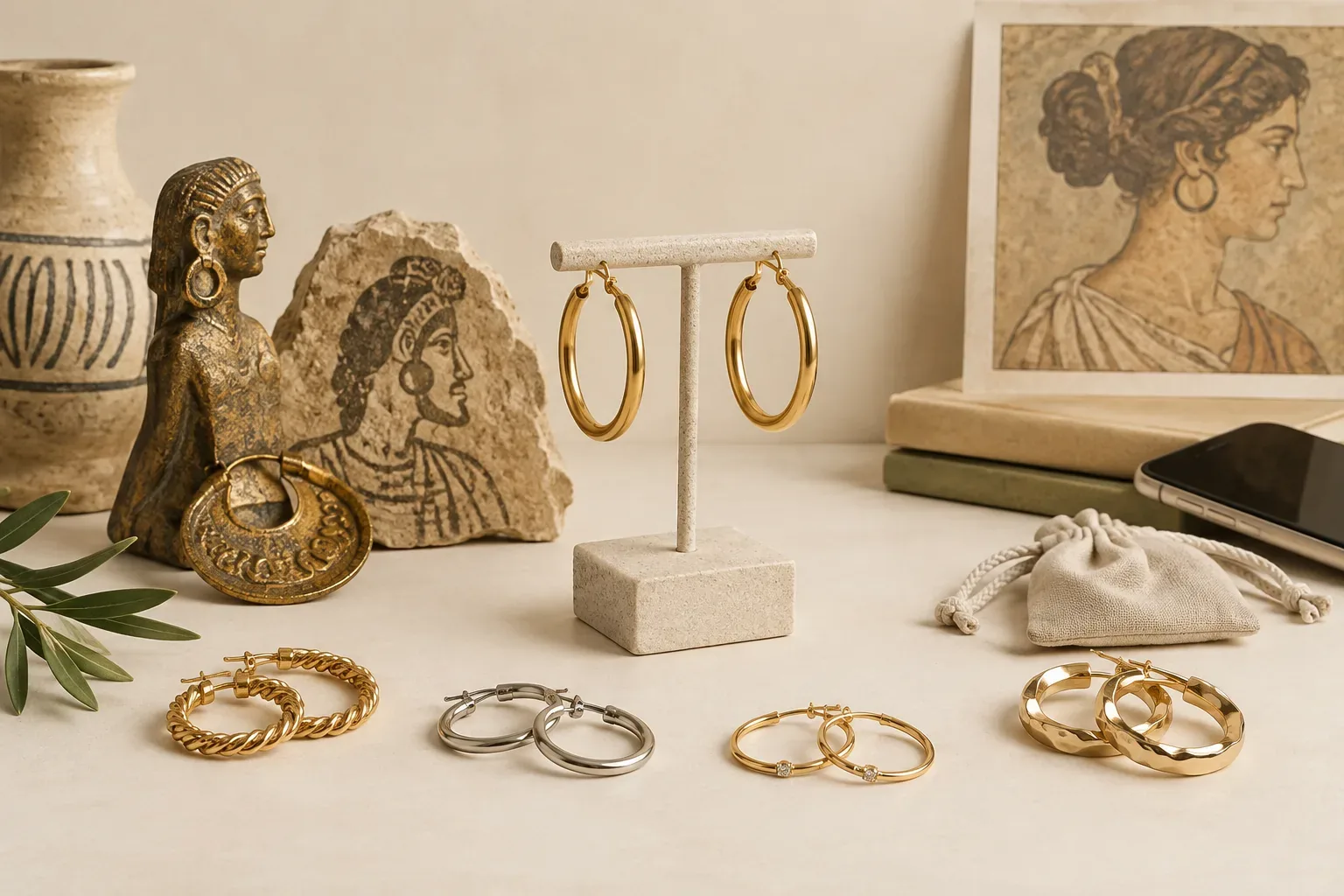
Museum scholarship shows that hoop-style earrings are an enduring decorative form but their meanings and uses have varied by culture and period. The Victoria and Albert Museum documents hoop and circular jewellery forms in multiple collections and exhibitions, noting examples from ancient Egyptian burials, classical antiquity, medieval and later European work, and global traditions held in museum collections. The V&A’s historical overview emphasizes changing social contexts and techniques rather than a single, fixed meaning for the form.
Specify cultures and contexts separately
In surviving ancient Egyptian jewellery, circular ear ornaments appear among grave goods and personal adornment; museum descriptions associate these objects with status and identity within that society rather than with a universal symbolic message. Classical antiquity (Greek and Roman contexts) also produced hoop and ring earrings using gold and wire techniques, often reflecting local fashions and technical skill rather than a single ritual meaning. The V&A records medieval and Renaissance European examples where hoops appear alongside other earring types, and it catalogs hoop and circular forms from South Asian and West African collections where local materials and techniques give different visual and social emphasis. Each of these attestations is a documented example of use and style, not proof that hoop earrings carried the same symbolism across these cultures.
Documented historical meanings versus modern interpretations
Museum records focus on craft, materials, and social context but rarely attribute universal symbolism to the hoop. Where museums like the Victoria and Albert Museum describe an object’s archaeological or collection context, they ground interpretation in provenance and comparative study. Modern popular meanings often layer on notions of timeless empowerment, minimalism, or identity that are contemporary personal or marketing interpretations rather than direct continuations of a single historical meaning. Treat claims such as "hoops always mean X" with skepticism and look for the provenance and scholarship behind any claim.
How the hoop motif and gemstones appear in jewellery
The hoop is a structural motif: a continuous circle or partial circle worn at the ear. In metalwork the form ranges from simple wire circles to broad, hollow hoops or intricately decorated bands. The V&A’s resources on gemstones show how stones are historically incorporated into settings, and the same principles apply to hoop earrings that carry gemstones: stones may be set along the outer face of a wide hoop, suspended as a drop inside a hoop, or inset in terminals or clasps. Designers use gemstones for contrast, color, and perceived value, but the technique—bezel, prong, or pave setting—affects durability and care needs.
Reading online photos: what to inspect
High-quality photos are the single most important tool when shopping for hoops online. Look for clear, well-lit images from multiple angles that show the front, side, back, and the clasp or hinge in close-up. A scale reference—such as millimetres, a ruler, or the earring worn on a model—helps judge diameter and width. Zoomable macro shots of solder joints, settings, hallmark stamps, and the interior of hollow pieces reveal finishing quality. For gemstone-set hoops, request close-ups that show stone setting integrity and any inclusions if accurate representation is important to you.
Seller policies and documentation to check
Good sellers provide clear material descriptions, metal marks or karat disclosures, and any information about plating, hollow construction, or composite parts. For gemstones and diamonds, the Federal Trade Commission’s buyer guidance recommends checking for written disclosures about treatments, synthetics, and imitations; reputable sellers will list whether stones are natural, treated, lab-grown, or simulants. Look for explicit return and refund policies, accurate shipping timelines, and a visible customer service contact. If a seller offers grading reports or certificates for gemstones or diamonds, request copies before purchase.
Red flags to avoid
Beware of listings with only one small or low-resolution image, vague material descriptions, or phrases such as "looks like" without specifics. Sellers who refuse to confirm metal content, refuse returns for "change of mind," or cannot provide documentation for high-value gemstones should be treated with caution. Extremely low prices for items claimed to be high-karat gold or set with premium gemstones can indicate plating, heavy imitation, or misrepresentation. Finally, watch for stock photos that do not match the exact item—clear, item-specific photos should be standard.
Practical and respectful selection and gifting guidance
When selecting hoops as a gift, prioritize the recipient’s style and lifestyle. Consider diameter and width in relation to daily comfort and professional dress codes; large or heavy hoops can be striking but may be impractical for active wear. For cultural or traditional styles, learn the specific context: if a design references a living cultural tradition, choose makers from that community when possible or seek permission and clear attribution from the seller. For gemstone choices, use the V&A’s gemstone guidance to understand how treatments affect appearance and care, and choose settings that protect the stone for an active wearer. When in doubt, choose a retailer with a flexible return window so the recipient can try the piece in person.
Care, maintenance, and when to ask for clarification
Care needs vary by metal and construction. Solid gold is more resistant to wear than gold-plated base metals, and gemstones differ in hardness and vulnerability. Ask the seller whether the hoops are hollow, plated, or solid, and whether any stones have surface treatments that require gentle cleaning. If the listing does not describe construction or materials in detail, ask the seller specific questions in writing and keep replies. Documented answers are useful if you later need a return, repair, or reselling information.
Final checklist before checkout
Before you buy, confirm the hoop’s diameter and weight, verify metal and gemstone descriptions in writing, inspect high-resolution photos including the clasp and any hallmark, check the seller’s return and repair policies, and look for written disclosures about treatments or synthetics in gemstone descriptions. If the piece references a contemporary cultural tradition, consider the maker’s origin and attribution. These steps reduce the risk of disappointment and help ensure you buy a hoop that matches both your aesthetic and practical expectations.
Frequently asked questions
How do I judge hoop size from online photos?
Ask for a referenced photo that shows the hoop on a model or next to a ruler, or request the exact diameter in millimetres. Sellers who provide multiple, well-lit angles and a scale reference make sizing reliable; if the listing lacks that information, request it in writing before purchase.
What should I expect sellers to disclose about metal and gemstones?
Reputable sellers will state metal type and karat or plating, and disclose whether gemstones are natural, treated, lab-grown, or simulants. The FTC recommends buyers ask for written disclosure about treatments and imitations for gemstones and diamonds; if a seller will not confirm these details, treat that as a potential red flag.
Are extremely cheap 'gold' hoops always fake?
Very low prices can indicate plating, low-purity alloys, or imitations rather than solid precious metal. Check the listing for metal description, hallmark photos, and return policy. If you need solid gold, insist on a clear karat statement and item-specific photos of the hallmark.
How can I shop respectfully for culturally specific hoop designs?
Research the style’s cultural significance using museum resources or scholarship, choose makers from the originating community when available, and seek sellers that provide attribution. Avoid claiming a historical or religious meaning without documented evidence and prioritize respectful sourcing and attribution.
What return and repair policies should I prefer for hoop purchases?
Prefer sellers who offer a reasonable return window for fit and appearance, clear refund terms, and reliable repair or warranty options for hinges and settings. Document any pre-sale confirmations about materials and keep written records in case of later disputes.
Sources and further reading
- Bedazzled: A History of Jewellery — Victoria and Albert Museum
- An A-Z of Gemstones — Victoria and Albert Museum
- Buying Gemstones, Diamonds, and Pearls — Federal Trade Commission