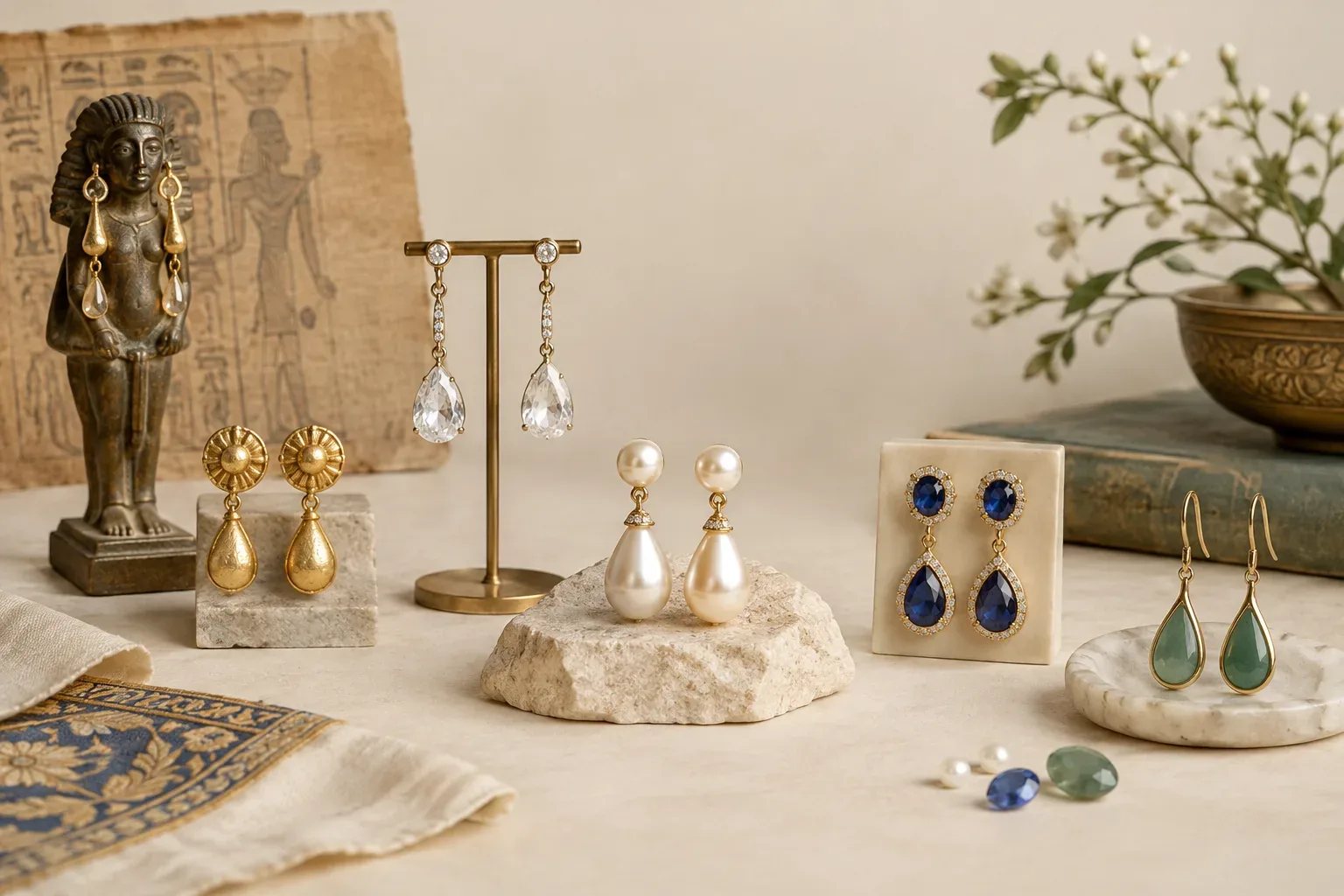
Meaning at a glance
Choose drop earrings by separating documented historical contexts from modern interpretation, check material and gemstone treatments, prioritize fit and repairability, and ask sellers for clear disclosure—this guide explains the recorded history, how motifs and stones appear in drop earrings, and practical buying questions.
Quick answer
Drop earrings buying guide: prioritize material disclosure, visible craftsmanship, and comfortable scale, and verify gemstone treatments and metal purity with the seller. Historically, drop styles have shifted in meaning and function across cultures; this guide distinguishes documented historical evidence from later popular interpretations and gives specific, practical advice for selecting and gifting drop earrings today.
What the historical record shows (and where it comes from)
Museum scholarship summarises that earrings—already widespread in many societies—have changed in form, status signalling, and use over centuries. The Victoria and Albert Museum documents these changing social contexts and fashions in jewellery rather than attributing a single meaning to a single style. Evidence from collections and exhibition interpretation shows that styles now called "drop" have appeared in many different periods and places as a variation on pierced or suspended ornament.
Across the long sweep of jewellery history presented by the Victoria and Albert Museum, the form of a suspended or hanging element on the ear was adopted for aesthetic effect, technical possibilities, and social signalling. Because museums and catalogues track objects by provenance, materials, and recorded use, the safe historical claim is that drop shapes recur and acquire different functions and associations depending on the time, place, and wearer, rather than having one universal meaning.
Identifying cultures and periods precisely
When you read about historical earrings in museum records, look for the object's provenance and catalogue notes. The Victoria and Albert Museum presents items from many cultures and periods—ancient, medieval, early modern, and later—each with its own context. For example, a pair catalogued from a late-19th-century European collection will have different documented social uses than a pair acquired from an earlier archaeological context.
If a seller or label calls a pair "Victorian-style" or "inspired by an ancient motif," treat that as a style reference unless the seller supplies provenance or credible documentation. Museum documentation is explicit about provenance and context; private sellers often are not.
Documented historical meanings versus modern personal interpretations
Documented historical meanings are those recorded in provenance, catalogue entries, or contemporaneous texts and are typically cited in museum descriptions. The Victoria and Albert Museum's material on jewellery emphasises social context—who wore an object, where, and for what purpose—so documented meanings are tied to context rather than to a single symbol.
Modern personal interpretations—such as reading a teardrop pendant as grief, a coin drop as luck, or a particular stone as carrying a fixed spiritual property—are valid personal or cultural expressions but are not the same as documented historical usage. A contemporary wearer or designer can assign new meaning to a drop earring motif; when discussing historical claims, keep the two categories distinct.
How motifs, gemstones, and traditions appear in drop earrings
The drop earring is a structural form: a pendant or ornament hangs below the ear lobe on a wire, hook, post, or hinge. Motifs—such as teardrops, coins, floral elements, religious symbols, or geometric shapes—are incorporated as the hanging element or as part of a multi-part construction. The motif’s visual language depends on design choices and cultural references rather than being intrinsic to the drop form itself.
Gemstones and natural materials appear in drop earrings as beads, cabochons, faceted stones, pearls, or carved elements. The Victoria and Albert Museum's A–Z of Gemstones explains how particular stones (pearls, emeralds, sapphires, etc.) have been used in jewellery across contexts and how the stone type affects both appearance and social valuation. In practice, pearls are common in classic drop styles because their shape suits a hanging form, while faceted stones or carved hardstones often form precise drops or settings.
Materials, treatments, and what to ask sellers
Metal choice affects durability, price, and the risk of irritation. Gold, silver, and platinum are common for quality pieces. The Federal Trade Commission advises buyers to ask about treatments, imitations, and any material disclosure required by law. Request clear answers about metal purity and look for hallmarks or written confirmation of karat or fineness.
For gemstones, ask whether stones are natural, treated, lab-created, or simulated. The Victoria and Albert Museum's guidance on gemstones highlights the long history of both natural and worked stones in jewellery; modern commerce adds treatments and synthetics. The FTC recommends sellers disclose treatments and imitations, so a trustworthy seller will state whether a sapphire has been heat-treated, whether pearls are cultured, or whether a stone is a synthetic substitute.
Quality markers and price drivers for drop earrings
Price depends on materials, workmanship, weight, and brand or provenance. Metal content and gemstone carat or quality are direct factors. Craftsmanship—secure settings, smooth joins, even finish, and neat soldering—affects both durability and perceived value. Movement and balance matter for drop earrings because a heavy or poorly balanced drop will pull or tilt uncomfortably.
Design features that raise cost include articulated joints, multiple stone settings, hand engraving, or complex metalwork. Provenance or historical interest also increases value; museum-quality or antique pairs documented with provenance can sell at a premium. Expect modern trade to reflect these same drivers, but always verify material claims and inspect construction before purchase.
Fit, comfort, and practical selection advice
Measure scale against the wearer’s face, hair, and typical outfits. Long drops can be dramatic but catch on clothing; shorters drops are versatile for daily wear. Consider the ear post or hook: leverbacks and hinged hoops are more secure for heavier drops, while simple hooks and posts are common for lighter designs.
If the recipient has sensitive skin, prioritize high-purity metals (for example, 14k+ gold or sterling silver with known alloy content) and ask about nickel content. For pierced ears, check the post thickness and backing type. For unpierced wearers, consider clip-on or conversion options and verify that the clip mechanism is comfortable for extended wear.
Gifting with respect: cultural and personal considerations
When you gift jewellery with a motif tied to a particular culture or religion, learn whether that motif carries contemporary sacred or communal meaning. Museums such as the Victoria and Albert Museum show how motifs circulate, but context matters: a motif appropriate as decorative heritage in a museum display may be sensitive in living cultural contexts. If in doubt, ask respectfully or choose a neutral design.
For occasions, match the scale and formality: understated drop earrings suit everyday or workplace gifts, while larger, gem-set drops suit formal events. Consider asking for a gift receipt and knowing the recipient's preferences about metal and stone type so they can exchange or adjust the piece if needed.
Care, repairability, and long-term value
Choose settings and construction that allow repair. Simple bezel or prong settings are easier to maintain than glued stones. Inspect jump rings and joints that connect drops to posts; soldered fixings are more durable than open rings. Museums and conservators stress that materials age differently, so think about cleaning requirements for pearls and porous stones versus hardstones and diamonds.
Keep documentation from the seller: receipts, material statements, and any treatment disclosure. This paperwork helps with future resale, insurance, or conservation, and aligns with FTC guidance on transparent disclosure of treatments and imitations.
Summary: practical steps when buying
Before you buy, verify metal purity and any hallmarks, ask about gemstone origin and treatments, confirm construction details that affect comfort, and consider the cultural context of any motif. Use reputable sellers who provide clear written information and offer returns or repair options. Treat museum-cited historical styles as context and not as fixed meanings.
Frequently asked questions
How much should I expect to pay for quality drop earrings?
Price depends on metal purity, gemstone type and quality, and workmanship. Basic sterling silver drops with small semi-precious stones can be modestly priced, while solid gold or platinum pieces with high-quality gemstones or complex handwork carry a higher price. Always confirm metal karat or fineness and gemstone details with the seller.
What questions should I ask about gemstones in drop earrings?
Ask whether stones are natural, treated, lab-created, or simulated; whether any treatments (such as heating) were applied; and whether the seller provides documentation. The Federal Trade Commission recommends that sellers disclose treatments and imitations, so request written confirmation if it is not offered.
Are longer drop earrings always less comfortable?
Longer drops can be heavier and catch on clothing or hair, which can reduce comfort. Comfort also depends on balance, the support of the backing or closure, and the wearer’s tolerance. If comfort is a priority, choose lighter materials, articulated designs that move freely, and secure closures such as leverbacks or hinged hoops.
Can I assume a decorative motif has a specific cultural meaning?
No. A motif’s meaning depends on documented context. Museums such as the Victoria and Albert Museum emphasise that motifs acquire different meanings in different times and places. If a motif is associated with a living culture or religion, research or ask about contemporary significance before gifting or wearing it.
How can I tell if an earring’s metal is hypoallergenic?
Look for higher-purity metals and ask about alloys. For example, 14k+ gold or sterling silver with known alloy composition can reduce reactions for many people, but some alloys may contain nickel. Ask the seller about nickel content and consider tested hypoallergenic options such as implant-grade titanium or surgical steel if sensitivity is a concern.
Should I expect antique or vintage drop earrings to be easier to resell?
Antique pieces with clear provenance, good condition, and documented materials can command higher value, but resale depends on trends and market demand. Maintain any documentation, and have valuable items appraised or conserved rather than hastily modifying them.
Sources and further reading
- Bedazzled: A History of Jewellery — Victoria and Albert Museum
- An A-Z of Gemstones — Victoria and Albert Museum
- Buying Gemstones, Diamonds, and Pearls — Federal Trade Commission