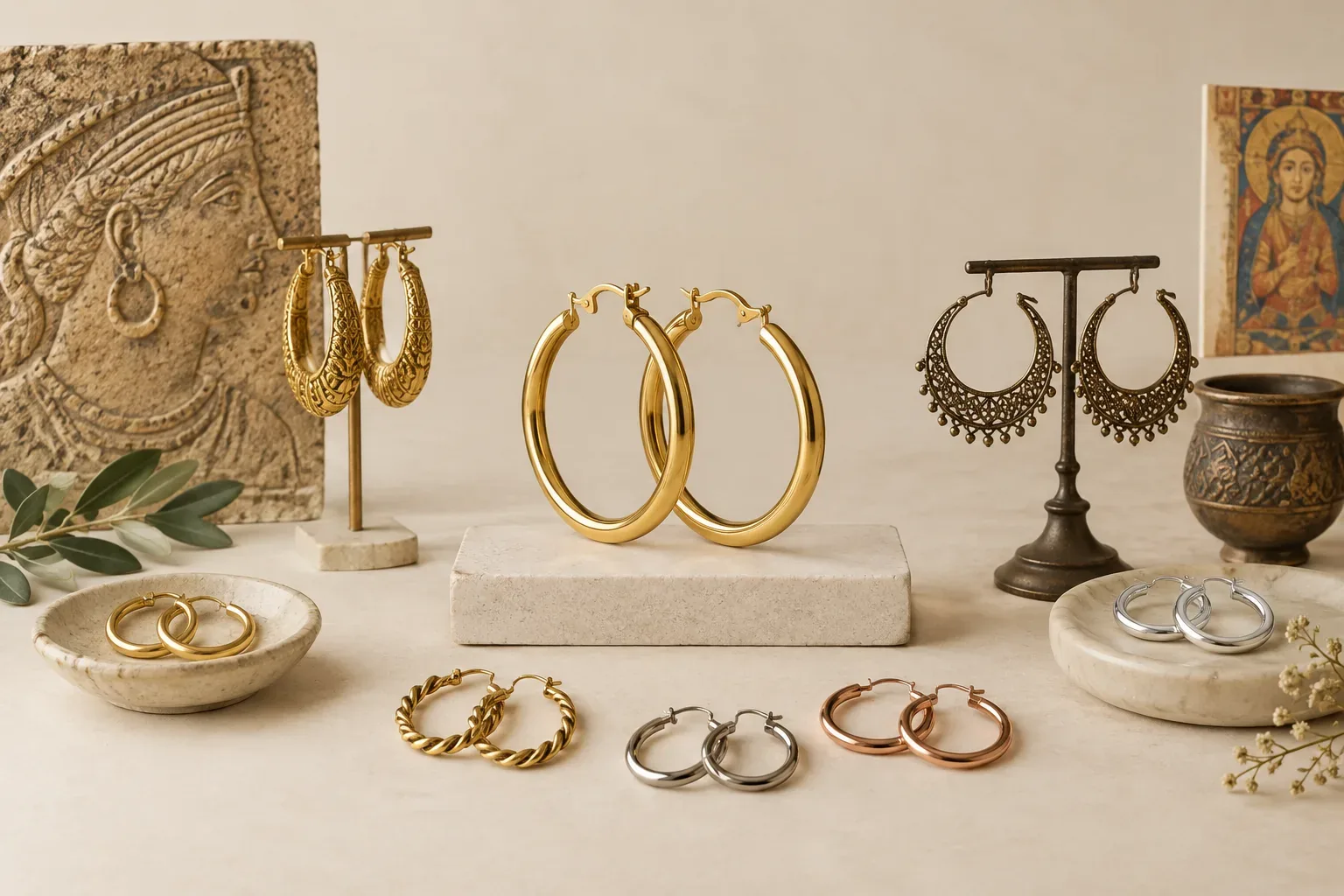
Meaning at a glance
Use a focused checklist that inspects materials and hallmarks, join and closure construction, gauge and weight, surface finish and plating, gemstone setting and disclosure, and repairability; understand that hoop forms appear across many cultures historically (as documented by the Victoria and Albert Museum) while modern meanings are often personal, and follow FTC guidance on disclosure for treated or imitation stones when assessing authenticity.
Historical evidence and precise cultural contexts
Museum scholarship shows hoop-shaped earrings are not a single-culture invention but a recurring form across many regions and periods. The Victoria and Albert Museum has curated and written about jewelry forms spanning ancient, medieval, and modern contexts, showing how circular and hoop forms appear in collections from a variety of cultures and eras and how meanings change with social role and fashion.
Specifically, the V&A’s historical work traces jewelry objects and their changing social contexts from ancient object types through later European and global fashions; the museum attributes different uses and meanings to similar forms depending on time and place. Treat references to any culture’s uses of hoop forms as context-specific: the presence of a hoop earring in a museum collection documents its historic use in that society or period rather than proving a single, universal symbolic meaning.
Documented meanings versus modern interpretations
Documented meanings in museum records generally link jewelry to social roles such as status display, identity marking, trade, or dress codes. The V&A’s materials and exhibition commentary make clear that jewelry—including hoop shapes—has served economic, social, and aesthetic functions, and that these functions change over time and across communities.
Modern personal or popular interpretations—such as claiming that hoops always mean strength, rebellion, or cultural solidarity—are contemporary readings that can be meaningful to wearers today but are not universal historical facts. Separate historical documentation (what a hoop was used for or how it functioned in a particular society) from modern symbolic uses, which are often individual, community-specific, or driven by fashion cycles.
How the hoop motif, gemstones, and traditions appear in jewelry
The hoop is an enduring motif because of its simple geometry, ease of manufacture in metal, and adaptability to different sizes, closures, and decorative techniques. Hoops appear as plain metal rings, as wire-formed cylinders, as hollow tubes, or as settings for beads and gemstones. Museum collections show these technical variations alongside stylistic details that reflect the maker’s techniques and the patron’s social context, as described by the Victoria and Albert Museum.
When gemstones appear in hoop earrings they may be set in the hoop itself, strung as drops, or used as accent stones where settings must be secure and accessible for inspection. For historical and identification context about gemstones and their traditional uses, the V&A’s A–Z of Gemstones is a useful reference that explains how different stones were chosen and worked. For modern purchases, remember the Federal Trade Commission’s guidance that sellers should disclose treatments, synthetics, and imitations; lack of disclosure should be treated as a red flag when assessing gemstone claims.
Quality checklist: construction details to inspect
Materials and hallmarks. Confirm the listed metal (for example, gold, silver, platinum, or base metal) and look for reliable hallmarks or maker’s stamps. Solid precious metals will usually carry a recognized mark indicating purity or a country-specific hallmark. If a piece is described as vermeil or plated, check thickness and base-metal disclosure. The FTC requires sellers to be clear about treatments and imitations, so an absence of clear marking or documentation is a point to question.
Quality checklist: join, closure, and soldering
Closures and joins determine long-term reliability. Inspect whether the hoop is continuous and welded, a hinged style, a click-top, a latch-back, or a wire that threads through and tucks into a notch. A well-made continuous or soldered join will look clean, with no visible gaps or weak solder lines, while hinged and latch mechanisms should close securely without excessive play. Poorly finished seams or loose closures are the most common failure points in everyday wear.
Quality checklist: gauge, diameter, and weight for comfort
Gauge and diameter matter for both fit and comfort. Thicker-gauge hoops resist bending and tend to feel sturdier, while thin wires can be elegant but more prone to deformation. Larger-diameter hoops catch on clothing more easily; smaller hoops are generally less likely to cause snagging. Feel the weight at the ear: a hoop that pulls noticeably will be uncomfortable for long wear, and the lack of balance between thickness and diameter often predicts strain on the ear lobe over time.
Quality checklist: surface finish, plating, and wear
Examine surface finish for evenness, polish, and signs of flaking if plated. Gold plating thickness and method affect how long a finish lasts; vermeil and heavy gold plating will endure far longer than thin flash plating. Look for even color across join areas and near the closure, since these are common wear points. If the listing or seller mentions rhodium or other plating, ask about its thickness and the base metal beneath it.
Quality checklist: gemstones and setting security
When gemstones are integrated into hoops, check that settings are tight, prongs are even, and stones sit flush without glue evidence. Ask whether stones are natural, treated, or synthetic and request any available certification; consult the V&A’s gemstones guidance for historic and material context, and follow FTC expectations that sellers disclose treatments and synthetic materials. Loose or glued-in stones, or settings that allow movement, are likely to fail with ordinary wear.
Quality checklist: allergy, metallurgy, and safety
Consider the metallurgy if the wearer has sensitive skin. Nickel and some base metals can cause reactions. Solid high-karat gold, platinum, and known nickel-free alloys are more reliable for sensitive ears. Always verify alloy content and ask the seller about nickel-free certification if allergies are a concern.
Quality checklist: repairability and long-term care
Assess the hoop’s repairability. Hollow tubes, very thin wires, and complicated inlaid settings can be harder to repair. Prefer constructions that a jeweler can easily resolder or rework. Ask about recommended cleaning methods and whether the finish tolerates ultrasonic cleaning or requires hand-soap and soft cloth care. Proper care prolongs plating and setting security and reduces the need for repairs.
Practical and respectful selection and gifting guidance
Choose with the wearer and context in mind. If the hoop form has a known cultural or religious association in the recipient’s community, learn about that meaning before gifting and respect the owner’s role in deciding whether to wear it. When uncertain, choose more neutral designs or discuss preferences openly rather than assuming symbolism.
For everyday wear, prioritize closures that lock securely and materials that suit a person’s lifestyle—lighter, low-profile hoops for active wear or thicker, solid-metal designs for durability. Include any paperwork, hallmarks, or provenance when gifting; a copy of cleaning and care instructions and an honest note about metal content or gemstone treatment makes a gift more respectful and useful.
If buying vintage or museum-inspired pieces, note the difference between historic provenance and modern reinterpretation. Museum documentation, such as the Victoria and Albert Museum’s cataloguing and exhibitions, can inform stylistic choices and help you describe the source of inspiration accurately when presenting a gift.
Conclusion
A dependable hoop earrings quality checklist focuses on materials and hallmarks, join and closure integrity, gauge and weight for comfort, surface and plating durability, gemstone setting and disclosure, allergy concerns, and repairability. Use museum sources like the Victoria and Albert Museum for historical context and the Federal Trade Commission’s consumer guidance for questions about gemstone treatments and seller disclosure, then apply the checklist practically and respectfully when choosing or gifting hoops.
Frequently asked questions
How can I tell if a hoop earring is solid gold or gold-plated?
Look for hallmarks and maker’s marks indicating karat purity; solid gold items commonly bear recognized stamps. If a seller claims vermeil or plated finish, ask for plating thickness and base-metal disclosure. The FTC expects clear disclosure of plating and treatments, so missing or vague information is a reason to ask for further verification or a return policy.
Which closure type is best for everyday hoop wear?
Closures that lock securely like hinged click-tops or sturdy latch-backs tend to be best for regular wear. Continuous welded hoops are very reliable but can be harder to remove without a proper seam. Inspect the mechanism for play and make sure it closes solidly without gaps.
How do I choose the right hoop size for comfort?
Consider both diameter and gauge: smaller diameters and moderate gauge reduce snagging and pulling, while larger diameters can be heavier and more likely to catch on clothing. Try hoops on for balance and check whether they pull at the lobe; a hoop that pulls is likely to be uncomfortable over long periods.
Are gemstones in hoop earrings often treated or synthetic?
Yes. Gemstones may be heat-treated, fracture-filled, dyed, or synthetic. The Victoria and Albert Museum’s gemstones guidance explains historical preferences, and the Federal Trade Commission requires sellers to disclose treatments and synthetics. Always ask the seller for disclosure or certification if authenticity is important.
What should I check if I have metal allergies?
Verify metal content and ask whether the piece is nickel-free or made of high-karat gold, platinum, or known hypoallergenic alloys. If the seller cannot confirm metal content, choose verified hypoallergenic options to reduce the risk of reaction.
How do I care for plated versus solid-metal hoops?
Plated items should be kept away from perfumes, lotions, and abrasive cleaning to extend the finish. Solid metals generally tolerate more robust cleaning. Ask the seller about recommended cleaning methods and follow any supplied care instructions to preserve finish and settings.
Sources and further reading
- Bedazzled: A History of Jewellery — Victoria and Albert Museum
- An A-Z of Gemstones — Victoria and Albert Museum
- Buying Gemstones, Diamonds, and Pearls — Federal Trade Commission