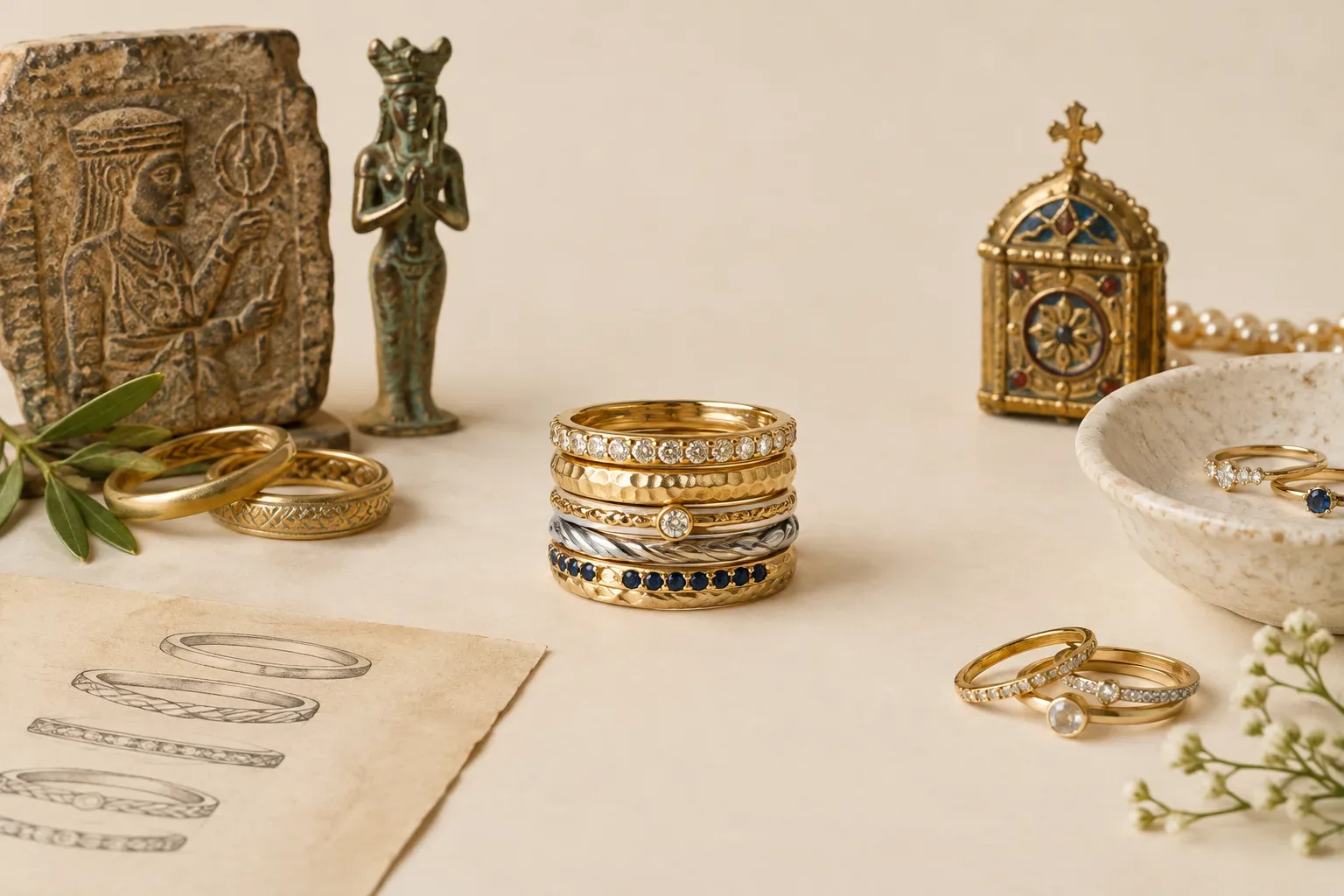
Meaning at a glance
Explain the documented history and changing contexts of the stacking ring online shopping guide motif, separate cultural or religious evidence from later popular interpretations, and give practical guidance for choosing and wearing the motif in modern jewelry.
What the historical record actually shows
The practice of wearing multiple rings together or wearing multiple slim bands on a single finger appears repeatedly in the long history of jewellery, but the reasons for doing so have changed over time. The Victoria and Albert Museum’s survey of jewellery history describes how rings have shifted in social meaning—from markers of status and office to tokens of love and personal expression—across different periods and tastes. That museum collection and its 'Bedazzled' framing are a good general source for how social context reshapes how people wear rings.
Because meanings shifted with culture and period, it is important to cite specific contexts rather than assume a single, continuous symbolism. For example, in some European nineteenth-century contexts documented by museum collections, rings functioned strongly as sentimental tokens tied to mourning, betrothal, or social rank, whereas twentieth- and twenty-first-century uses increasingly emphasize personal choice and fashion layering. The V&A frames these changes as part of broader social shifts in how jewelry was made and used.
Documented historical meanings versus modern interpretation
Documented historical meanings are the functions and uses that contemporary records and collections attribute to rings in a particular culture or period. Museum evidence supports claims about status, commemoration, and fashion in specific times and places, but it does not prove that a particular practice had the same meaning everywhere or for everyone.
Modern interpretations—such as reading a stack of slim rings as a single 'symbol' of contemporaneous identity, relationship status, or spirituality—are often personal or marketing-driven. Those contemporary meanings can be legitimate as personal expression, but they should be presented as modern or individual interpretations rather than universal historical facts.
How the stacking motif and gemstones appear in jewelry
In practical terms, stacking as a design approach favors narrow bands that layer comfortably together. Makers use a variety of motifs—plain bands, milgrain edges, textured or hammered finishes, small bezel or prong-set gems, and tiny signet or motif rings—so stacking functions as both a stylistic choice and a technical design problem. Museum collections and exhibitions show many historical approaches to narrow-band design where artisans deliberately created rings intended to be worn in multiples.
Gemstones commonly used in stacking rings include diamonds, sapphires, emeralds, rubies, and a broad array of semi-precious stones. The Victoria and Albert Museum’s A–Z of Gemstones is a reliable reference for how particular gems have been used and perceived historically and for practical information about durability, common treatments, and typical settings. Because stacking often mixes metals and stones, consider hardness and wearability: some gems and soft cuts can scratch or chip when in close contact with other rings.
How to evaluate listing photos before you buy
High-quality photos are the single most useful clue to an honest listing. Look for multiple views: an overall ring, close-ups of the shank and setting, clear shots of hallmarks or maker’s marks, and images that show scale such as the ring on a hand or with a ruler. Magnified detail photos should reveal any surface wear, repairs, or visible inclusions in stones.
Be wary when a listing only shows stylized stock photos, one low-resolution image, or images that appear to be copied from other sellers. If you cannot see hallmarks or maker’s marks in the images, ask the seller for a clear, close photo of those marks before paying. Ask for images in natural light and request a video if the seller can provide one; movement can reveal loose settings or color shifts.
Policies to check on any stacking-ring purchase
Before you complete a purchase, read the seller’s return, resizing, and warranty policies. Confirm whether they accept returns and under what conditions, who pays return shipping, and how long you have to decide. For rings that may need resizing, ask if the seller offers resizing or if returns are accepted for size issues.
For gemstone and treatment information, consult the Federal Trade Commission guidance that requires disclosure of treatments, synthetics, and imitations for gemstones and diamonds. The FTC resource explains buyers’ rights and seller obligations around material-treatment and imitation disclosure. If a listing omits any statement about treatment or certification for high-value stones, request a written clarification or a lab report; lack of disclosure is a material omission and therefore a legitimate cause for caution.
Practical selection and gifting guidance
Decide first how the rings will be worn: will they be a single coordinated set meant to stay together, a starter stack to be added to over time, or a mixed stack combining family rings and fashion pieces? That intent guides metal choice, profile, and whether you should prioritize comfort-fit shanks, flush settings, or low-profile bezels for daily wear.
When gifting, be respectful of personal and cultural meanings. If a receiver may interpret a ring as an engagement or marital token in their community, use clear wording and, if possible, ask indirect questions about preferences and expectations. For mixed-metal stacks, choose complementary tones (for example, rose and yellow gold with warm stones) or deliberately contrast for a modern look. For heirloom stacking or combining antique rings, ask a jeweller about soldering and resizing risks.
Red flags that should make you pause
Unrealistic pricing on a listing that lacks clear provenance or hallmarks is a major red flag. If the price is far below comparable listings, ask why; silence or evasive answers are cause to step back. Listings that avoid answering basic questions about metal content, gemstone treatment, or certification should be treated with suspicion.
Other red flags include no returns on a first-time seller with poor reviews, stock photos only, missing contact information, absence of hallmarks in photos when the seller claims a particular metal, and refusals to provide further images of key details. Additionally, if a seller provides verbal assurances but refuses to put treatment or grading statements in writing, treat that as a serious warning sign.
A short checklist to use before you click Buy
Ask for or confirm high-resolution photos showing hallmarks and close details, confirm return and resizing policies in writing, and request written disclosure of any gem treatments or synthetics. For higher-value stones, ask for independent certification; for everyday fashion rings, verify metal content and finish. Keep a written record of communications and saved screenshots of the listing and the seller’s stated policies in case a dispute arises.
Final notes
Stacking rings are a flexible, personal form of adornment with deep historical roots and many modern meanings. Museums such as the Victoria and Albert Museum document how those meanings have shifted, and government guidance such as the Federal Trade Commission’s consumer pages explains buyer protections around gemstones and disclosures. Use photos and written policies as your primary tools for assessing authenticity and value, and treat contemporary symbolic meanings as personal or cultural interpretation rather than universal fact.
For more practical guides and context about choosing meaningful jewelry, see our Jewelry Guides category and related posts that help you research symbols and select gifts thoughtfully.
Frequently asked questions
How should stacking rings fit?
Stacking rings should fit comfortably without cutting into adjacent fingers when worn together. For a coordinated stack, consider matching shank profiles and ordering a single consistent size. If you plan to mix sizes or rings from different makers, allow for half-size adjustments and check resizing policies before buying.
Can stacking rings be resized after purchase?
Some stacking rings can be resized, but narrow bands, rings with continuous stones, or certain stamped finishes may be difficult or risky to alter. Ask the seller whether resizing is available, whether it affects warranties, and if a professional jeweller has resized similar pieces before.
What photos should I require from a seller?
Request multiple high-resolution photos showing the full ring, close-ups of the setting and shank, a clear image of any hallmarks or maker’s marks, and a scale shot such as the ring on a finger or beside a ruler. If any detail is unclear, ask for a short video showing the ring rotating in natural light.
How can I tell if a gemstone has been treated or is an imitation?
Sellers are required to disclose common treatments and whether a stone is synthetic or an imitation. For significant purchases, ask for a written statement about treatments or an independent lab report. If the seller refuses to disclose treatments or certification, treat that as a red flag. The Federal Trade Commission advises that treatment and synthetic disclosures are material facts for buyers.
What are the most important seller policies to check?
Confirm the return, refund, and resizing policies in writing, who pays return shipping, whether there is a warranty for manufacturing defects, and the timeframe for returns. Also verify the seller’s stated metal content and treatment disclosures for gemstones before completing a purchase.
Sources and further reading
- Bedazzled: A History of Jewellery — Victoria and Albert Museum
- An A-Z of Gemstones — Victoria and Albert Museum
- Buying Gemstones, Diamonds, and Pearls — Federal Trade Commission