Meaning at a glance
This article explains the documented history and changing contexts of stacking rings and related motifs, separates cultural and religious evidence from modern personal interpretation, and gives practical guidance for choosing and wearing stacking rings today.
Short answer
A robust stacking ring quality checklist evaluates three things: sound construction (secure joins and settings, consistent profile, and good finishing), comfort for repeated wear (correct sizing, smooth interior, and thoughtful profile for stacking), and durability for everyday life (appropriate mounting for stones, properly soldered links, and honest disclosure of treatments). The checklist should be applied with an awareness of the ring’s cultural history as documented by museum scholarship and with respect for modern personal meanings and gifting contexts.
Why history matters for a quality checklist
Understanding how rings have been made and used over time helps you ask the right questions about any contemporary piece. The Victoria and Albert Museum’s survey of jewellery history explains that design, materials, and manufacturing methods have changed in response to technological advances and shifting social meanings, so a single checklist that ignores context will miss important quality signals. For example, an antique thin band may be historically appropriate but fragile for daily stacking; conversely, modern production methods often allow stronger joins and more consistent finishes.
Documented historical uses and the cultures they appear in
Museum scholarship collects evidence across named cultures and periods. The Victoria and Albert Museum’s historical overview and exhibitions trace jewellery practices from ancient civilizations through classical antiquity, medieval Europe, the early modern period and into the 19th- and 20th-century industrial eras, including the Victorian period in Britain where sentimental and mourning rings were especially important. These documented occurrences identify how different societies used rings as markers of status, identity, memory, and fashion rather than establishing a single, universal meaning.
Separating documented meanings from modern personal interpretations
When a museum records a ring’s historical role—for example, a finger ring used in a particular ritual or as mourning jewellery—those are documented meanings supported by material evidence and contemporaneous records. The Victoria and Albert Museum’s resources distinguish these historical contexts. Modern wearers and makers frequently repurpose motifs and forms, assigning personal narratives—such as marking birth order, milestones, or simply following current fashion trends—that are contemporary choices rather than continuations of a single historic meaning. Treat each as distinct: documented cultural practice versus individual or subcultural interpretation.
How motifs, gemstones, and traditions appear in stacking rings
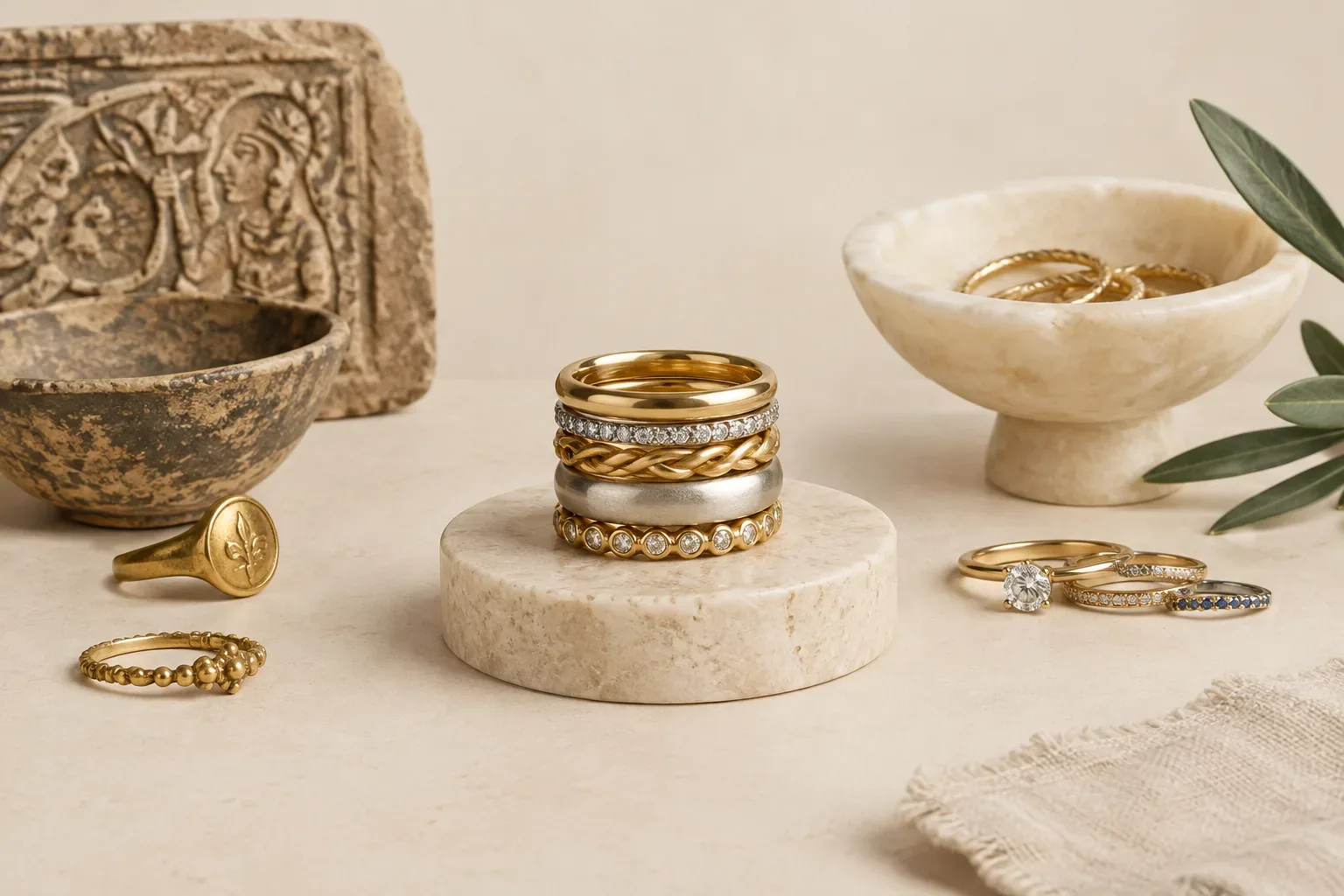
Stacking rings are a modern arrangement—multiple slender bands worn together—but they can carry motifs that have older origins. Historical motifs such as engraved bands, signet-style devices, or simple gem-set accents reappear in contemporary stacks. The Victoria and Albert Museum’s A–Z of gemstones describes how specific stones have been used over time, which helps explain why certain colors or gem choices recur. Today, motifs appear as plain polished bands, set stones (bezel or flush for low profile), engraved textures, and mixed-metal contrasts. The motif’s historical provenance does not force a single interpretation: a Victorian-style engraved band in a modern stack can be a stylistic nod rather than a literal continuation of its original meaning.
A practical stacking ring quality checklist — construction
Inspect joins and soldered seams for neatness and continuity; a visible or rough join can snag and is often an indicator of weaker assembly. Check settings: stones should sit secure with consistent prong heads or well-finished bezels and without visible gaps between the setting and the stone. Examine ring profiles for consistency; if rings are intended to sit flush together, the profiles should complement not conflict. Look at finishing details: edges and seats must be smoothed and polished to prevent discomfort and wear to adjacent rings. If the piece is described as handmade, ask how the maker finishes joins and secures small stones.
A practical checklist — comfort
Confirm accurate sizing for the finger and for stacking: a ring that fits perfectly alone may shift when paired with others. Consider interior finish: comfort-fit bands with a rounded inner surface are often easier to wear for long periods. Check for low-profile settings for rings you plan to stack daily; raised settings and high prongs will catch on fabrics and adjacent bands. Consider weight and width: multiple heavy or wide bands will fatigue a finger over hours of wear. If possible, try the intended stack in the store to assess how the rings move together and whether they press into each other.
A practical checklist — durability and materials
Ask about metal type and whether the piece is hallmarked or stamped; reputable makers disclose metal content and finishing. For stones, request disclosure of treatments and imitations; the Federal Trade Commission requires that sellers disclose treatments and enhancements for gemstones, diamonds, and pearls, and you should expect clear information about whether a stone has been dyed, heated, filled, irradiated, or is a simulant. Check the setting style for resilience: bezels and flush settings typically protect small stones better in stacked configurations, while high-prong settings may be vulnerable. For plated finishes, expect that the plating will wear with frequent contact; inquire about the base metal and the expected longevity of the plating.
Practical testing and questions to ask sellers or makers
When evaluating a ring or a stack, gently wiggle the stone to test for movement, ask to see close photographs of joins and settings, and request the maker’s or retailer’s policy on resizing, repairs, and warranty. Ask whether settings are soldered closed or cast as a single piece, and whether any finish is protective (for example, lacquer over mixed metals). For antique or vintage bands, ask about provenance and prior repairs that may affect structural integrity. If the seller makes health or religious claims about motifs, ask what evidence supports them and whether the item is an original or a modern reproduction.
Selecting and gifting stacks respectfully
Choose with intention and etiquette in mind. If you choose a historically charged motif—such as a symbol with specific cultural use—research its documented context first and be transparent about your intent when gifting. When gifting to someone from a tradition different than your own, avoid assuming meanings or appropriating religious or cultural symbols without understanding what they signify; consult reputable historical sources and, when appropriate, community members. Offer practical options such as a receipt and an exchange policy, and consider giving a single foundational band as a starter that the recipient can expand with their own choices. If you are gifting a set that includes birthstones or personal symbols, ensure you have correct information and disclose any treatments or simulated stones as required by consumer-protection guidance.
Care, repair, and planning for longevity
Plan for maintenance: stacked rings worn daily may require more frequent inspections of settings and joins. Ask the maker about recommended cleaning and whether they provide resizing or repair services. For plated items, discuss re-plating options and expected timelines. Keep documentation: receipts, descriptions of treatments, and maker notes help future repairs and retain value. Finally, if you value a particular historical character—antique patina, for example—document those preferences so repairs respect the piece’s aesthetic history rather than erasing it.
Summary: applying the checklist with context
A good stacking ring quality checklist combines objective inspection of construction, comfort, and durability with awareness of history and contemporary use. Use museum scholarship—such as resources from the Victoria and Albert Museum—to separate documented historical roles from later interpretations, and rely on consumer-protection guidance—such as the Federal Trade Commission’s rules on disclosure—for honest information about treatments. Ask makers and sellers practical questions about joins, settings, interior finish, and disclosure. Finally, choose and gift with respect for cultural meanings and the recipient’s preferences so the stack you build lasts both physically and meaningfully.
Frequently asked questions
What should I ask a seller about gemstone treatments?
Ask whether the gemstone has been treated or enhanced in any way and request a written description. The Federal Trade Commission requires disclosure of treatments and imitations for gemstones, diamonds, and pearls, so a transparent seller should provide this information and explain how any treatment affects appearance and care.
How do I size rings intended for stacking?
Sizing for a stack may differ from sizing for a single ring because multiple bands affect how a stack sits and moves. If possible, try the exact stack or try two rings together when sizing. If buying separately, consult the maker about expected fit when stacked and whether the rings are comfort-fit or standard fit.
Are bezel or prong settings better for stacked rings?
Bezel and flush settings generally offer a lower profile and more protection for stones when compared with tall prong settings, which can catch on fabric or on adjacent bands. Choose a setting style that suits the wear pattern you expect—daily wear typically benefits from lower, more protective settings.
What signals indicate poor construction?
Visible rough solder joins, loose stones, inconsistent band profiles, sharp interior edges, and flaky plating are practical signs of weaker construction. Ask the maker for close-up photos or an in-person inspection to verify finishes and joins before purchase.
How should I gift a culturally meaningful motif respectfully?
Research the motif’s documented cultural context using reputable sources before gifting, be transparent about whether the piece is a reproduction or a contemporary design, and avoid assigning meanings to symbols without confirming their significance. When in doubt, choose neutral designs or ask the recipient about their preferences.
Sources and further reading
- Bedazzled: A History of Jewellery — Victoria and Albert Museum
- An A-Z of Gemstones — Victoria and Albert Museum
- Buying Gemstones, Diamonds, and Pearls — Federal Trade Commission