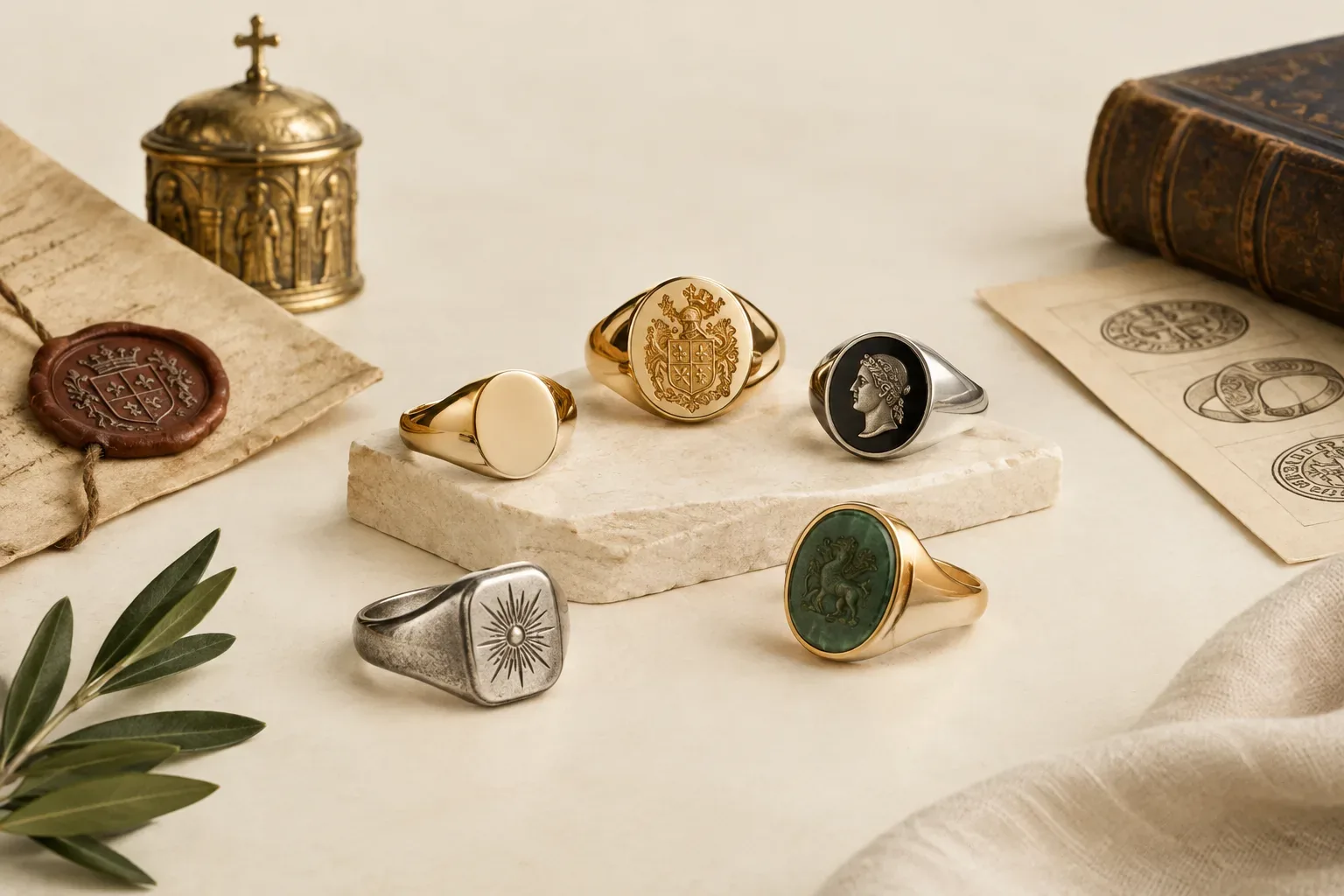
Meaning at a glance
Explain the documented history and changing contexts of the signet ring buying guide motif, separate cultural or religious evidence from later popular interpretations, and give practical guidance for choosing and wearing the motif in modern jewelry.
What the historical evidence shows (and where it comes from)
Museum collections and exhibition summaries provide the best-established evidence for early signet and seal rings. The Victoria and Albert Museum (V&A) presents examples and interpretive material showing that small engraved stones and metal rings with intaglio designs were used in ancient Egyptian and Near Eastern contexts as functional seals pressed into soft materials, and that similar technologies and forms appear in the classical world and later Europe. This is physical and art-historical evidence in museum collections rather than a single universal story.
In the classical Greco-Roman world, museum-identified rings and engraved gems indicate use for personal identification and property control; curators and catalogues at institutions such as the V&A link the object form to sealing and identification practices. Medieval and early modern European material in museum holdings shows continuity and change: signet rings were used by offices, households, and landed families to seal legal documents and mark ownership. The V&A also documents later revivals and reinterpretations, including nineteenth-century sentimental and heraldic uses that influenced how signets are viewed today.
Separating documented historical meanings from modern interpretation
Documented historical meanings derive from the object itself, its archaeological or archival context, and curator interpretation. For example, when a museum catalogue describes a carved carnelian ring found with administrative records, the reasonable historical inference is that the ring functioned as a practical seal or identifier. Museum records cited here come from the Victoria and Albert Museum’s historical surveys of jewellery and gem collections and should be read as evidence about function and social context rather than universal symbolism.
Modern personal or popular interpretations — such as viewing a signet as primarily a symbol of status, heritage, or personal identity — are legitimate but separate. Those contemporary meanings draw on historical forms but are shaped by recent fashion, family tradition, media, and individual intent. A modern wearer who chooses a signet for aesthetic or sentimental reasons is part of a continuing but different history from the ring’s original administrative or sealing function. A buying guide should therefore treat historical function and contemporary symbolism as complementary but distinct layers of meaning.
How motifs, gemstones, and traditions appear in signet jewelry
Motifs: Historically, signet faces often featured intaglio images carved into a hard stone and used to make an impression. In museum collections those motifs include animals, deities, monograms, and heraldic devices. In contemporary signet jewellery the most common motifs are family crests, initials or monograms, geometric patterns, and personalized symbols. The motif choice signals different intentions: a heraldic device often references ancestry or institution, a monogram prioritizes personal identity, and modern symbols can carry bespoke meanings chosen by the wearer.
Gemstones: The V&A’s reference materials on gemstones explain that certain stones have been preferred for intaglio and seal work because of their hardness and ability to take fine carving. Historically used stones include varieties of agate, carnelian, onyx, and other chalcedonies, alongside hard stones such as jasper. For modern signet rings, a wide range of materials are used: traditional carved gems, polished cabochons, engraved metal faces, and manufactured or lab-grown stones. The V&A’s guides and catalogues place gemstones in historical context but do not prescribe intrinsic symbolic meanings beyond their practical and decorative properties.
Tradition and wear: Museum displays and historical accounts show that signet rings have been worn differently across times and places. In some European contexts, signets were associated with particular hands or fingers and with social rank or office. Today, wearing a signet on the little finger remains a common Western style, but variations are frequent and culturally contingent. The important point for a buyer is that tradition can inform your choice but does not strictly determine how a ring should be worn now.
Assessing quality, materials, and price
Materials: Start by deciding whether you want a traditional carved gemstone, an engraved metal face, or a modern stone setting. Each choice affects price and durability. Hardstones used historically for intaglio (for example, agates and carnelian, as discussed in the V&A’s gemstone guides) are durable and carry a particular look. Precious metals such as gold and sterling silver remain common for signet bands, with heavier gold alloys adding weight and cost.
Workmanship: Examine the depth and clarity of engraving or carving, the precision of any hallmark, and the finish of the band. A well-executed intaglio or engraving will have crisp lines and consistent relief. If the ring is vintage or marketed as antique, ask about provenance and any restoration work. Museum-quality description practices reported by institutions like the V&A are useful benchmarks: provenance, material identification, and condition should be described clearly.
Gemstone treatment and disclosure: The U.S. Federal Trade Commission’s guidance on buying gemstones, diamonds, and pearls stresses the importance of seller disclosure for treatments, enhancements, and imitations. Always ask whether a stone has been heat-treated, dyed, filled, or otherwise altered, and request written disclosure. For high-value purchases, ask for lab reports or independent verification of natural vs. lab-grown stones.
Price drivers: Expect price variance based on metal purity and weight, gemstone type and quality, the complexity of carving or engraving, and whether the piece is antique, signed by a known maker, or bespoke. Handmade intaglio carving and custom heraldic engraving typically cost more than a mass-produced stamped design. Compare offers from several reputable sellers and factor in return policies and any certification.
Practical questions to ask before you buy
Ask for a clear description of materials, metal hallmarks, and any gemstone treatment. Request condition reports and provenance information for antique pieces. Confirm ring sizing options and resizing policies because signet rings — especially those with broad faces — can be more difficult to resize without altering proportions or design.
When buying a coat-of-arms or crest signet, be mindful that heraldry is regulated in some countries or communities and that the use of a particular crest may carry familial or legal meanings for some people. If the crest is important to your purchase, research its provenance and, if appropriate, consult family records or a heraldic authority. For personalized commissions, ask for a drawing of the proposed engraving and a clear timeline for completion.
Respectful selection and gifting guidance
Respect cultural context. A ring form that was once a functional seal in one culture may have ceremonial or familial weight in another. If you gift a signet with a cultural or religious motif, check with the recipient (or their family) about appropriateness before you proceed. A museum-led buying ethos is to treat objects and symbols with respect for their origins.
Match intent and inscription to the recipient. If the ring is a family heirloom or contains a personal crest, ensure accuracy in engraving and adequate documentation of family attribution. If gifting to mark a life event, choose a motif, metal, and gemstone that suit the recipient’s everyday wear habits and style: heavier, thicker rings suit people used to substantial jewellery; lighter, low-profile styles may be better for someone who works with their hands.
Present information. When you gift a signet, include any available provenance, metal and gemstone disclosure, and care instructions. This transparency mirrors museum practice in documenting objects and helps the recipient care for and understand the piece.
Care, maintenance, and ethical considerations
Care: Solid-gold and silver bands require different cleaning and occasional polishing. Hardstone faces are durable but can chip if struck. For antique signets, consult a conservator or reputable jeweller before cleaning or having stones re-set.
Ethics and sourcing: Ask sellers about sourcing of gemstones and metals, and whether materials are recycled, responsibly mined, or lab-grown. For consumer protections and disclosure about treatments and imitations, refer to government guidance such as the U.S. Federal Trade Commission’s advice on buying gemstones, diamonds, and pearls.
Frequently asked questions
What is a signet ring used for historically?
Museum evidence cited by the Victoria and Albert Museum shows signet and seal rings were used in ancient and medieval contexts to stamp soft materials and to function as identifiers or administrative seals; these documented uses are based on object context and curator interpretation rather than universal symbolic claims.
Which gemstones were traditionally used for signet intaglio work?
Historically, hardstones such as varieties of agate, carnelian, onyx, and other chalcedonies were commonly used because they carve well and hold fine detail, a point discussed in the V&A’s gemstone guides.
Should I be concerned about gemstone treatments or imitations?
Yes. The Federal Trade Commission advises buyers to ask sellers for disclosure of treatments, enhancements, and imitations and to request written confirmation; for higher-value stones, get independent verification or lab reports.
How do I choose the right finger and size for a signet ring?
Traditions vary: some European contexts historically favored the little finger, but contemporary wearers choose comfort and style. Because signet rings often have wide faces, check resizing policies before buying as resizing can be more complex than for narrow bands.
Is it acceptable to wear someone else’s crest or heraldic device?
Heraldic devices can carry legal or familial significance in some traditions. If the crest is important to the purchase, research provenance and consider consulting family records or a heraldic authority before using or gifting it.
How do I evaluate workmanship and authenticity?
Look for crisp engraving or carving, clear hallmarks for metal purity, good stone setting, and transparent seller documentation. For antiques, ask about provenance and any restoration. Museum cataloguing practices, like those used by the V&A, provide a model for clear descriptions.
Can I commission a modern signet with a custom motif?
Yes. Many jewellers offer bespoke engraving or carving. Request a proof or drawing of the proposed design, a timeline, and clear terms on revisions, materials, and warranties before commissioning the work.
How should I care for a signet ring?
Care depends on materials: clean metals with appropriate polishes, avoid harsh chemicals on stones, and seek professional conservation advice for antique pieces. Hardstone faces are durable but can still chip on impact.
Sources and further reading
- Bedazzled: A History of Jewellery — Victoria and Albert Museum
- An A-Z of Gemstones — Victoria and Albert Museum
- Buying Gemstones, Diamonds, and Pearls — Federal Trade Commission