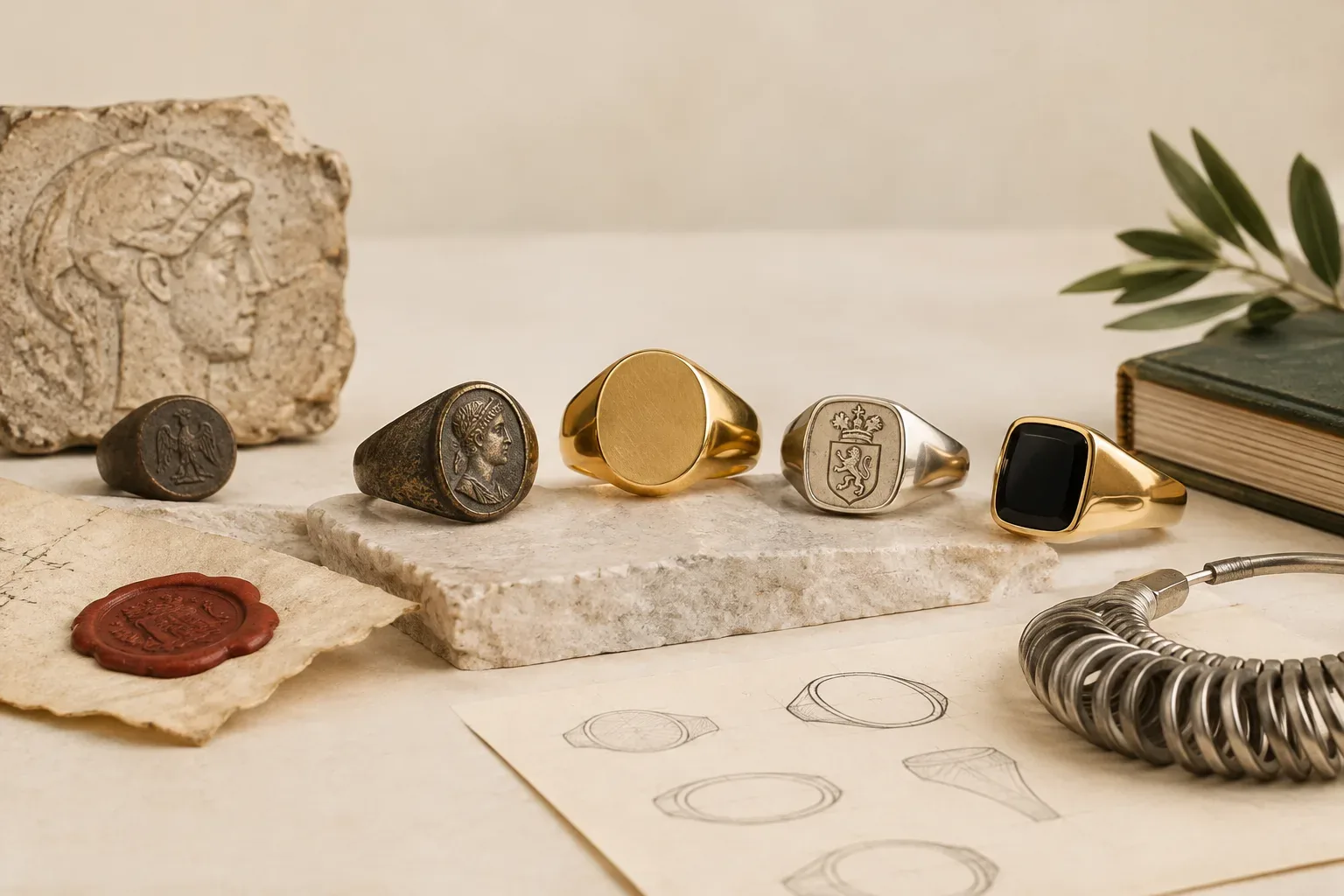
Meaning at a glance
This guide explains the documented history and changing contexts of signet rings as recorded by museum sources, distinguishes historical uses from modern personal interpretations, details how motifs and gemstones appear in signet jewelry, and gives practical advice on measurement, fit, resizing, and respectful gifting.
Quick answer
Signet ring size and fit should balance historical intent and modern comfort: historically signet rings functioned as seals and status markers, which influenced their shape and placement, and today the ring should be sized so the broad face sits comfortably without rotating while still passing over the knuckle. Use an accurate finger measurement, allow for the wider band and flat top common to signets, and consult a jeweler about gemstones, carved faces, or resizing to preserve any historic or decorative work.
What the historical record says (and what the record does not claim)
Museums and historical surveys document that rings have long served social and practical functions that changed over time. Institutions such as the Victoria and Albert Museum describe jewellery as an object whose meaning and uses shift with fashion, technology, and social context. Their public-facing histories emphasize that jewellery may indicate status, identity, or function within a particular culture or period, rather than carrying a single, unchanging meaning.
That documentation supports a careful reading of signet rings: historically many societies used rings with engraved or raised faces for sealing documents and indicating ownership or authority. Museum collections and exhibitions record such uses as part of broader jewellery histories, but these records concern objects and contexts, not universal symbolic prescriptions. Avoid treating one historical use as the only valid meaning for signet rings across cultures or centuries.
Separating documented historical meanings from modern interpretations
Documented historical meanings derive from surviving objects, inscriptions, and contemporary records. Museums like the Victoria and Albert Museum catalogue examples of rings used as seals, rings that signal rank or office, and decorative signets that reflect changing tastes. Those are empirical observations about how rings were used and valued in particular contexts.
Modern interpretations often layer personal, familial, or fashion meanings onto those historical types. Wearing a signet today might reference ancestry, a family emblem, or simply a personal aesthetic preference. These contemporary meanings are valid for the wearer but should be presented as personal or modern usages rather than direct continuations of a single historical practice. In short, distinguish museum-documented function and context from later or personal symbolism when describing why someone might choose a signet.
How motifs, gemstones, and traditions appear in signet jewelry
Signet faces carry motifs carved, engraved, or set into the metal. These motifs range from initials and crests to abstract patterns. Museum resources that survey gemstones and jewellery design note that the choice of stone, carving technique, and face design reflect available materials and the technical skills of a period as much as symbolic intent. The Victoria and Albert Museum’s resources on gemstones and jewellery history illustrate how particular gemstones and carving techniques appear across different kinds of rings and periods.
Gemstones are sometimes used as signet faces, either left as a polished stone, engraved (intaglio), or set beneath a protective layer. An intaglio carved into a gemstone produces a clear seal impression but requires careful handling and specialist work. Modern signets may use cabochons or flat stones for visual contrast. Whether a stone is used for display, carving, or durability depends on technical and stylistic choices rather than a single symbolic rule.
Measurements that matter: practical fit guidance
Accurate finger measurement is the first step. Measure the finger at the time of day you expect to wear the ring, because finger size varies with temperature and activity. Use a well-calibrated ring sizer or have a professional jeweler measure the finger to determine the ideal circumference and corresponding ring size.
Consider the signet’s face and band width. The broad, flat face of a signet and a wider shank change how a ring moves on the finger. Wider bands require a slightly larger internal circumference to sit with comparable comfort to a narrow band. As a rule of thumb, allow for the extra contact area: if you’re between sizes, many jewelers recommend moving up by a half-size for a band much wider than a standard narrow ring.
Balance snugness and mobility. A well-fitting signet should slide over the knuckle with a firm push and then rest without spinning on the finger. It should not feel so tight that it impedes circulation, nor so loose that it risks slipping off during normal use. If you will wear the signet for long periods, choose a fit that errs slightly toward comfort while ensuring the face remains oriented.
Account for knuckle shape and placement. If your knuckle is larger than the base of the finger, you may need a size that allows the ring to pass the knuckle but still fit the finger base snugly. Try the intended finger with the actual signet design when possible, because prototypes and flat templates do not always replicate weight and rotation.
Consider how often you will wear the ring and in what activities. If the signet will be worn daily, favor a durable fit and materials. If it’s for occasional or ceremonial use, you might prioritize traditional placement and design over continuous comfort, but still avoid a fit that risks loss or damage.
Gemstone and material considerations
If the signet incorporates a gemstone, consider hardness, setting style, and susceptibility to damage. The Victoria and Albert Museum’s overview of gemstones highlights how different stones were used historically for carving, ornament, or symbolic reasons and how technicians adjusted designs to suit each material’s properties.
Ask about treatments and disclosure. When buying a gemstone set into a signet, follow current buyer-protection expectations. The U.S. Federal Trade Commission provides guidance on the need for transparent disclosure of treatments, synthetics, and imitations for gemstones and diamonds. Request written information about any heating, stabilization, or filling treatments, and insist on clarity about lab-grown versus natural stones.
Resizing, repair, and conservation considerations
Resizing a signet is often possible, but the presence of an engraved, carved, or inset face can complicate work. Have a qualified jeweler examine the ring before resizing. Resizing may require cutting and soldering the band, and in some cases the face or stone may need removal to avoid damage. If the ring is a historic piece, consult a conservator or a jeweler experienced with antiques to preserve provenance and decorative elements.
If a signet bears historical engraving, enamel, or a carved intaglio, record any maker’s marks or inscriptions before work begins. Those markings can be important for provenance and should be preserved in any repair process.
Practical and respectful selection or gifting guidance
When selecting or gifting a signet, be mindful of cultural and familial contexts. A signet engraved with an emblem, crest, or monogram may carry family significance in some traditions and could be sensitive if used casually. Do some research into the motif’s cultural associations before commissioning a personalized face, and prefer neutral or clearly personal designs if you are uncertain.
If gifting a historic or heirloom signet, accompany it with provenance information and care instructions. Explain any historical uses known from museum or family records rather than asserting unverified claims. Treat the ring’s history as contextual information rather than a fixed meaning.
For commissioned contemporary signets, discuss size expectations with the recipient if possible. If that is impractical, select a jeweler who offers free or low-cost resizing, or provide a gift certificate that includes a fitting session. This approach respects both the personal nature of a signet and the practical reality that ring sizes vary.
Final thoughts
Signet rings carry layered meanings: documented historical functions and contexts recorded in museum collections, and the personal or cultural meanings people attach today. Use museum sources to ground statements about historical use and rely on clear measurement and material information when choosing a fit.
Choosing the right signet size and fit is a combination of accurate measurement, attention to the signet’s broader top and band width, and respect for any historical or familial significance. When in doubt, consult a professional jeweler for fitting and a conservator for historic pieces, and ask sellers for full disclosure on materials and treatments as recommended by consumer-protection guidance.
Frequently asked questions
How tight should a signet ring fit?
A signet should be snug enough to stay oriented and not rotate during normal wear, but loose enough to pass over the knuckle with moderate pressure. It should not restrict circulation or feel painful. If you are between sizes for a wider signet band, consider going up half a size and consulting a jeweler for a trial fit.
Does the wide face of a signet affect sizing?
Yes. The broad face and wider shank of many signets increase contact with the finger, so you may need a slightly larger size than for a narrow ring. Try the specific design when possible because weight and face shape influence how the ring sits.
Can signet rings be resized?
Many signet rings can be resized, but resizing may be complicated if the ring has an engraved face, inlaid stone, or enamel. Have a qualified jeweler inspect the ring and discuss options before any resizing work, and consult a conservator for historic or heirloom pieces.
Which finger should a signet ring be worn on?
Historically placement varied by culture and era. Today placement is personal: some prefer the pinky for tradition, others wear signets on the ring or index finger. Consider comfort, hand dominance, and whether the ring’s face should be easily visible or more private.
What should I ask about gemstones when buying a signet?
Ask about the gemstone’s origin, whether it is natural, lab-grown, or an imitation, and any treatments it has received. The Federal Trade Commission recommends that sellers clearly disclose treatments and imitations, so request written confirmation and documentation if available.
Is it appropriate to use family crests or cultural symbols without permission?
Use care. Family crests, clan emblems, or culturally specific motifs can carry meaning and authority for particular groups. Research the symbol’s associations and, when in doubt, choose a neutral or clearly personal design to avoid misappropriation or unintended offense.
Sources and further reading
- Bedazzled: A History of Jewellery — Victoria and Albert Museum
- An A-Z of Gemstones — Victoria and Albert Museum
- Buying Gemstones, Diamonds, and Pearls — Federal Trade Commission