Meaning at a glance
This guide explains the documented history and changing contexts of chokers, distinguishes historically documented meanings from modern personal interpretations, describes how motifs and gemstones are used in choker jewellery, and gives practical advice for choosing, gifting, and spotting red flags when buying chokers online.
Quick answer
This choker online shopping guide explains the documented history and changing contexts of the choker as a motif, separates cultural and historical evidence from later popular interpretations, and gives practical guidance for choosing, gifting, and evaluating photos, seller policies, and common red flags when buying chokers online.
Historical evidence and specific cultural or period contexts
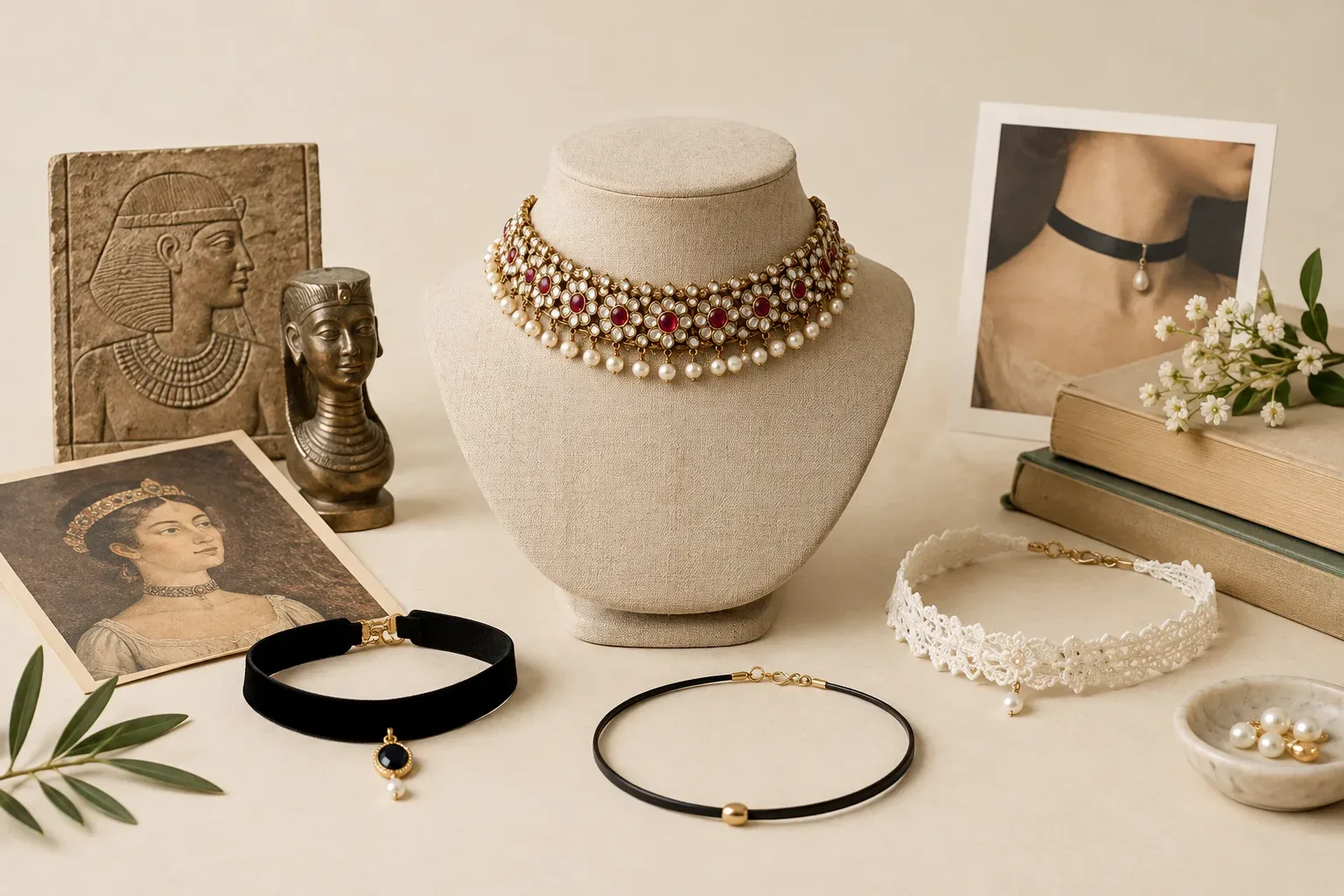
Objects that we now call chokers appear in a variety of times and places; museums and curators present them as part of a changing fashion vocabulary rather than a single universal symbol. The Victoria and Albert Museum notes that jewellery styles evolve with social conditions and tastes, and that close-fitting neck ornaments recur across many periods and regions in different materials and for different reasons.
The Victoria and Albert Museum's collections and interpretive material show examples of close neck adornment in antiquity, in European dress across the nineteenth century, and in multiple 20th- and 21st-century revivals. In each documented instance the form and function differ: some pieces are decorative status ornaments made from metals and gems; others are simple ribbons or bands worn with specific clothing; and some later forms are revivals that reference earlier styles.
Because museum documentation treats chokers as objects whose meaning depends on context, it is important to identify the specific culture or period when you encounter a choker. For example, an ancient near-eastern metal collar and a Victorian-era ribbon tie will have different material construction, social associations, and documented uses, even when both are described as chokers in exhibition labels or catalogues.
Documented historical meanings versus modern personal interpretations
Published museum interpretation tends to focus on how pieces were used and displayed in their original social context rather than on single symbolic readings. The documented roles of close neck ornaments in museum catalogues include fashion statements, status indicators, and components of ceremonial dress, depending on the object’s origin and date, as the Victoria and Albert Museum explains when it discusses jewellery history and changing social context.
Modern personal or popular interpretations — for example, that a choker universally signifies rebellion, sexuality, or allegiance to a subculture — are contemporary readings that can be meaningful to individuals but are not universal historical facts. Treat these modern meanings as valid personal or subcultural interpretations rather than as direct continuations of a single historical meaning.
When a choker design references a specific cultural or religious motif, treat any asserted traditional meaning with care. If a seller claims a choker design carries a particular ceremonial or sacred meaning tied to a living community, verify that claim with sources from that community or reputable scholarship rather than assuming it from a stylistic resemblance.
How motifs, gemstones, and traditions appear in choker jewellery
Chokers are a form factor rather than a single motif, and they carry motifs and materials in the same ways other jewellery types do. You will find chokers executed as plain ribbons, metal collars, gem-set bands, beaded strands, and pendants suspended from close-fitting chains. The design choices — chain or ribbon, metal type, gem setting, clasp — determine both appearance and care needs.
Gemstones appear in chokers from subtle seed-pearl trims to dramatic central gemstones set in metal plates. The Victoria and Albert Museum’s overview of gemstones highlights how different stones and settings have been used historically for decoration and for conveying value. When a gemstone is featured in a choker, its size, setting type, and mounting affect durability and how the piece sits when worn.
Traditions of making chokers reflect available technology and fashion. Metalwork techniques produce rigid collars and finely chased neck plates, while textile techniques produce velvet or ribbon chokers. Contemporary makers may combine materials and modern findings so that a choker resembles a historic form while incorporating modern clasps, adhesives, or treatments.
How to shop online: what photos and seller policies should show
High-quality photos are essential. A reliable listing includes clear, close-up images that show the full piece worn on a mannequin or model so you can judge scale, a straight-on view of the item lying flat with a stated length in centimetres or inches, and detail shots of the clasp, hallmarks, gem settings, and any areas where wear could occur.
Look for measurements and fit information. A responsible seller provides the choker’s length, the range if an extender is included, and the width of the band or chain. They may also list the model’s neck size or provide a size reference photograph, which helps you predict how the piece will sit on a real neck.
Seller policies should be transparent about materials and treatments. The U.S. Federal Trade Commission advises buyers that sellers should disclose material treatments, imitations, and significant repairs or restorations. Expect to see clear statements about metal purity, whether gemstones are natural, laboratory-grown, treated, or simulated, and whether a grading report or authenticity certificate is provided.
Return, repair, and shipping policies matter. The listing should state return windows, who pays return shipping, how fragile items are packed, and how the seller handles lost or damaged parcels. For higher-value pieces, look for insured shipping and explicit restoration or repair options.
Common red flags when buying a choker online
Vague or missing material descriptions are a major red flag. If a listing uses ambiguous terms like “looks like gold” or “real-looking pearls” without clarifying whether materials are plated, filled, imitation, or natural, proceed cautiously and ask the seller to clarify. The Federal Trade Commission’s guidance on buying gemstones and pearls emphasizes the importance of disclosure about treatments and imitations.
Inconsistent or obviously edited photos can signal quality or authenticity issues. If key areas like clasps or hallmarks are blurred, missing, or provided only as small thumbnails, request additional unedited pictures and a video of the clasp working. Stock images that do not match the photographed item are another concern; reputable sellers will label stock photos explicitly if they are used as examples.
Too-good-to-be-true pricing on high-value gemstone chokers is a warning. If a seller offers a necklace with a named gemstone at a fraction of typical market prices and cannot produce independent paperwork or provenance, get a second opinion before you pay.
No return policy, evasive shipping timelines, or a lack of contact information can make post-sale issues difficult to resolve. Prefer sellers with clear return instructions, physical addresses, and explicit customer service channels.
Practical and respectful selection and gifting guidance
Fit and comfort come first. Measure the recipient’s neck in centimetres or inches and compare to the choker’s stated length. Remember that chokers are meant to sit close to the neck, so allow for personal comfort preferences and for breathing room. If you cannot measure directly, choose a choker with an extender or a flexible fastening.
Consider materials and allergies. For people with sensitive skin, choose chokers with hypoallergenic metals (for example fully marked sterling silver or gold of known karat) or textile bands whose linings are labelled. Ask sellers about metal plating thickness and base metals, and favour pieces with clear metal marks.
Think about durability and daily wear. For everyday chokers choose secure clasps and settings with low-profile mounts to reduce snagging. For special-occasion pieces you can choose more delicate constructions, but be sure the recipient understands care needs.
Respect cultural meaning and avoid appropriation. If a choker explicitly reproduces a motif tied to a living culture or religious practice, research its significance and the contemporary community’s perspective. When in doubt, use internal resources such as 'How to Research the Meaning of a Jewelry Symbol' to check whether a design is appropriate as a gift.
Document provenance for higher-value or antique pieces. For antiques or gemstones of significant value, ask for receipts, condition reports, and any available provenance. These documents are useful both for insurance and for future resale.
Final practical checklist before you buy
Confirm dimensions and how the choker sits on a neck with photos or a model reference, ask about materials and treatments, and request clear close-ups of clasps and settings. Verify the seller’s return and shipping policies, request documentation for high-value gemstones, and be suspicious of vague descriptions or dramatically low prices. If a design references a specific culture, research and respect that cultural context before gifting.
Frequently asked questions
How should a choker fit?
A choker should sit close to the base of the neck without feeling constrictive; check the seller’s stated length and, if possible, compare with a photograph showing the piece on a model. If you are buying for someone else and cannot measure, choose a choker with an extender to allow for small adjustments.
What should I ask about gemstones in a choker?
Ask whether stones are natural, lab-grown, treated, or simulated and request documentation for significant gemstones. The Federal Trade Commission recommends that sellers disclose treatments and imitations; for costly pieces ask for grading reports or provenance.
What photo angles are essential in a choker listing?
Essential images include a worn view to show scale, a flat lay with measurements, close-ups of the clasp, hallmarks, and any gem settings, and at least one image showing the piece being handled to confirm detail and scale.
Are there safety concerns with chokers?
For children and people in certain professions, chokers can pose snagging or breathing risks. Choose safety clasps for active wear and avoid very tight fits. If gifting, consider the recipient’s lifestyle and comfort with close-fitting neckwear.
How can I spot a seller using misleading photos?
Look for image inconsistencies such as different lighting, backgrounds, or model features across photos; ask for unedited detail shots and a short video of the actual item. Reputable sellers will provide those on request.
Sources and further reading
- Bedazzled: A History of Jewellery — Victoria and Albert Museum
- An A-Z of Gemstones — Victoria and Albert Museum
- Buying Gemstones, Diamonds, and Pearls — Federal Trade Commission