Meaning at a glance
Enamel is a glass-like surface fused to metal that resists chemical tarnish but can chip, crack, or wear at edges; historical museums document its long use as decorative and status material, and modern care focuses on gentle cleaning, protective wear habits, clear disclosure from sellers, and professional repair when needed.
Documented history and cultural contexts
Enamelling as a technique and decorative choice appears repeatedly across many cultures and periods. The Victoria and Albert Museum describes jewellery history as a field shaped by changing social uses and technologies, with enamelling among the crafts that enabled colour and imagery on metalwork. Museum surveys treat enamelling as a long-standing technical practice rather than a single cultural symbol.
Different periods used enamel for different ends: to add colour, to depict imagery and heraldry, and to show technical skill, all of which are forms of adornment the V&A records when discussing jewellery and its social contexts. The V&A’s resources on gemstones and jewellery emphasize changing tastes and materials across eras rather than a single, universal meaning for any technique, including enamel.
Documented meanings versus later or private interpretations
Museum documentation tends to record how and why materials were used: for display, identification, commemoration, or to showcase wealth and craftsmanship. That factual record—what people made and how they wore it—is separate from later or individual interpretations. For example, historical pieces that incorporate enamel and particular motifs may be described in museum catalogues as funerary, commemorative, or fashionable without asserting a fixed symbolic meaning.
Modern wearers and designers often layer personal meaning onto historic motifs. Those contemporary interpretations are valid for the wearer but should not be taken as documentary fact about the past. When researching historical symbolism, rely on evidence recorded by museums and primary sources; when choosing a piece to wear or give, recognize that personal and cultural meanings may vary widely and evolve over time.
How enamel and related motifs appear in jewellery
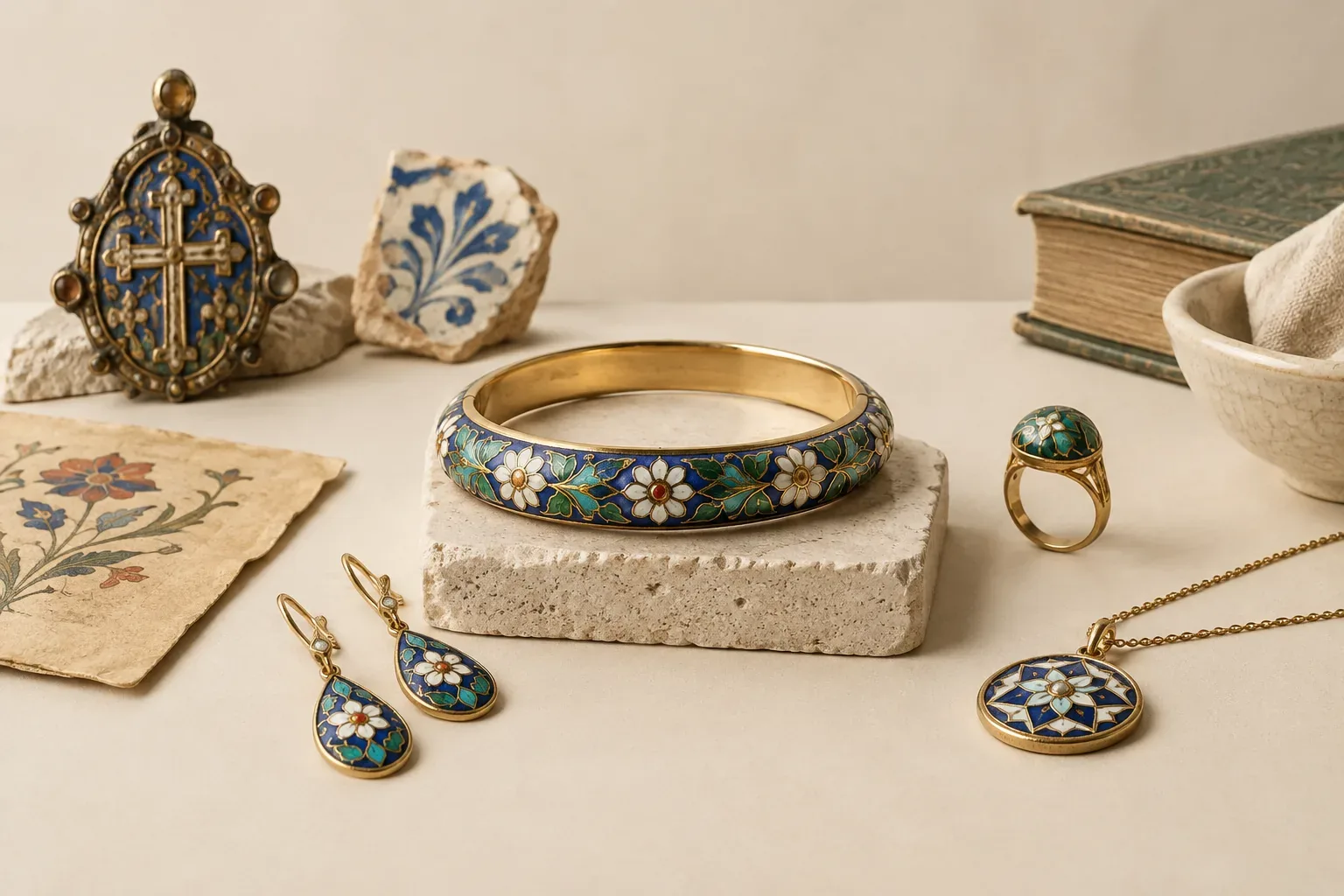
Enamel appears in jewellery as coloured surfaces, pictorial panels, or patterned inlays. Craftspeople use enamel to create colourful motifs—floral designs, geometric patterns, portraits, and ornamental borders—that are fused to a metal base. The technique allows bright, durable colour where gemstones are impractical or where pictorial detail is desired.
Enamel and gemstones often appear together. Enamel can frame stones, provide contrast, or carry imagery that complements a gem’s colour or symbolism. Museum discussions of gemstones note that gemstones and settings change in meaning and value over time; enamel works alongside these materials as part of a piece’s overall design rather than as a single universal symbol.
Durability: common modes of deterioration
Enamel does not tarnish in the same way that untreated silver or base metals do because its surface is a vitrified (glass-like) layer. However, because enamel is brittle relative to metal, it is vulnerable to mechanical damage: chips at edges or points of impact, hairline cracks from knocks or flexing, and loss of adhesion where the substrate has corroded or been damaged.
The underlying metal can still corrode or tarnish if exposed to moisture, acids, or chemicals, and that metal change can undermine the enamel’s adhesion. Wear often appears first where enamel meets exposed metal—thin edges, fastenings, clasps, and settings—so those junctions merit particular attention during inspection and care.
Cleaning, care, and routine maintenance
Treat enamel jewellery gently. For regular surface cleaning, use a soft, dry cloth to remove dust and skin oils. If dirt requires more, a damp cloth with plain water and gentle blotting is safer than vigorous scrubbing. Avoid household bleach, strong acids, ammonia, and abrasive cleaners that can scratch the glass surface or attack the metal underneath.
Store enamel pieces so they cannot knock against other jewellery: individual soft pouches or fabric-lined compartments reduce the risk of chipping. Remove enamel jewellery during activities with significant impact risk or exposure to chemicals—household cleaning, swimming in chlorinated pools, gardening, or heavy exercise. These precautions protect both the enamel and the metal substrate.
For routine inspections, look for hairline cracks, loss of gloss, exposed metal edges, or loose settings around stones and enamel panels. At the first sign of structural damage, stop wearing the item and consult a professional conservator or jeweller experienced with enamels; improper at-home repair attempts often worsen the damage.
Choosing and gifting enamel jewellery respectfully and practically
When selecting an enamel piece, examine both the enamel surface and the metal backing. Ask the seller about the metal substrate, the technique used, and any stabilizing treatments or repairs the piece has had. The U.S. Federal Trade Commission advises buyers to expect clear disclosure about material treatments and imitations; request written confirmation when a seller describes treatments or restorations.
Think about the recipient’s lifestyle and the piece’s intended use. If the wearer is active or prefers low-maintenance jewellery, choose designs with recessed enamel panels, robust settings, or smaller enamel areas that are less likely to chip. For heirloom or antique pieces, consider professional conservation and insurance rather than expecting daily wear.
Be culturally respectful with motifs that have specific meanings to living communities. Museums document historical contexts but do not assign contemporary ownership of symbols. If a motif originates in a clearly identifiable cultural or religious tradition, research its current significance and, when in doubt, ask knowledgeable community representatives or choose a neutral design to avoid unintended offense.
Repair, restoration, and professional services
Enamel repair and restoration are specialist crafts. Depending on the damage, a trained enameller can re-fuse or fill lost enamel, color-match retouching, and stabilise panels. For antiques, conservators balance aesthetic restoration with preserving original material; museums and reputable dealers can advise on acceptable approaches for valuable or museum-quality pieces.
Always seek a qualified jeweller or conservator for major repairs. Ask for references, examples of prior enamel work, and a written estimate that explains whether the repair will use original techniques or modern substitutes. For pieces with significant historic value, consult a professional conservator before any invasive treatment.
Frequently asked questions
Does enamel tarnish?
Enamel itself does not tarnish like silver; it is a glass-like surface. However, the metal underneath or at exposed edges can tarnish or corrode, which may affect the enamel’s adhesion and appearance.
How should I clean enamel jewellery?
Use a soft, dry cloth for routine cleaning. If needed, blot gently with a damp cloth and plain water. Avoid abrasive cleaners, strong chemicals, and harsh scrubbing. For significant grime or suspected damage, consult a professional jeweller.
Can enamel be repaired if it chips or cracks?
Yes, qualified enamellers and conservators can repair many chips and losses, though results depend on the damage, the original technique, and whether the piece is an antique. Seek a specialist and ask for examples of prior enamel repair work.
Is enamel suitable for everyday wear?
Enamel can be worn daily, but you should avoid high-impact activities and exposure to harsh chemicals. Consider the piece’s construction: recessed enamel panels and robust settings are better candidates for frequent wear.
What should I ask a seller before buying enamel jewellery?
Ask about the metal substrate, the enamelling technique, any past repairs or restorations, and whether any treatments apply. The Federal Trade Commission recommends clear disclosure about material treatments and imitations, so request written details if possible.
Are enamel motifs culturally sensitive?
Some motifs have cultural or religious significance. Museums document historical contexts but do not assign contemporary cultural ownership. If a motif is linked to a living culture, research its current meaning and consider asking community sources before gifting or wearing it in a way that could be disrespectful.
Sources and further reading
- Bedazzled: A History of Jewellery — Victoria and Albert Museum
- An A-Z of Gemstones — Victoria and Albert Museum
- Buying Gemstones, Diamonds, and Pearls — Federal Trade Commission