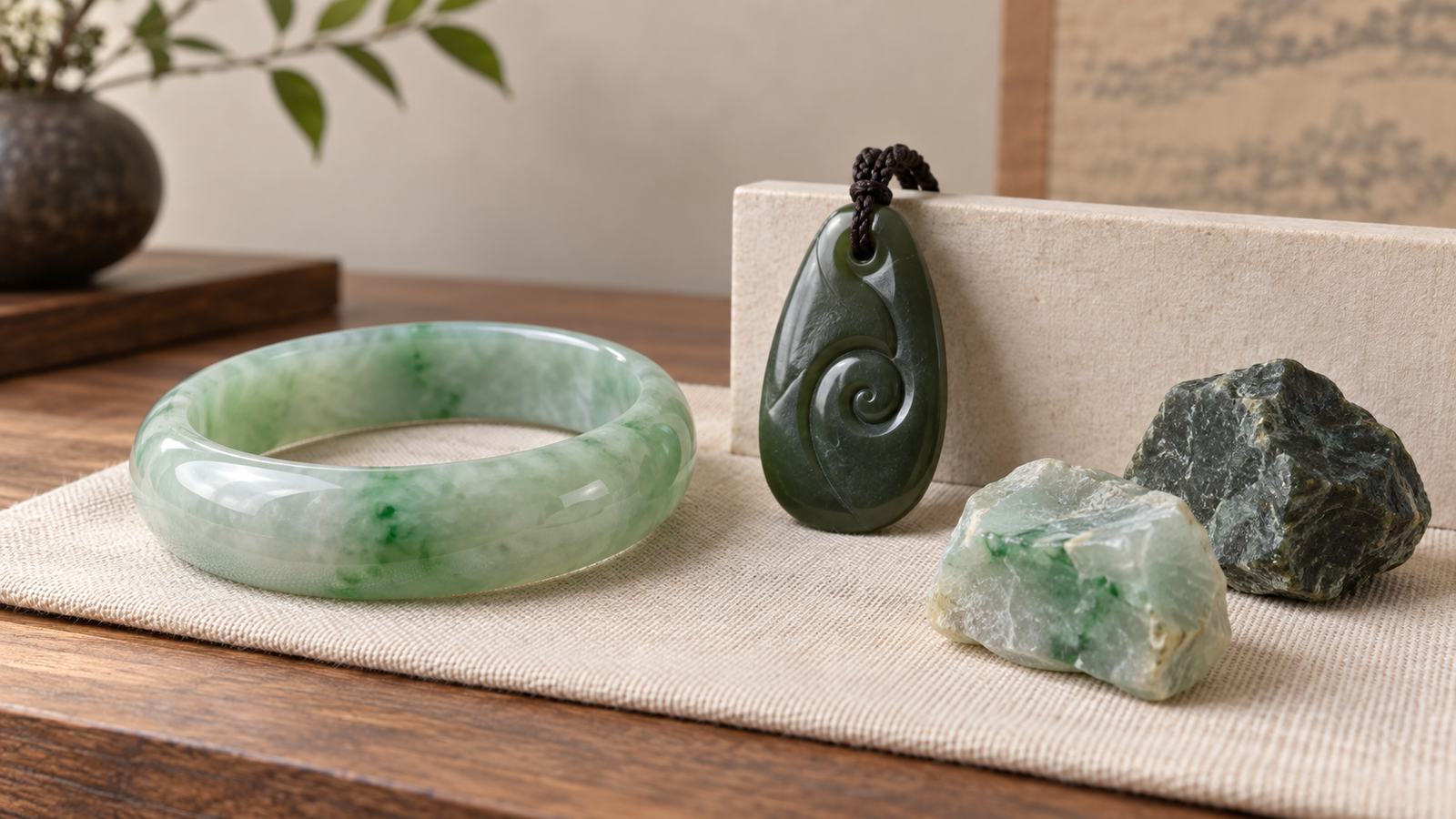
Meaning at a glance
Jade names two distinct materials, jadeite and nephrite, whose histories and meanings vary across cultures; responsible jewelry guidance begins with correct identification, treatment disclosure, provenance, and respectful cultural context.
What 'jade' is and why it matters
The Gemological Institute of America (GIA) defines jade as including two distinct mineral species: jadeite and nephrite. They differ in chemical composition, crystal structure, and typical appearance, and those differences affect durability, color range, and market value.
Because the minerals are different, lab identification matters for buying, selling, and insurance. A reputable gemological report will identify whether a piece is jadeite or nephrite and note any treatments or enhancements. When discussion or valuation treats all 'jade' interchangeably, important distinctions are being lost.
Historical evidence and cultures
Museum collections and scholarship trace long, separate histories for jade in different regions. The Smithsonian National Museum of Asian Art documents that much ancient Chinese jade was nephrite and that nephrite played a continuity of roles from the Neolithic into later historical periods. Those museum records show nephrite used for objects that were carved, worn, and buried, and they emphasize that meanings were tied to specific cultural contexts and uses rather than being uniform across time.
The Metropolitan Museum of Art also highlights why jade was prized: its toughness and capacity to be finely carved made it a durable medium for personal adornment and ritual objects. Both museum sources underline that jade’s value in many collections is as much about workmanship, form, and cultural function as it is about color.
The GIA describes the gemological differences and the practical consequences: toughness rather than hardness is a major reason jade has been favored for tools, ornaments, and high-status objects in several cultures. Together, these professional and museum sources support the core facts: 'jade' can mean two different minerals, ancient Chinese jades were predominantly nephrite, and jade’s durable physical properties contributed to its historical prestige.
Documented historical meanings versus modern personal interpretations
Historical meanings tied to jade are documented in museum collections and archaeological study, and those meanings vary by period, region, object type, and social role. For example, in Chinese contexts recorded by museum curators and scholars, nephrite objects served both ornamental and ritual functions; different shapes and contexts conveyed specific social or cosmological ideas. Such claims are conclusions based on artifact contexts, inscriptions, and comparative study rather than modern marketing narratives.
Modern personal meanings—what an individual wearer attributes to a piece today—are separate from those documented histories. Contemporary wearers might choose jade for its color, perceived luck, family tradition, or aesthetic match with other jewelry. Those personal interpretations are valid for the individual but should not be conflated with historical evidence. Treat museum documentation and community traditions as sources about past and communal meanings, and treat individual belief as a living, personal layer that sits beside rather than replaces historical context.
How motifs and traditions appear in jewelry
Across collections the stone appears in multiple forms: finely carved pendants, beads, bangles, small figurines, and flat discs. Museums show a range of carved motifs and object types that were made from nephrite historically, and more recent jewelry design often adapts those forms into contemporary pendants, cabochons, and bead strands.
In modern jewelry, artisans and brands may present jade as polished cabochons set in gold or silver, as beads on a string, or as carved decorative elements integrated with metalwork. Motifs—whether abstract shapes, stylized animals, or traditional forms—are translated into wearable scales and combined with modern settings. Where motifs carry cultural or ritual significance, those meanings can be acknowledged on a label or in conversation with the buyer; when motifs are borrowed for aesthetic reasons, respectful attribution and awareness of provenance are good practice.
Selecting and gifting jade respectfully and practically
Begin by asking for clear identification. Request a certificate from an independent gemological laboratory or a detailed seller report that states whether the piece is jadeite or nephrite and notes any treatments or stabilizing substances. The Gemological Institute of America recommends professional identification because the two minerals differ materially and economically.
Ask about provenance and treatment disclosure. Provenance—where the material was mined, who carved it, and its documented history—matters both ethically and for cultural sensitivity. Many buyers prefer pieces with transparent supply chains. Sellers should disclose whether a piece has been dyed, impregnated, or otherwise altered; those treatments change appearance and market value.
Consider the recipient’s background and the object’s cultural meaning. If the piece carries traditional or ritual significance to a living community, discuss the gift with respect for that context. For purely decorative pieces, explain the source, material, and any symbolic attributions you mean to convey so the recipient can understand the intent.
Set realistic expectations for value and care. High-quality, untreated jadeite in prized colors can command premium prices, while many attractive nephrite pieces are more affordable. Match purchase choices to budget and the recipient’s likely preferences rather than to marketing claims about fixed 'spiritual' powers.
Caring for jade jewelry
Jade is celebrated for toughness, but toughness is not indestructibility. Avoid hard knocks that could cause fractures or chips, and store pieces so they do not rub against harder gems or metals that could scratch carved surfaces over time.
Clean jade gently with a soft brush and mild soap and water; rinse thoroughly and dry on a soft cloth. Avoid harsh chemicals, concentrated acids, and household cleaners that could affect surface polish or treatments. Ultrasonic cleaners are generally not recommended for older or treated pieces because they can exacerbate cracks or draw out impregnating substances; when in doubt, consult a professional jeweler or gemologist.
For high-value or historically important pieces, seek conservation or repair advice from qualified professionals rather than attempting home restoration. When traveling with valuable jade, keep documentation and images for insurance and provenance records.
Summary and best practices
In short, jade jewelry meaning is layered: gemological fact (jadeite versus nephrite), documented historic and cultural roles (well represented in museum collections and scholarship), and modern personal meanings assigned by wearers today. Use trusted identification, ask about treatments and provenance, and be mindful of cultural context when buying or gifting.
If you want a single practical checklist: confirm the material and any treatments, ask for provenance and lab documentation when appropriate, choose a design that respects the motif’s origins if it carries cultural weight, and care for the piece with gentle cleaning and prudent storage.
Frequently asked questions
What is the difference between jadeite and nephrite?
Jadeite and nephrite are distinct minerals with different chemical makeups and crystal structures. They differ in color range, translucency, and market value, so lab identification is recommended when determining a piece’s material.
Can I tell real jade by looking at it or tapping it?
Visual cues can help but are not definitive. Professional testing by a gemological lab provides reliable identification. Tapping or simple tests are unreliable, and some treatments can change appearance.
Is jade durable enough for everyday wear?
Jade is known for its toughness and is suitable for many types of jewelry, but it can still chip or fracture on hard impact. Protect carved or thin pieces and store them separately from harder gemstones.
How should I clean and store jade jewelry?
Clean jade with mild soap, warm water, and a soft brush, then dry with a soft cloth. Avoid harsh chemicals and consult a professional before using ultrasonic cleaners on older or treated pieces. Store jade separately to prevent abrasion.
Does jade have a single symbolic meaning?
No. Historical meanings vary by culture, time, and object type; modern wearers also attach personal meanings. Museum and scholarly records document community-specific uses and meanings rather than a universal symbolism.
What should I ask a seller when buying jade jewelry?
Ask whether the piece is jadeite or nephrite, request written identification or a laboratory report if the piece is high value, inquire about any treatments, and ask about provenance and the maker when cultural or historical associations are important.
Sources and further reading
- Jade — Gemological Institute of America
- Ancient Chinese Jades — Smithsonian National Museum of Asian Art
- A Lasting Legacy: Chinese Jades from New York Collections — The Metropolitan Museum of Art