Meaning at a glance
Documented jewelry history shows motifs gain and change meaning with social context; there is little museum-documented evidence that trilobites carried fixed cultural or religious meanings in pre-modern societies. Today trilobite jewelry is primarily a modern, natural-history‑inspired motif or an object of fossil collecting; separate these modern personal interpretations from assertions of ancient symbolism, and follow ethical sourcing and disclosure practices when buying or gifting.
Short answer — what trilobite jewelry means
If you want a concise answer: museum studies of jewelry show that motifs acquire new meanings as social tastes and knowledge change, and there is no widely documented, historically attested cultural or religious meaning for trilobites preserved in major jewelry histories. In modern use, trilobite jewelry is most often an expression of interest in natural history, paleontology, or a personal symbolic association such as endurance or antiquity. Treat modern significance as personal or contemporary rather than a continuation of an ancient, universal symbolism.
What the historical record actually shows
Surveying museum-based histories of jewelry demonstrates a useful principle: designs, motifs, and materials are adopted, adapted, and reinterpreted according to the tastes, technologies, and meanings of a particular time and place. The Victoria and Albert Museum’s work on the history of jewellery emphasizes how social context, collecting practices, and new sources of materials shape what people wear and why they wear it.
That same framework is the right approach for trilobites. Major museum publications and surveys on jewellery history do not establish a continuous, clearly documented tradition of trilobite symbolism in pre-modern or pre-industrial societies in the way they do for, for example, religious icons or heraldic emblems. Instead, the presence of fossils in personal adornment appears primarily in contexts where natural history collecting, scientific interest, or collectible curiosities are influential factors—contexts that are predominantly modern.
In short, use museum histories as a reminder to seek documented provenance and context for any claimed historical meaning rather than assuming continuity or universality.
Documented meanings versus modern interpretations
Documented historical meaning requires reliable provenance, dated examples, and contemporaneous commentary. For many well-established jewelry symbols, museums can point to such documentation. For trilobites, the available museum-based literature supports the interpretation that their appearance in jewelry is a modern phenomenon tied to fossil collecting and the popularization of natural history.
Modern personal interpretations—such as seeing trilobites as symbols of resilience, deep time, or continuity—are valid as contemporary meanings but should be distinguished from claimed ancient or religious meanings. A piece may carry powerful personal symbolism for its wearer; that subjective meaning is real for that individual but should not be presented as an objective historical fact without evidence.
When writing or speaking about trilobite jewelry meaning, clearly label statements that reflect contemporary taste or personal symbolism as such, and rely on documented sources (for example, museum histories) when asserting historical patterns.
How the motif and fossil appear in jewelry
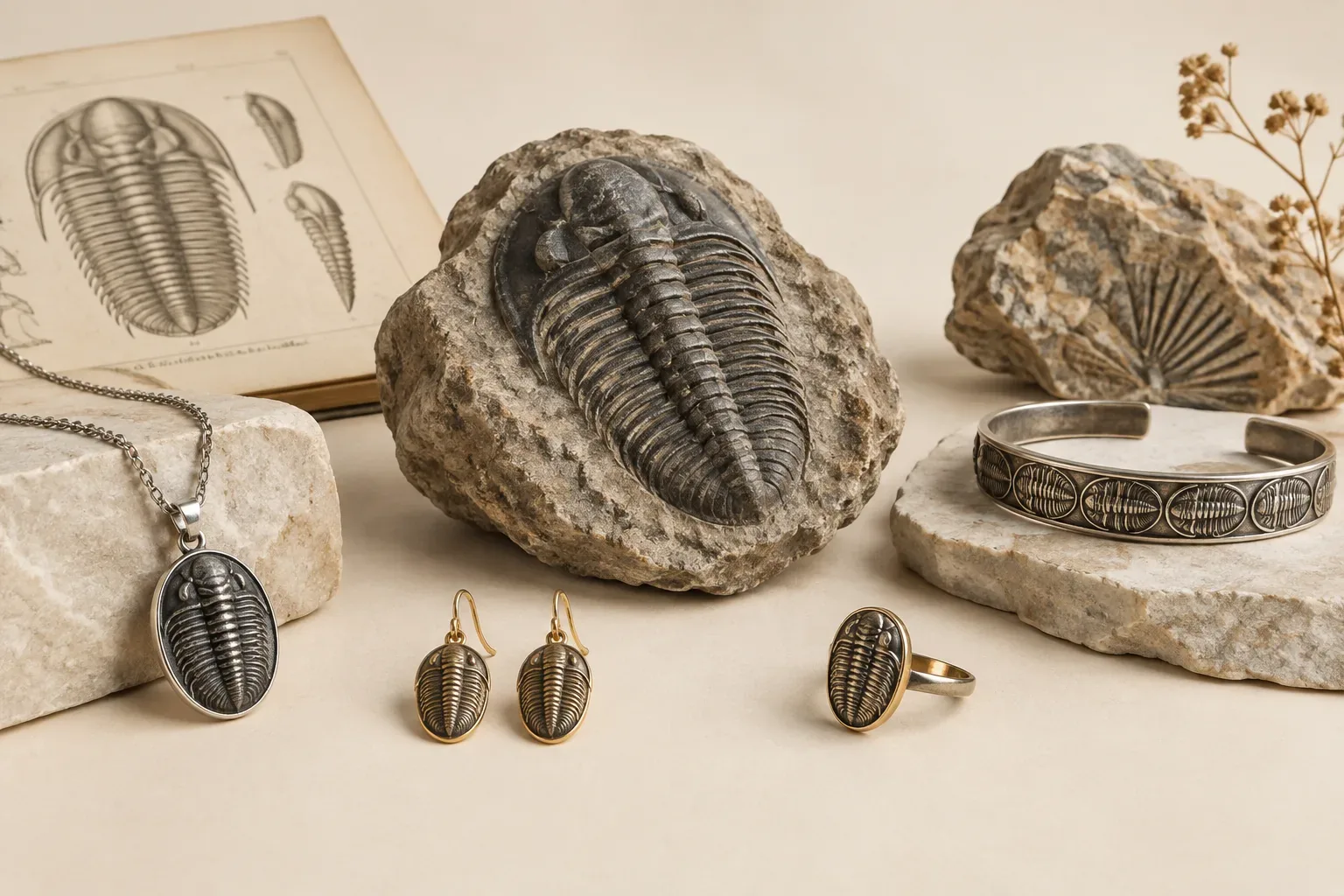
The trilobite motif appears in jewelry in several clear ways. Designers cast or etch stylized trilobite shapes in metals as an aesthetic or symbolic motif. Collectors and makers also set real trilobite fossils into bezels, pendants, rings, and brooches, treating the fossil as both specimen and ornament. Replicas and fossil-inspired reliefs appear on cufflinks, charms, and medals where the fossil’s distinctive segmented form makes a recognisable visual motif.
From a materials perspective, the handling and presentation of trilobites in jewellery follow the same practical and conservation considerations as other delicate organic or mineral materials. The Victoria and Albert Museum’s guidance on gemstones and jewellery history explains how artisans choose settings and supports to preserve materials and convey desired aesthetic values. When real fossils are used, makers often employ protective mountings or domed coverings to prevent abrasion and to stabilise fragile specimens.
Be aware of reproductions and treatments. As with other gem and collectible markets, treated, imitation, or composite pieces exist. Guidance from consumer protection authorities reminds buyers to expect clear disclosure about treatments, imitations, and the nature of the material used.
Practical guidance for selecting trilobite jewelry
Decide what you value most: scientific authenticity, aesthetic design, or symbolic meaning. If scientific authenticity matters, look for sellers who can provide provenance information about the fossil specimen, ideally including where it was collected and whether it was legally and responsibly collected. If your priority is design, evaluate craftsmanship and how the trilobite motif integrates with the piece’s construction and finish.
Ask sellers for specific disclosures about treatments, repairs, or enhancements. Consumer guidance on buying gemstones and related materials recommends that sellers disclose material treatments, imitations, and any significant repairs; the same principle applies to fossils in jewellery. Request written confirmation when possible and retain documentation.
Consider conservation: real fossils are fragile and can fracture under pressure or when exposed to certain chemicals. Look for settings that protect the specimen without resorting to destructive adhesives or invasive repairs. When in doubt, consult a conservator or a reputable maker experienced with fossils.
Check legal and ethical considerations. Fossil collecting and trade are governed by different rules around the world; verify that the seller complies with local laws and that the specimen was not removed from protected sites. When provenance is unclear, prefer reputable dealers, museum shops, or established workshops that provide transparency.
Match the piece to the recipient’s interests and sensitivity. A trilobite pendant may be perfect for someone who studies natural history; a stylised metal motif may better suit someone who prefers subtle symbolism. Avoid gifting fossils that might be culturally sensitive without knowing the recipient’s perspective and preferences.
Buying, disclosure, and long-term care
Be deliberate about documentation. Written receipts should state whether the item contains an actual fossil, a replica, or a stylised motif, and should disclose any stabilisation or adhesives used. The Federal Trade Commission advises consumers to expect clear labeling for gemstones and related materials, and the same standard improves transparency in fossil jewellery purchases.
Care for trilobite jewellery conservatively. Avoid ultrasonic cleaners, harsh chemicals, or excessive heat. Store fossil-containing jewellery separately with cushioning to prevent knocks. For high-value or fragile pieces, seek professional conservation advice rather than attempting home repairs.
If you plan to insure valuable fossil jewellery, provide insurers with provenance and condition documentation. Professional photographs and condition reports are helpful for both insurance and future resale.
Wearing trilobite jewellery respectfully
Wearing trilobite jewellery is usually a personal aesthetic choice. Resist general claims that the motif carries universal spiritual power. Instead, contextualise the piece for others if you wish: explain whether it is a scientific specimen, an artist’s interpretation, or a sentimental symbol for you.
When travelling or attending culturally sensitive spaces, be mindful of local attitudes toward fossils or collecting. In some places fossils are protected or subject to cultural sensitivities; if your piece has an unclear or international provenance, consider erring on the side of caution and learning local norms before publicly displaying it.
Finally, consider how best to preserve the specimen aspect of a wearable fossil. For pieces intended as heirlooms, choose conservative mountings and keep documentation so future owners know the object’s history and how to care for it.
Concluding note
Trilobite jewellery today sits at the intersection of design, collecting, and personal meaning. Museums remind us to distinguish well-documented historical traditions from contemporary reinterpretations. If you love the trilobite motif for its form, geological story, or personal resonance, enjoy it; but do so with an eye toward provenance, disclosure, conservation, and the difference between historical fact and modern symbolism.
Frequently asked questions
What does trilobite jewelry mean?
There is no single, historically documented meaning for trilobite jewelry across cultures. Museum histories indicate that trilobite motifs are primarily modern natural-history or design choices; any personal symbolism—such as endurance or fascination with deep time—is a contemporary interpretation rather than an established ancient tradition.
Are real trilobites legal to buy and wear?
Legal status varies by country and by site of origin. Many fossils are legal to buy when collected and sold in accordance with local laws, but fossils removed from protected sites or exported illegally are problematic. Prefer reputable sellers who provide provenance and confirm legal collection and export.
How can I tell if a trilobite in jewelry is real or a replica?
Ask the seller for documentation stating whether the item contains an authentic fossil, a composite, or a replica. Trusted dealers will disclose treatments and stabilisation. If still unsure, seek an independent assessment from a museum curator or qualified fossil dealer.
How should I care for trilobite jewellery?
Avoid ultrasonic cleaners, harsh chemicals, and extreme temperature changes. Store fossil pieces separately with padding to prevent knocks. For fragile or high-value items, consult a conservator for bespoke advice on cleaning and repairs.
Should I disclose that a piece contains a fossil when gifting?
Yes. Disclose whether the piece contains a real fossil, a replica, or is purely a motif. If the fossil’s provenance is known, include that information so the recipient understands its origin and any conservation needs.
Sources and further reading
- Bedazzled: A History of Jewellery — Victoria and Albert Museum
- An A-Z of Gemstones — Victoria and Albert Museum
- Buying Gemstones, Diamonds, and Pearls — Federal Trade Commission