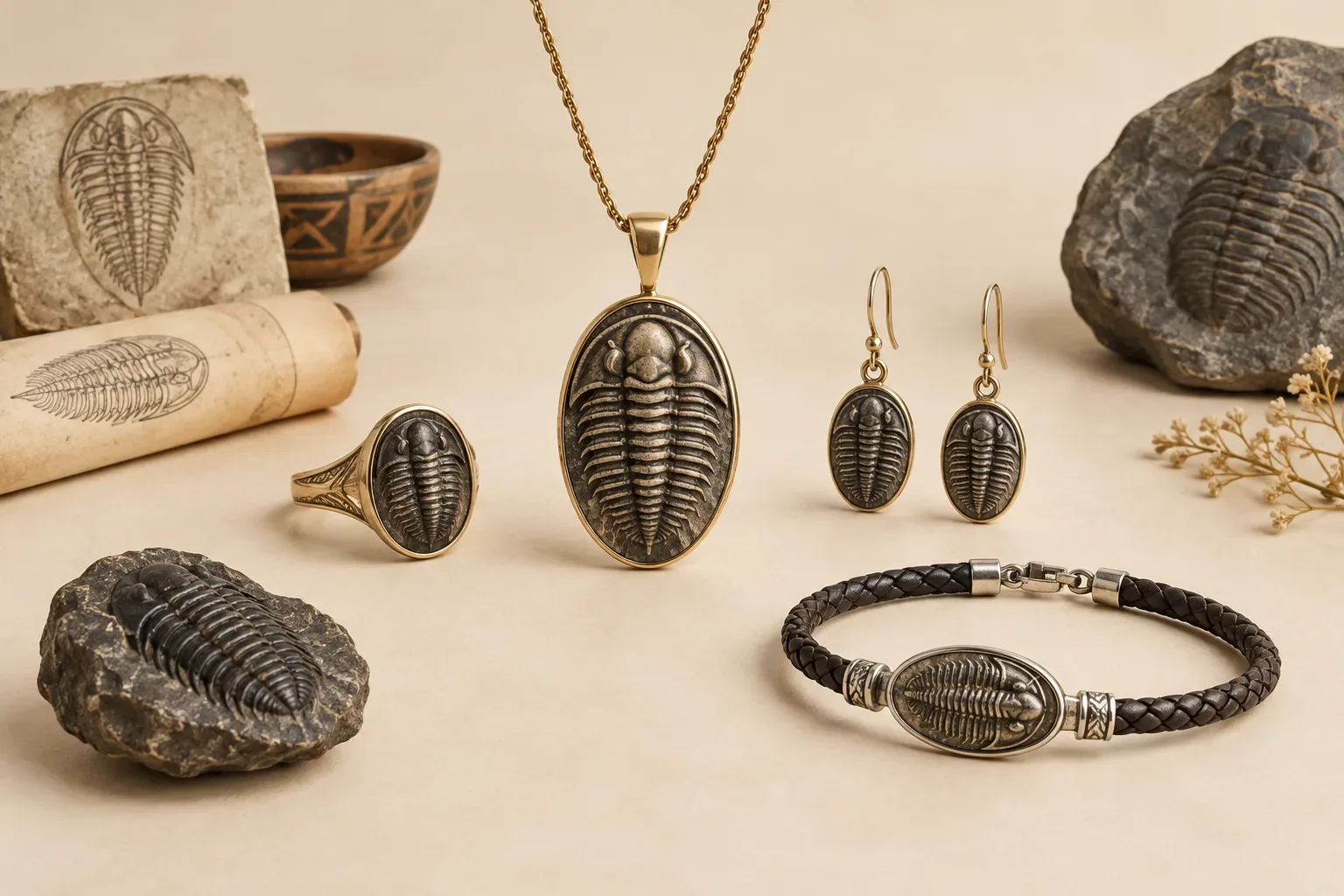
Meaning at a glance
This trilobite jewelry buying guide explains that the motif’s use is primarily a modern phenomenon rather than a long-documented cultural symbol, outlines how trilobites appear in contemporary jewelry, and gives practical guidance on authenticity, treatment disclosure, selection, gifting, and basic care.
What the historical record actually shows
Major museum surveys of jewellery history emphasize that materials and motifs change according to social, technological, and trade contexts, but they do not present trilobites as an established historical religious or cultural symbol in the way that, for example, certain gemstones or iconography have been documented. The Victoria and Albert Museum’s overview of jewellery history describes broad shifts in how people used materials and symbols in personal adornment, supporting the approach of looking for evidence for particular motifs rather than assuming continuity.
Because the V&A’s museum-level surveys do not treat trilobites as a widespread ancient symbolic motif, the best-documented appearance of trilobites in jewellery comes from modern collecting, scientific interest, and contemporary craft rather than from a long line of ritual or traditional use recorded by museums. That means any claim that a specific ancient culture used trilobites as a religious or healing symbol needs specific archaeological evidence; general histories of jewellery do not treat trilobite symbolism as a documented ancient tradition.
Documented meanings versus modern personal interpretations
Documented meanings are those recorded in primary historical sources, museum catalogues, or reputable surveys of jewellery history. On that standard, there is no broadly documented, cross-cultural religious meaning for trilobites recorded in the main surveys of jewellery history held by institutions such as the Victoria and Albert Museum. Put simply, the historical record as surveyed by museum scholarship does not support treating trilobites as an established ancient symbol with consistent cultural meanings.
Modern interpretations are different and plentiful. Contemporary wearers, makers, and collectors often attach meanings such as deep time, resilience, scientific curiosity, connection to the natural world, or a fascination with fossils and paleontology. These are personal or community meanings developed in recent decades rather than meanings documented by historical sources. When buying or gifting trilobite jewellery, treat modern symbolic claims as contemporary associations offered by makers or sellers, not as universal historical facts.
How trilobite motifs and fossils appear in jewellery today
Contemporary jewellery makers and sellers use trilobites in several common ways: original fossil specimens may be set into bezels or mounts, stylized or cast representations of trilobites are produced in metal, and replicas or fossilized slices may be incorporated as wearable elements. Makers also use fossil imagery in engraved, stamped, or printed designs. The Victoria and Albert Museum’s resources on gemstones and materials help explain the broader practice of using unusual natural materials and motifs in jewellery, which places modern trilobite use into the larger context of innovation and novelty in decorative arts.
Because trilobites are fossils rather than conventional gemstones, their physical qualities vary more than standard gem materials. Buyers will encounter whole small specimens, partial fossils, and artistic renditions. Sellers may also combine fossils with conventional jewellery materials and gemstones; the V&A’s A–Z of gemstones is a useful reference for understanding how conventional gems are identified and described in jewellery, but trilobites remain a distinct category—treated and valued for different reasons than cut and polished gemstones.
Authenticity, treatments, and seller disclosures
Authenticity for trilobite jewellery has several dimensions: whether the fossil is genuine, whether it has been treated or stabilized, whether the piece is an original specimen set in jewellery or a replica, and whether the seller is transparent about provenance and legal export. The U.S. Federal Trade Commission’s guidance on buying gemstones, diamonds, and pearls is relevant here because it sets the consumer expectation that material treatments and imitations should be disclosed. Apply that same standard to fossils: ask the seller to describe any stabilizing treatments, adhesives, or surface coatings and to confirm if a piece is a replica or a natural specimen.
Common seller disclosures relevant to trilobites include provenance (where the fossil was sourced), any conservation or stabilization treatments applied to the specimen, whether the item is an original fossil or a cast/replica, and any repairs. If provenance is important to you, request documentation or a clear seller statement. The FTC’s consumer guidance supports the principle that treated or imitation materials should not be misrepresented as natural and untreated.
Practical steps for verifying authenticity before you buy
Start by asking the seller for clear photographs from multiple angles, ideally with a scale reference. Request a condition report and a description of any treatments or stabilizing materials used. If a seller claims scientific provenance or museum-quality standards, ask for documentation to support that claim. The Victoria and Albert Museum’s approaches to material identification and museum standards underline the value of careful documentation and provenance for unusual materials.
Buy from reputable dealers, scientific suppliers, or established jewellery makers who specialize in fossils and who provide written details. If price seems unusually low for an apparently large or intact specimen, be cautious—replicas or casts are common. When in doubt, ask whether the seller will accept a return if the piece is later found to be misrepresented. For significant purchases, seek an independent assessment from a qualified fossil dealer or a conservator familiar with natural-history objects.
Selection and respectful gifting guidance
Consider why you or your recipient want a trilobite piece. If the interest is scientific or educational, favour sellers who disclose provenance and who can supply contextual information. If the interest is aesthetic or symbolic, choose a design and scale that fit the wearer’s lifestyle and jewellery preferences. For a gift, include a note that explains the item’s nature—whether it is a fossil, a replica, or a stylized motif—and any relevant provenance or treatment facts so the recipient can understand and care for it.
Be mindful of legal or ethical considerations. Some fossil localities have export restrictions, and certain collecting practices are frowned upon by scientific communities. If sourcing is a concern, ask sellers about the legal status of the specimen and whether it was collected with appropriate permissions. If you want to tie the piece to a cultural meaning, be explicit that contemporary symbolic interpretations are modern and personal rather than historic facts, and avoid attributing unverified ancient beliefs to the item.
Basic care and maintenance
Fossil material and fossil-mounted jewellery are often more fragile than conventional gemstones. Ask the seller for any care recommendations specific to the item and follow them. As a general rule, prevent mechanical stress: avoid wearing delicate fossil jewellery during vigorous activities and choose protective settings that reduce the chance of knocks or abrasion.
Request the seller’s advice about cleaning and whether the item has consolidants or coatings that could be affected by solvents, heat, or ultrasonic cleaners. When storing, keep fossil pieces separate from harder gemstones or abrasive metals to prevent scratching and, where possible, store in a stable environment away from rapid temperature or humidity changes. These practical precautions help preserve both scientific and aesthetic value.
Frequently asked questions
Are trilobite fossils in jewellery usually authentic fossils or replicas?
Both appear on the market. Sellers offer genuine fossil specimens set into jewellery, as well as casts, replicas, and stylized metal representations. Ask the seller to state explicitly whether a piece is an original fossil, a cast, or a stylized motif and request photographs and any provenance information to verify authenticity.
How can I tell if a trilobite piece has been treated or stabilized?
Request a written description of any treatment or stabilization from the seller. Common disclosures should include use of adhesives, consolidants, coatings, repairs, or added backing materials. The Federal Trade Commission’s guidance for gemstones supports the principle that sellers should disclose treatments and imitations; apply that expectation to fossils as well.
Do I need to worry about legal or ethical issues when buying trilobite jewellery?
Possibly. Some fossil localities are subject to export restrictions or legal protections. If provenance matters to you, ask the seller where the specimen was collected and whether it was legally exported. For high-value or scientifically significant items, seek independent advice from a qualified fossil dealer or museum conservator.
What basic care does trilobite jewellery require?
Care recommendations vary with the material and any treatments used. As a general approach, avoid subjecting fossil-mounted jewellery to harsh mechanical stress, and ask the seller whether any particular solvents or cleaners should be avoided. Store fossil pieces separately from hard gemstones to reduce the risk of abrasion.
Should I buy trilobite jewellery from a general jewellery shop or a specialist?
Both can be appropriate, but specialists in fossils or reputable scientific suppliers are more likely to provide detailed provenance and treatment information. Established jewellery makers who work regularly with fossils may also offer useful conservation advice and protective settings; in all cases, prefer sellers who provide clear written information and return policies.
Sources and further reading
- Bedazzled: A History of Jewellery — Victoria and Albert Museum
- An A-Z of Gemstones — Victoria and Albert Museum
- Buying Gemstones, Diamonds, and Pearls — Federal Trade Commission