Meaning at a glance
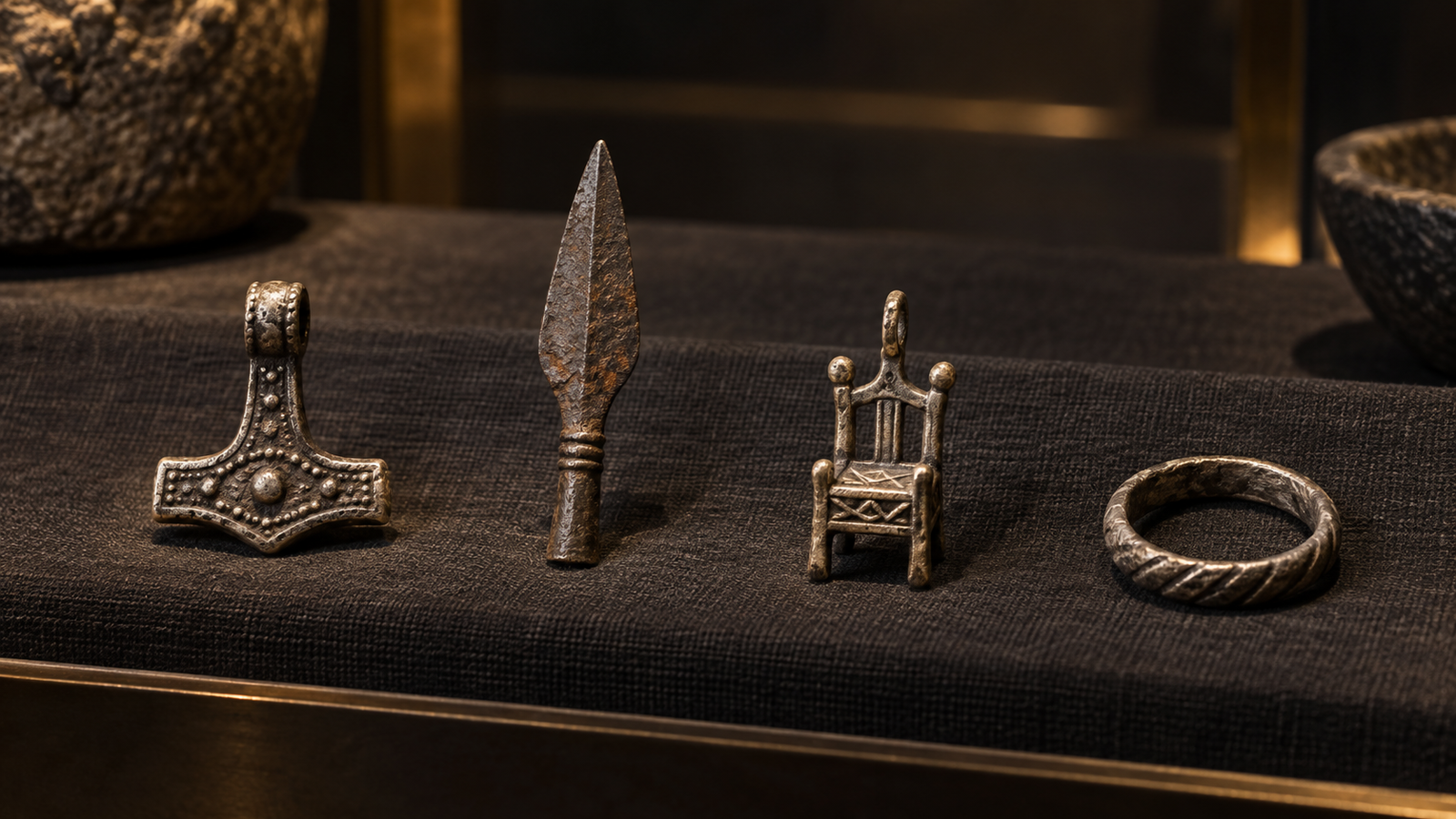
Viking Age amulets include Thor's hammers, miniature weapons, small chairs, rings, and other forms, yet their uses and meanings vary by object and context and often remain interpretations rather than certainties.
Historical evidence and context
Archaeologists and museums base our knowledge of Viking amulets on finds from graves, hoards and ritual deposits. The Swedish History Museum notes that multiple amulet types are attested in Viking Age material culture and that interpreting their exact function is often uncertain. These objects are typically described as intentional small-scale items — pendants, rings and tiny representations of familiar objects — rather than random debris.
The National Museum of Denmark highlights certain kinds of amulets, such as small-chair pendants, in ritual or cultic contexts and connects them to broader practices associated with seeresses and ritual specialists in some find assemblages. Together, these museum collections show a diversity of forms and find contexts across the North Atlantic and Scandinavian world during the Viking Age, but they do not present a single, uniform meaning for all such objects.
Archaeological types and what they may have meant
Thor’s hammer pendants and rings: Small depictions of Thor’s hammer (Mjölnir) are among the best-known Viking Age amulets. The Swedish History Museum specifically documents Thor’s hammer rings and pendants in its collections. Archaeologists have proposed several possible meanings for hammer amulets: identification with the god Thor, markers of religious affiliation, protective talismans, or garments fasteners that adopted a symbolic form. Museums emphasize that while the motif clearly references the hammer, the precise social and religious implications can vary by region and context.
Miniature weapons: Tiny axes, swords and spearheads appear in Viking Age assemblages. These miniatures have been interpreted as symbolic stand-ins for the actual weapons of warriors or as objects connected with oath-taking, status and protection. The archaeological record shows them in burials and hoards, but their presence in a grave does not automatically indicate a single, universal meaning.
Small chairs and thrones: Small-chair amulets and tiny seat-shaped objects are a distinctive class noted by the National Museum of Denmark. These items often occur in contexts interpreted as ritual or linked to seeresses in the museum’s narratives. Scholars have suggested they could symbolize a ritual seat, the status of a practitioner, or an object used in cultic performance, but the museum cautions that interpretations are tentative and built from association rather than a written explanation from the period.
Rings and band-shaped amulets: Rings with symbolic motifs — sometimes interpreted as protective or identity-related — occur in the archaeological record and in museum exhibitions, including the Swedish History Museum’s coverage of Thor’s hammer rings. Rings can be both jewelry and symbolic objects; in some cases they may signify allegiance, status or ritual connection, yet each ring’s meaning depends on manufacture, inscription and find context.
Other small iconic forms: Beyond hammers and chairs, Viking Age material includes numerous small figurative objects: animal heads, boats, and anthropomorphic pendants. The Swedish History Museum summarizes the record as showing many amulet classes, while reminding readers that the evidence rarely provides a single definitive explanation.
Documented historical meanings versus modern interpretations
What the archaeological record documents is the presence, form and find context of these objects. Museums carefully report where items were found, their material and workmanship, and their association with graves, hoards or ritual deposits. From those facts, scholars build interpretations. The Swedish History Museum repeatedly warns that interpretation is often uncertain; the museum documents the objects and notes plausible readings rather than asserting certainties.
Modern personal interpretations — for example, the belief that a Thor’s hammer pendant guarantees a wearer’s physical protection or that a chair amulet establishes a lineage of seeresses — are contemporary meanings layered onto the archaeological evidence. These modern meanings can be meaningful to individuals, and they draw on historical motifs, but they are not the same as proof that Vikings intended those exact effects in the past. Distinguishing documented context (what was found, where and with what) from later personal or ideological readings is essential when we talk about ‘Viking amulets meaning.’
How motifs and traditions appear in jewelry
In the archaeological record, Viking amulets appear primarily as small wearable objects: pendants, rings and miniature objects that could be attached to clothing or worn on a cord. The Swedish History Museum’s catalogs and displays demonstrate how a single motif, like Thor’s hammer, can show up in multiple formats such as rings and pendant forms. Museum pieces are typically metalwork made for everyday wear or special use.
Contemporary jewelers draw on these archaeological motifs for modern jewelry: hammer-shaped pendants, rings engraved or cast with runes, and miniature-weapon-inspired charms. Today’s materials range widely and include sterling silver, bronze finishes, and modern alloys; gem settings do occur in modern interpretations, but the archaeological sources emphasize small metalwork rather than gem-studded objects as the predominant form in the Viking Age. When a modern piece references an archaeological type it may be a faithful replica, an inspired design, or a hybrid that blends historical motifs with contemporary style and materials.
Selecting and gifting Viking amulet jewelry respectfully
If you are choosing a Viking-inspired amulet to wear or to give, begin by learning about the object’s archaeological grounding. Museums such as the Swedish History Museum and the National Museum of Denmark provide trustworthy descriptions of artifacts and their contexts. If a seller claims historical authenticity, ask for provenance or for a clear statement that the piece is a modern reproduction.
Consider the recipient’s beliefs and cultural background. Because motifs like Thor’s hammer are drawn from Norse mythology and can carry religious or cultural significance for some people, it is respectful to avoid assuming universal meanings. Ask whether the recipient sees the motif as cultural heritage, spiritual symbol, fashion, or something else. If gifting to someone with a personal or community connection to Norse traditions, prioritize pieces produced by makers who acknowledge those traditions and who represent them respectfully.
Prefer sellers who are transparent about materials, manufacturing and inspiration. For actual archaeological replicas, reputable producers will state source museums and models. For modern reinterpretations, a clear modern artist statement is helpful. When buying collectible items, be wary of claims about supernatural effects; museums call these interpretive matters rather than empirical historical facts. Finally, take basic care guidance from the maker for any metalwork and consider including a short note about what drew you to the motif so the recipient understands the gift’s intent.
Conclusion
Archaeology shows a rich variety of Viking Age amulets — Thor’s hammers, miniature weapons, chairs, rings and other forms — but the meaning of each object depends on find context and cultural practices that do not always survive in written records. The Swedish History Museum and the National Museum of Denmark present the objects and sensible, often cautious interpretations based on context, while also noting the limits of what the material record can prove.
Modern wearers and makers freely add personal meanings to these motifs; that practice can be meaningful, as long as we keep the historical evidence and later interpretation distinct. Using museum resources and choosing respectful, transparent makers will help you select or give Viking-inspired jewelry in a way that honors both historical evidence and contemporary significance.
Frequently asked questions
What did Viking amulets mean to the people who used them?
Archaeological records show that Viking Age societies used many amulet types, but museums such as the Swedish History Museum and the National Museum of Denmark emphasize that the exact meanings often cannot be proven from objects alone. Contexts like graves and ritual deposits provide clues, and scholars propose functions such as protection, identity, status or ritual use, but these remain interpretations rather than ironclad facts.
Does a Thor’s hammer pendant prove someone was a follower of the old gods?
Not necessarily. The Swedish History Museum documents many hammer pendants and rings but also stresses interpretive limits. A hammer motif likely relates to the cultural figure of Thor in some way, yet whether each pendant signaled religious belief, social identity or fashion is context-dependent and not universally provable.
Were chair amulets specifically for women or seeresses?
Small-chair amulets appear in contexts that scholars sometimes link with ritual specialists; the National Museum of Denmark discusses such finds in relation to seeresses. However, the museum also notes interpretive uncertainty, and it is not accurate to claim a single gendered or professional meaning for all chair-shaped objects across the Viking world.
Can I wear a modern replica of a Viking amulet?
Yes. Many people wear modern reproductions or designs inspired by Viking motifs. If you want to do so respectfully, choose makers who are transparent about whether a piece is a replica or a modern interpretation and consider the cultural significance the motif might have for others.
How can I tell if an amulet is a genuine Viking Age artifact?
Authenticating an artifact requires specialist knowledge: provenance, find documentation, scientific analysis and museum curation. Sellers should provide verifiable provenance; if in doubt, consult a museum or qualified archaeologist rather than relying on sales descriptions.
Were gemstones commonly used in Viking amulets?
The primary museum evidence emphasizes small metalwork pendants, rings and miniatures. While some high-status objects in the Viking Age may incorporate inlay or decorative stones, the surveys of amulets in the Swedish History Museum and similar collections foreground metal amulets rather than gem‑studded talismans as the most commonly documented class.
Sources and further reading
- Magical amulets — Swedish History Museum
- Thor's hammer rings — Swedish History Museum
- Viking seeresses — National Museum of Denmark