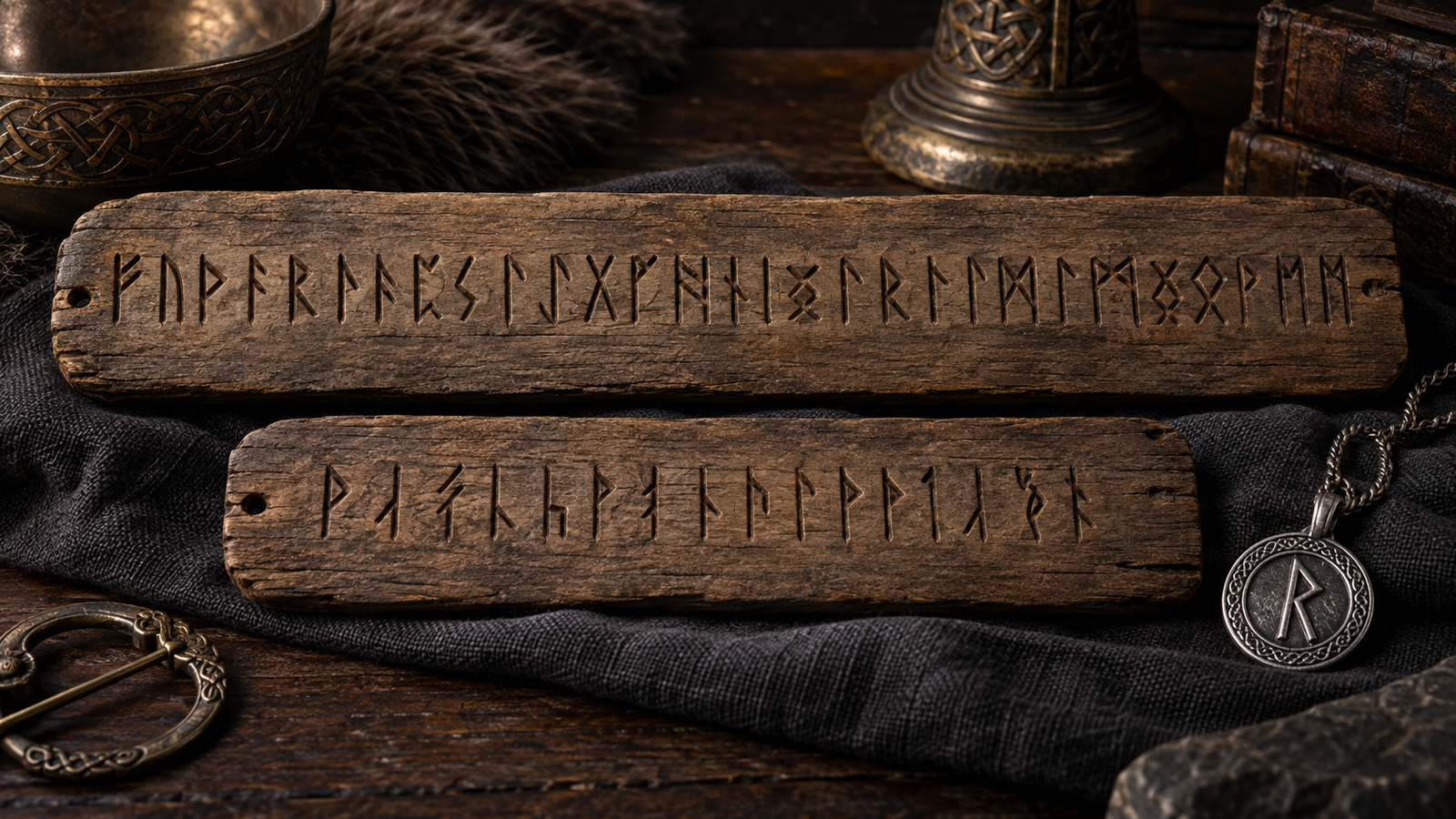
Meaning at a glance
Elder Futhark is a 24-character runic row that predates the Viking Age, while Viking Age Scandinavian inscriptions primarily used the 16-character Younger Futhark; the two systems are distinct and should not be treated interchangeably in jewelry labels or interpretation.
What the historical evidence shows and which cultures and periods used each system
Archaeological and museum research documents that the earliest runic rows differed from the set commonly used during the Viking Age. The Swedish History Museum describes the first runes as forming an older 24-character runic alphabet known today as the Elder Futhark, and it locates those forms before the period commonly called the Viking Age.
The Swedish National Heritage Board also explains that runic writing changed over time and that a reduced 16-character form, usually called the Younger Futhark, was the predominant runic row used in Viking Age Scandinavia. In short, the Elder Futhark belongs to earlier northern Germanic epigraphic traditions, while the Younger Futhark is the documented rune row for many Viking Age Scandinavian inscriptions.
Because runic writing evolved regionally and chronologically, find spots or artifacts dated to particular periods when assessing an inscription: pieces and inscriptions from the Viking Age are most likely to reflect the Younger Futhark forms recorded by the Swedish National Heritage Board and museum collections, whereas earlier inscriptions or continental finds may preserve Elder Futhark characters.
Documented historical meanings versus modern personal interpretations
What ancient runic inscriptions typically record is different from the symbolic meanings often applied in modern practice. In the archaeological record, many runic texts are short and practical: names, ownership marks, memorial formulas, or brief messages. This usage pattern emerges from the inscriptions curated and interpreted by institutions such as the Swedish History Museum and discussed by the Swedish National Heritage Board.
Modern rune use, by contrast, includes a wide range of personal and spiritual interpretations developed over the last two centuries and particularly since the 20th century. Contemporary meanings assigned to individual runes—such as interpreting specific signs as luck, protection, or destiny—are modern frameworks layered onto historical scripts. These personal or neo-pagan interpretations are valid as contemporary expressions, but they are different in kind from the documented communicative and memorial functions of historical inscriptions.
When presenting or wearing runic jewelry, it is good practice to separate what is historically documented from what is a modern personal meaning. Label museum-style reproductions or historically informed pieces with their provenance and rune-row type, and label contemporary or symbolic designs as modern reinterpretations so recipients and wearers understand the distinction.
How runic motifs, bind-runes, and gemstone traditions appear in jewelry
Runic characters and runic-inspired motifs appear in jewelry in several overlapping ways. Some makers reproduce single historical runes from either the Elder Futhark or the Younger Futhark as pendants or rings, often engraving or casting the character into metal. Museums and heritage organisations distinguish those rows, and accuracy requires indicating which rune set is represented.
Bind-runes—designs that combine two or more runes into a single motif—occur in both historical inscriptions and modern jewelry, although the way bind-runes are used today often reflects contemporary creativity rather than strict historical practice. If a piece claims to be a direct copy of an archaeological inscription, the provenance should be verifiable; if it is an artistic bind-rune, it should be described as a modern design. For more on how bind-runes are used historically and now, see our related article on bind runes in jewelry.
Gemstones and metal choice in runic jewelry follow general jewellery traditions rather than historical 'runic gemstones'. Common metals are silver and bronze to echo archaeological finds, while modern artisans may add gemstones for aesthetic or symbolic reasons. When a gemstone is presented as having an ancient runic meaning, that claim should be treated as a contemporary interpretation unless a specific historical source is cited.
Practical and respectful guidance for selecting or gifting runic jewelry
Decide first whether your priority is historical accuracy, modern symbolism, or personal aesthetics. If historical accuracy matters, look for pieces that state which rune row they use and provide the basis for that attribution. A historically labeled Viking Age-style inscription should indicate it uses the Younger Futhark, consistent with the Swedish National Heritage Board’s description of Viking Age runic practice. A piece described as Elder Futhark should be presented as representing an earlier runic tradition, as the Swedish History Museum notes.
Ask sellers for transliteration and explanation. Reputable makers and dealers will specify the runes used, offer a transliteration into Latin letters, and say whether the inscription is a faithful reproduction, a modern text set in historical characters, or a purely decorative motif. The Swedish National Heritage Board’s guidance on transliteration principles is a helpful reference point for understanding how runes map to modern letters.
Be culturally respectful. Do not assume runic symbols are culturally neutral. If you are gifting runic jewelry to someone with a Scandinavian family background, to a practitioner of a living tradition, or to someone who places personal or spiritual importance on runes, ask about their preferences and beliefs. Avoid commercial pieces that mix Elder Futhark and Younger Futhark characters without explanation, and avoid using runes as exotic ornamentation when the recipient might prefer a historically grounded or explicitly contemporary design.
Choose materials and sizing thoughtfully. Silver evokes a look familiar from many museum displays, while bronze or bronze-tone alloys can reference archaeological finds without implying false antiquity. For rings and bracelets, ensure correct sizing and consider how engraving will age. If a piece claims to be a faithful reproduction of an inscription, expect clear provenance or curator notes; if it is a modern reinterpretation, expect an explanation of the maker’s intentions.
Practical next steps and further reading
If you want to buy runic jewelry for historical interest, prioritize items that identify whether they use Elder Futhark or Younger Futhark and ask for a transliteration and explanation. If you are interested in modern symbolic meanings, select a maker who documents the contemporary meanings they attach to their designs and labels them as modern interpretations.
For readers who want to explore related topics on this site, consider our articles on bind runes in jewelry, Norse runes in jewelry, and the actual Younger Futhark rune row used in the Viking Age. These resources can help you understand the difference between historical practice and modern use before you buy, wear, or gift runic pieces.
Frequently asked questions
What is the main difference between Elder Futhark and Viking runes?
Elder Futhark is a 24-character rune row that predates the Viking Age, while Viking Age inscriptions in Scandinavia most commonly use the reduced 16-character Younger Futhark, so they are distinct writing systems and not interchangeable for historical accuracy.
Can I use Elder Futhark runes on Viking-themed jewelry?
You can use Elder Futhark designs for aesthetic or personal reasons, but if you aim for historical fidelity to Viking Age Scandinavia, choose Younger Futhark forms; sellers should clearly label which rune row a piece uses.
Were runes originally magical symbols?
Historical inscriptions preserved in museums and studied by heritage boards are typically practical texts—names, ownership marks, and memorials—rather than systematic magical formulae. Modern occult or spiritual meanings are contemporary layers, not the standard function of most archaeological inscriptions.
How can I check whether a piece of jewelry uses the correct rune row?
Ask the maker or seller for a transliteration into Latin letters and for the rune row name. Reliable vendors will state whether a design uses Elder Futhark or Younger Futhark and whether the inscription is a faithful reproduction, a modern message set in historical characters, or purely decorative.
Is it respectful to gift runic jewelry to someone from Scandinavia?
Gifting runic jewelry can be respectful if you consider the recipient’s cultural background and personal beliefs. Prefer historically accurate labeling or clearly modern designs, and ask whether the recipient favors an authentic or a modern symbolic piece.
Sources and further reading
- The first runes — Swedish History Museum
- Allmant om runor — Swedish National Heritage Board
- Begrepp och principer for translitterering — Swedish National Heritage Board