Meaning at a glance
Thor's-hammer and cross jewelry coexisted during the gradual Christianization of Viking Age Scandinavia, and individual objects could signal competition, adaptation, coexistence, or personal choice rather than embodying a single, universal message.
What the historical evidence shows
Archaeological finds and museum collections make two clear points: the change from Norse paganism to Christianity in Scandinavia was a process stretched over generations, and both hammer and cross motifs appear in the same broader time frame. The National Museum of Denmark describes Christianization as gradual and notes that hammer and cross objects were present in the same horizons, not as instantaneous replacements.
The Swedish History Museum likewise documents examples in which different symbolic concepts were combined in single objects or found alongside each other in the same contexts. The museum has highlighted both cast 'Thor's hammer' rings and pieces that show blending of motifs, underlining that the relationship between the symbols is visible in the material record but rarely simple.
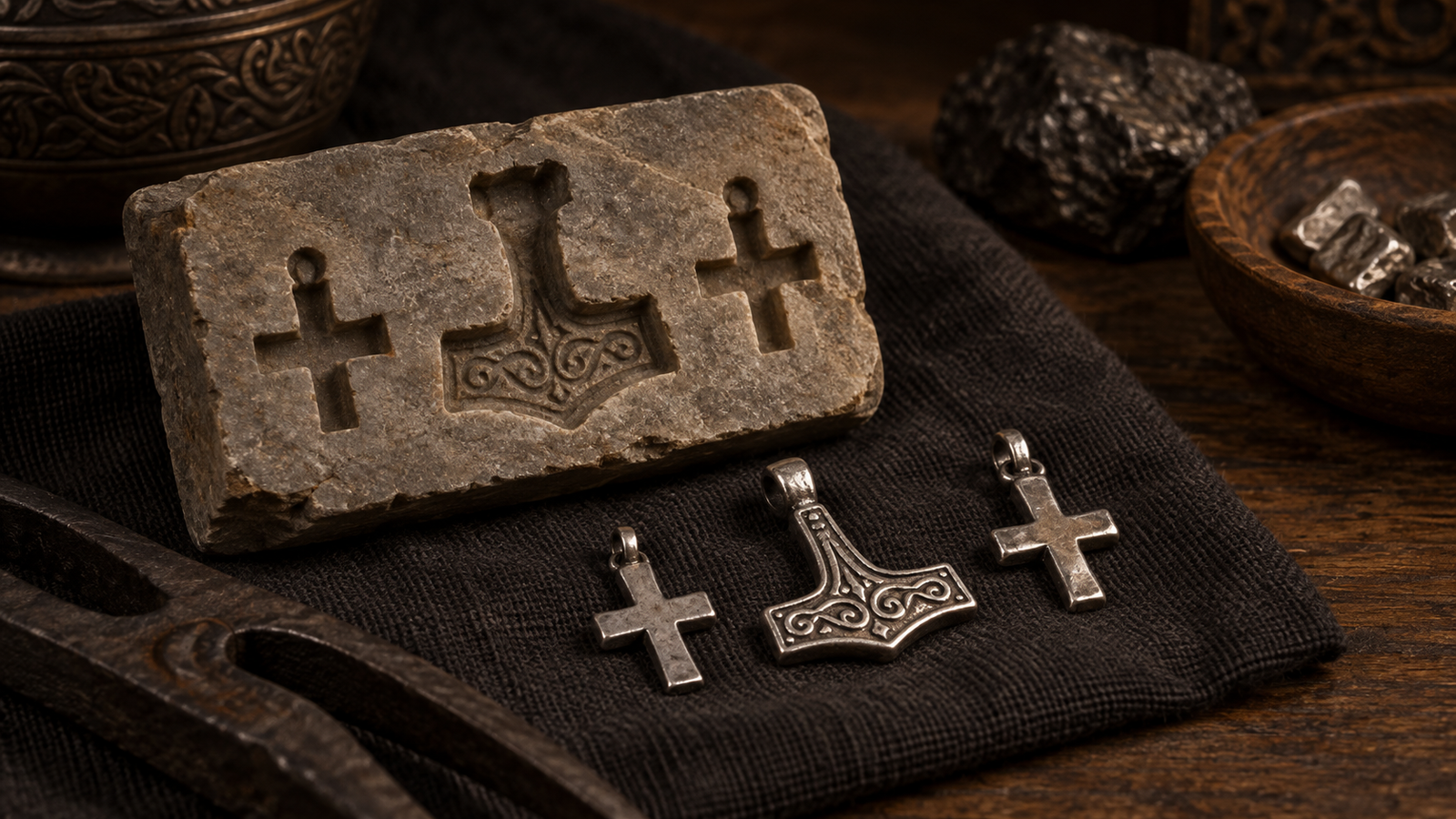
Museums emphasize that many of these pieces were produced using moulds and repeated forms, which created trends that spread through trade and imitation. The existence of mould-produced hammers and crosses shows that these were popular, broadly shared signifiers in their time—but the production method does not by itself tell us what every owner intended the symbol to mean.
Which cultures and periods are we talking about
This subject concerns the Viking Age of Scandinavia, broadly the centuries when Norse societies in what are now Denmark, Sweden, and Norway were encountering Christianity through missions, trade, and political change. When I refer to 'Viking Age Scandinavia' I mean the cultural sphere represented in the finds curated by national museums such as the National Museum of Denmark and the Swedish History Museum.
The museums' collections and research focus on finds from archaeological contexts created during that extended era of conversion. That means the objects discussed are products of overlapping cultural influences: traditional Norse religious practice and the incoming Christian beliefs that spread across different regions and social groups at different speeds.
Documented historical meanings versus modern interpretations
What museums can document is the presence, form, and archaeological context of objects. From those data scholars can reasonably infer that people in Viking-Age Scandinavia used hammer and cross motifs contemporaneously and sometimes in hybrid forms. The National Museum of Denmark and the Swedish History Museum both caution, however, that the precise personal meaning of any single object—that it marked a person's private belief, their political stance, a fashion choice, or an amulet for protection—cannot be assumed from symbol type alone.
Modern personal and cultural interpretations are separate from this documented archaeological record. Today, people wear replicas of Mjolnir or crosses for many reasons: faith, heritage, fashion, identity, or as statements about cultural belonging. Those contemporary meanings are legitimate for modern wearers but are different from the concrete, provable facts that museums report about how objects were produced and found in Viking Age contexts.
How the motifs appear in jewelry
In surviving finds the hammer and cross appear primarily as small wearable objects: pendants, rings, and small amulets. The Swedish History Museum has highlighted so-called 'Thor's-hammer rings' as one of the common categories, showing that the hammer motif was adapted to ring form as well as pendants and standalone amulets.
Archaeological examples show that many pieces were cast in moulds, a production technique that allowed repeated, standardized motifs to circulate widely. That is why museums speak of trends: the same shapes and motifs recur in different graves and hoards, indicating popular styles rather than unique, one-off creations.
Motifs sometimes appear combined or adapted. The Swedish History Museum documents objects that reflect a blending of visual language. That blending can take many forms: a hammer-shaped pendant with ornamental details that echo other artistic traditions, or pieces where Christian and Norse motifs appear in the same assemblage. Such artifacts demonstrate practical and aesthetic adaptation rather than a single, clear ideological statement in every instance.
How to choose or gift a hammer or cross respectfully
Choose with attention to the recipient's beliefs and background. A modern Mjolnir or cross can be a meaningful symbol of faith, heritage, or style. Ask whether the wearer intends the piece as a religious symbol, a cultural nod, or a purely decorative object, and select a design and material that match that intention. Genuine historicism and high-quality workmanship will matter to many recipients, so consider pieces made with care and clear provenance when authenticity is important.
If the goal is historical resonance, seek makers who base their designs on documented forms shown in museum collections and who are transparent about materials and methods. If you prefer a contemporary or stylized piece, choose an artisan whose aesthetic the recipient likes and who can explain the inspiration. When gifting between people of different faiths or cultural backgrounds, frame the gift with a short note that acknowledges the complex history: explain that Viking-Age objects show coexistence of symbols and that modern meanings vary.
Avoid assuming a symbol's meaning for someone else. Because museums emphasize that individual-object meaning is not straightforward, presenting a hammer or cross as though it must represent one specific identity risks miscommunication. Gifting with context and respect—either through conversation or an accompanying note—helps the receiver understand the thought behind the gift and honours the layered history of the motifs.
Caring for historic-style pieces and using them thoughtfully
Treat historic-style jewelry like any other valued object: store it away from strong chemicals and rough contact, clean it according to material-specific guidance, and keep documentation of purchase or maker details if provenance matters. For reproduction pieces inspired by museum examples, makers often provide notes about the original find or period; saving that information preserves the link between the modern object and the historical record.
If you display or wear a piece with cultural significance, be prepared to answer questions. Use those moments to explain the nuance: museums show that hammer and cross symbols appeared together through a period of change, and their presence in graves and hoards speaks to social complexity rather than a simple story of heroes and enemies.
Closing thought
The archaeological and museum evidence reminds us that symbols circulate in messy, human ways. Mjolnir and the cross in the Viking Age were part of shared visual vocabularies, economic networks, and personal choices. Recognizing that complexity—acknowledged explicitly by the National Museum of Denmark and the Swedish History Museum—lets us appreciate both the historic artifacts and the contemporary ways people choose to wear them today.
Frequently asked questions
Did Vikings wear Mjolnir and crosses at the same time?
Yes. Museum research shows that hammer and cross motifs appear during overlapping periods in Viking Age Scandinavia. Both the National Museum of Denmark and the Swedish History Museum document that these objects coexisted in the archaeological record rather than one immediately replacing the other.
Does a hammer pendant always mean the wearer was a pagan?
No. Museums caution against assuming the personal belief of an owner from a single object. A hammer pendant could signal religious affiliation, a cultural identity, a fashion choice, or other personal meanings; the archaeological record alone rarely gives a definitive answer.
Were these objects mass-produced?
Many hammer and cross pieces were made using moulds, which allowed repeated forms to circulate widely. This production method contributed to trends and the broad distribution of similar motifs, as noted by museum collections.
Can I safely wear a reproduction of Viking jewelry today?
Yes. Reproductions are commonly worn as jewelry. If historical accuracy matters to you, buy from makers who base their designs on documented examples and who disclose materials and methods. If the piece is a modern, stylized design, choose according to aesthetic and material preferences.
How should I gift a hammer or cross pendant respectfully?
Consider the recipient's beliefs and cultural background, explain the historical nuance if relevant, and choose a design that matches the intended meaning—whether religious, cultural, or decorative. Providing context with a short note helps avoid misinterpretation.
Do museums say the hammer and cross are evidence of conflict?
Museums present the evidence as more complex than a simple conflict. The National Museum of Denmark and the Swedish History Museum document coexistence, adaptation, and stylistic blending, suggesting a range of social dynamics rather than a single narrative of confrontation.
Sources and further reading
- Christianity comes to Denmark — National Museum of Denmark
- Different concepts combined in objects — Swedish History Museum
- Thor's hammer rings — Swedish History Museum