Meaning at a glance
This article explains documented history and changing contexts for spinel cuts and settings, separates historical evidence from later or personal interpretations, describes how spinel appears in jewelry, and gives practical guidance for selection and gifting focused on balancing beauty and durability.
What the historical evidence shows (and who says it)
Museum research and reference collections make clear that spinel has a long and varied role in jewelry. The Victoria and Albert Museum’s materials on jewelry history and gemstones explain that spinel has been used in both ancient and more recent pieces and that the way gemstones were cut and set changed with social fashion and technology. The V&A also points out that some gems historically identified as rubies were later identified as spinels, which underscores how identification, cutting and the perceived value of stones has evolved with knowledge and technique.
Those museum perspectives emphasize changing social contexts: an identical gem cut and set at different times or worn by different people could mean very different things. The V&A frames jewelry as an object whose meaning is shaped by use, display and changing taste rather than a fixed symbolic language attached to every stone or motif.
Documented historical meanings versus modern interpretations
Documented historical meanings are what contemporaries recorded or what curators infer from surviving objects and records. Museum sources show that spinel’s historical associations are often practical—value, color and availability—rather than a single, consistent symbolic meaning across cultures or centuries. The V&A’s surveys of gemstones and jewelry history stress that how a gem was valued depended on context, provenance and fashion.
Modern personal or popular interpretations—ideas such as spiritual properties, emotional benefits, or universal symbolism assigned to spinel in contemporary marketing or metaphysical circles—are not the same as documented historical meanings. These modern attributions can be meaningful for wearers today, but they should be presented and understood as recent beliefs or personal choices rather than established historical fact.
How spinel cuts affect appearance and durability
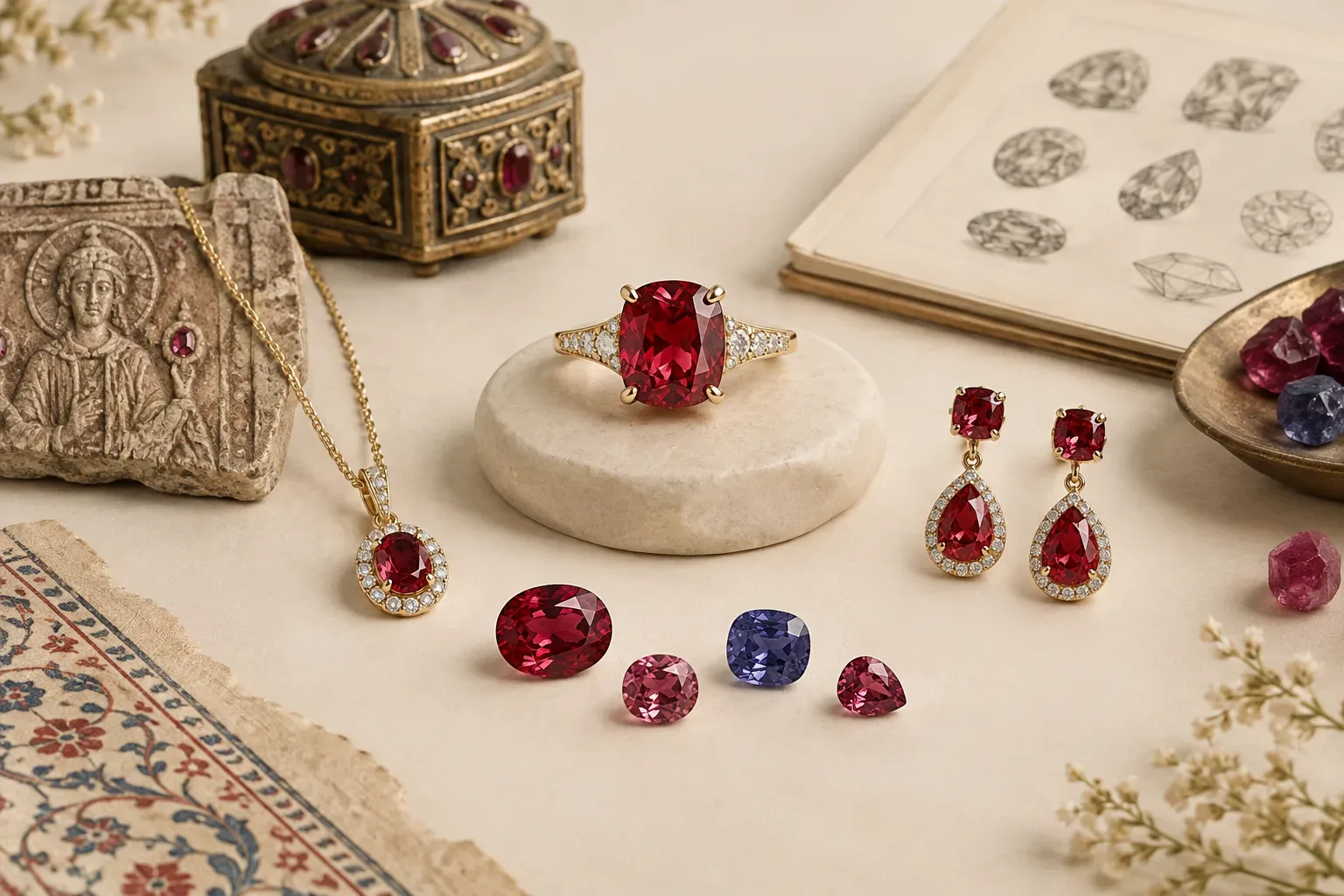
Cut determines how color and light interact in a spinel. Faceted cuts—brilliant, step, or modified cuts—are chosen to maximize color saturation and sparkle, and are the usual choice when gem cutters aim to show off a fine transparent spinel. Cabochon cutting, historically common for particular shapes and for stones with inclusions or silky textures, yields a rounded, polished surface and emphasizes color or chatoyancy rather than sparkle. Museums document both faceted and cabochon treatments across periods and styles.
From a durability perspective, the simplest rule is that cuts with sharp corners or thin pavé-style faceting can create vulnerable points; rounded cuts or cuts placed in protective settings reduce the chance of chipping. The right cut for you depends on the stone’s clarity and color and on whether the piece will be everyday jewelry or an occasional wear object.
Settings: trade-offs between beauty and protection
Settings control both how a gem looks and how well it survives wear. Prong mounts expose more of the gem, maximizing light and brilliance, which is attractive for faceted spinels. Bezel settings surround the stone with metal, offering more protection against knocks and chips and dampening the risk for stones worn daily. The museum literature on jewelry history shows designers have long chosen settings for both aesthetic and practical reasons, and the same considerations apply to spinel today.
Designs such as halos, partial bezels, and protective crowns combine visual impact with greater security. For high-carat or rare spinels, settings that hide vulnerable edges or distribute mechanical stress are advisable. When designers historically reset older gems, museums note that they often changed settings to suit new fashions or new ideas about wearing and preserving gems; that same flexibility applies to modern owners who plan to wear their jewelry often.
How spinel appears in jewelry across traditions
Spinel appears in many jewelry forms: single-stone rings and pendants, multi-stone necklaces, historical signet and sovereign jewels, and contemporary designer pieces. Museum materials highlight that the gem has been used both as a center jewel and as accent stones, and that its visual role shifts depending on cut and setting. In historical collections, curators note examples of spinel mistaken for ruby in crowns and other high-status pieces, showing how color and cutting determined perceived identity and value.
In modern craft and commercial jewelry, spinel is prized for its clear, saturated colors and relative affordability compared with some other red or pink stones, so it is common to see spinel in engagement rings, colored-stone rings, and fashion jewelry. Designers today often pair faceted spinels with white metals to highlight sparkle or with warm gold to emphasize red and pink tones, but these are stylistic choices rather than fixed traditions.
Practical guidance for choosing and gifting spinel jewelry
Start with the intended use. If the recipient plans to wear the piece daily, prioritize secure mounting and a cut that hides vulnerable edges. A bezel, partial bezel or halo setting gives extra protection for rings and bracelets that may experience knocks. For occasional-wear pieces, a prong-set faceted stone may maximize sparkle without as much risk.
Consider the stone’s color and clarity. Choose a cut that enhances the stone’s best visual qualities: deep, even colors often benefit from cuts that preserve color saturation, while lighter or more transparent stones can be cut to increase brilliance. If the piece will be set with other stones, think about contrast and harmony with metal and side-stone choices.
Ask direct questions about treatments and authenticity. The Federal Trade Commission advises buyers to request clear disclosure about treatments, enhancements, or imitations. Ask the seller whether the spinel is natural, whether it has been heat-treated, or whether any laboratory report accompanies the stone. For high-value purchases, consider an independent gemological report.
Match style to the recipient. If gifting, be mindful of personal taste and lifestyle: an active person may prefer a low-profile, sturdy setting; someone who values historical resonance may appreciate a cabochon or a design inspired by historical mounts. When in doubt, choose a classic, protective setting and include care instructions or a removable mounting option so the recipient can change how the piece is worn.
Document provenance and care. Keep receipts, any treatment disclosures, and a note of the maker or seller. Museums emphasize the importance of provenance for understanding an object’s history; in the consumer context, documentation supports later resale, insurance, or appraisal.
Final note
Spinel cuts and settings sit at the intersection of aesthetics, wearability and history. Museum collections and reference guides show that both cutting styles and settings evolve with technology and taste, and that what mattered for a gem’s meaning in the past often related to context rather than an intrinsic, unchanging symbolism. For contemporary buyers and gifters, a sensible approach combines respect for the stone’s character, attention to durability, and clear questions about treatments and provenance.
Frequently asked questions
Is spinel durable enough for an everyday ring?
Spinel is considered a durable gemstone and is commonly used in rings, but choose a protective setting (bezel, partial bezel, or halo) for everyday wear. Consider the wearer’s activities and opt for a low-profile mount if they do physical work or sport. If you have concerns about a particular stone or setting, ask the seller about risk factors and consider a setting that protects vulnerable edges.
Does spinel come in different cuts historically and today?
Yes. Historical collections and modern makers show spinel in polished cabochons and many faceted cuts. Cabochons were common historically for certain styles and stones with inclusions, while faceting is used to maximize brilliance and color in transparent stones. The museum record documents both approaches across periods.
Are spinels often treated or imitated?
Sellers may offer natural, heat-treated, or synthetic stones; the Federal Trade Commission recommends asking for clear disclosure about any treatments or imitations. Always request written information about treatments and, for high-value purchases, consider an independent gemological report.
How should I care for spinel jewelry?
Clean spinel jewelry with mild soap and a soft brush or cloth and avoid harsh chemicals or ultrasonic cleaners for stones with fractures or certain inclusions. Store items so they don’t rub against harder gems or metals that could scratch them. If in doubt, ask your jeweler for cleaning guidance specific to the setting and stone.
What should I ask a seller when buying spinel as a gift?
Ask whether the spinel is natural or synthetic, whether it has been treated, whether the setting is suitable for everyday wear, and whether any certificate or treatment disclosure accompanies the purchase. Also inquire about return policies and any available resizing or aftercare services.
Sources and further reading
- Bedazzled: A History of Jewellery — Victoria and Albert Museum
- An A-Z of Gemstones — Victoria and Albert Museum
- Buying Gemstones, Diamonds, and Pearls — Federal Trade Commission