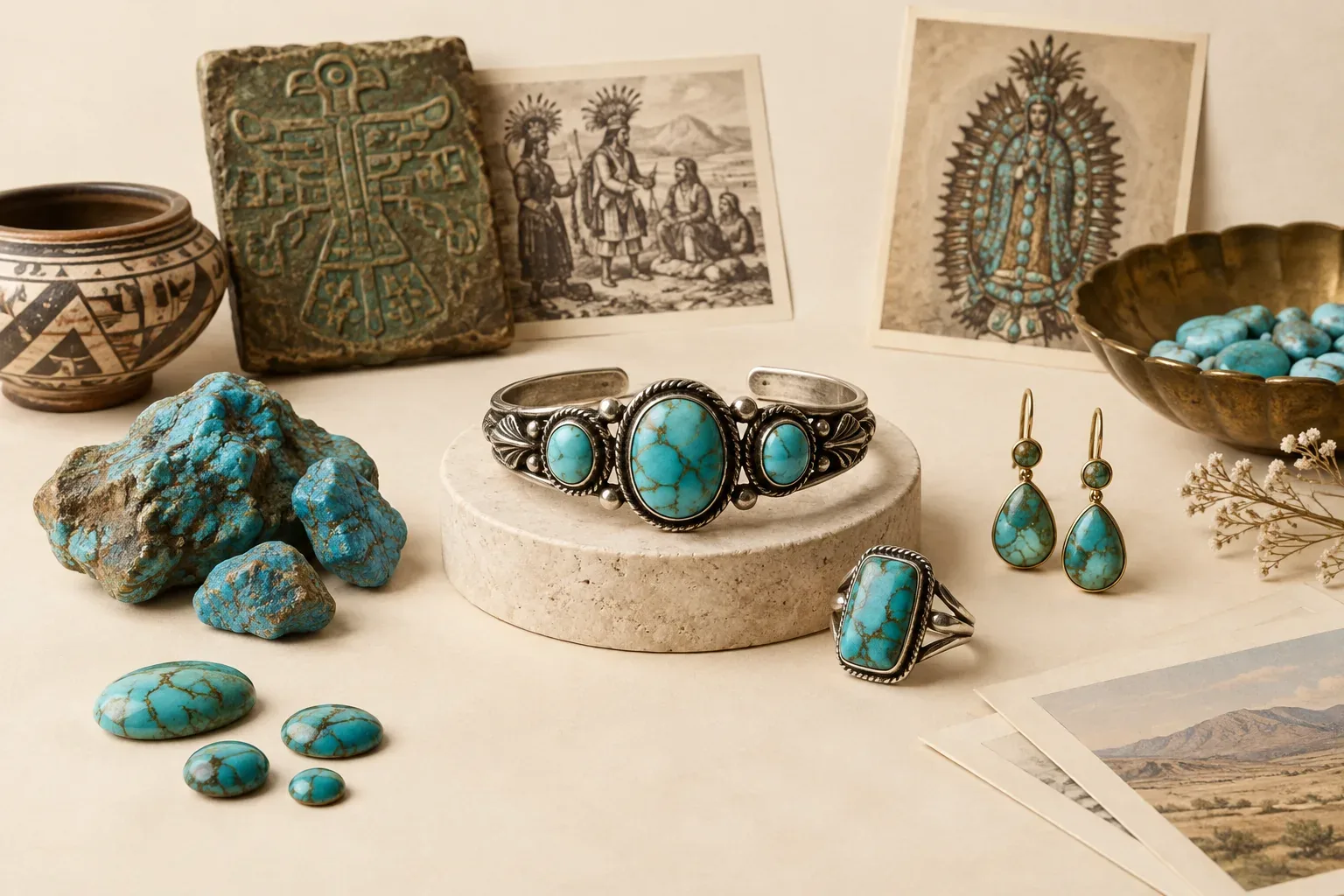
Meaning at a glance
Turquoise quality and value depend on color, matrix, hardness, treatments, and provenance; the Victoria and Albert Museum documents turquoise’s long cultural use while the FTC explains the need for disclosure of treatments and imitations—this guide separates documented history from modern interpretations and gives practical buying and gifting advice.
What the historical record documents
The Victoria and Albert Museum’s surveys of jewellery and gemstones trace turquoise across many periods and places as a prized material for its distinctive blue-green hue and decorative versatility. Museum collections and publications identify turquoise in objects from ancient royal and religious contexts through later decorative uses, indicating long-standing value for aesthetics and status rather than a single universal symbolism.
Different societies used turquoise within distinct social and material contexts. The V&A’s resources describe examples from ancient Near Eastern and Egyptian contexts, later medieval and early modern European jewellery, and Indigenous North American jewellery traditions, each with its own technical and social practices around working the stone. These findings show turquoise’s material importance and changing social meanings rather than a single fixed message across cultures.
Documented historical meanings versus modern personal interpretations
Where the historical record exists, it is possible to identify meanings that were documented in context. The V&A’s research shows turquoise was often prized for color, rarity in some settings, and its suitability for inlay and cabochon work; in particular contexts these practical and aesthetic values became linked to status or ritual use. Those links are historically situated and should be described as such: they belong to the people and times that used them.
Contemporary descriptions that present turquoise as universally protective, lucky, or spiritually charged are modern interpretations rather than uniform historical facts. Many individuals ascribe personal meanings to turquoise today—such as emotional calm, healing, or identity expression—and those personal meanings are valid for the wearer. It is important, however, to keep modern personal interpretations distinct from documented cultural practices and attributions recorded by museums and historical sources.
How turquoise appears in jewelry
Turquoise appears in a wide range of jewellery forms. Museum accounts note that craftsmen historically shaped turquoise as cabochons for rings, brooches, and pendants and used it as inlay in mosaics or combined with metals for bezel settings. In many traditions it was also strung as beads for necklaces and used as small decorative plaques or tiles.
Surface finishes, metal choices, and setting styles affect both aesthetics and value. For example, the V&A documents instances where turquoise was set in gold for high-status pieces and other traditions where it was paired with silver or used in multi-stone inlay work. Contemporary designers continue these practices, often adapting historic techniques to new styles while emphasizing color harmony and stable mounting to protect the softer stone.
Key technical quality and value factors
Color: Color is often the single most influential factor in turquoise pricing and preference. Shades range from pale blue to deep robin’s-egg blue and greenish tones. Buyers should decide which hue they prefer; historically, certain bright, evenly colored blues were prized in many markets, as reflected in museum descriptions of high-status pieces.
Matrix and patterning: Matrix refers to the darker veining or webbing from the host rock. Some collectors prize clean, even color with little matrix, while others value dramatic spiderweb matrix patterns for their character. Both are natural and affect taste more than objective worth—museum records document both preferences across cultures and time.
Texture, porosity and hardness: Turquoise is relatively soft and porous compared with many gem materials. Surface texture and density influence durability and how the stone takes polish. A compact, fine-grained turquoise that takes a smooth polish will wear better and generally command higher prices.
Treatments and stabilization: Because turquoise is porous and can be fragile, many stones on the market have been stabilized or treated to improve color and durability. The Victoria and Albert Museum’s gemstone resources note historical and modern practices of working and treating materials. The Federal Trade Commission requires sellers to disclose treatments and imitations, so authenticated treatment details should be part of any purchase conversation.
Imitations and substitutes: Look out for dyed howlite, plastic, or reconstituted material frequently sold as turquoise or as turquoise simulants. The FTC’s guidance on buying gemstones, diamonds, and pearls stresses the importance of disclosure of imitations and the seller’s duty to state whether a gemstone is natural, treated, or synthetic.
Provenance and craftsmanship: Provenance—where the stone was mined and how the piece was made—affects both cultural value and price. Museum catalogues often note provenance as key to understanding an object’s meaning. Craftsmanship—secure settings, appropriate mountings, and quality metalwork—can raise the practical value of a piece because turquoise benefits from protective settings and good construction.
Practical buying and gifting guidance
Get clear, written information about treatment and origin. The Federal Trade Commission recommends that sellers disclose whether a stone is natural, stabilized, dyed, reconstituted, or synthetic. Ask for a written statement and, when available, lab reports or credible seller documentation that confirm treatment and origin claims.
Decide whether appearance or authenticity matters more for you or the recipient. For everyday wearable pieces, stabilized turquoise with an even color and secure setting can be a sensible, durable choice. For collectors who prioritize untreated material, expect to pay more and to accept more fragility and variation in surface appearance.
Consider setting and wearability. Because turquoise is softer than many gemstones, choose protective settings for rings or pieces intended for daily wear, such as low bezels or inlay work. Necklaces, earrings, and brooches are often safer options for larger or softer pieces.
Respect cultural origins and artisan credit. If you are buying Native American–style turquoise jewellery or pieces made by identifiable cultural groups, seek out authentic makers or reputable galleries and ask about maker attribution. The Victoria and Albert Museum emphasizes the importance of context for understanding historical jewellery, and that same respect applies when choosing contemporary culturally specific work.
Balance budget with quality factors. Establish which qualities you value most—color, matrix, untreated stone, or artisan mounting—and allocate your budget accordingly. Well-made settings and trustworthy documentation often provide more long-term satisfaction than purchasing the visually “perfect” stone without disclosure.
When in doubt, consult experts. Reputable dealers, independent gemological laboratories, or museum publications can help you interpret quality claims and provenance notes. Use these resources to verify high-ticket purchases or pieces claimed to be untreated, antique, or of a specific cultural provenance.
Wearing and caring for turquoise
Treat turquoise with care. Avoid exposing it to harsh chemicals, ultrasonic cleaners, steam, or prolonged sunlight that can alter color or surface finish. Because of its porosity, oils and cosmetics can darken or change the appearance of some turquoise over time, so remove jewelry when applying lotions or doing work that could soil the stone.
Maintain and protect settings. Regular inspection of prongs, bezels, and inlay work will help prevent damage to the stone. Museum conservators and jewellery professionals recommend secure mountings and occasional professional cleaning and maintenance rather than aggressive home treatments.
Final note on meaning and context
Turquoise carries a layered history of material use and social value documented by museum collections and scholarship. The Victoria and Albert Museum’s resources are a useful starting point for understanding how the stone was used in different societies. Modern wearers often bring personal meanings to turquoise, and those meanings are meaningful for individuals. When choosing or gifting turquoise, seek reliable information about the object’s technical qualities and cultural origins, and prefer ethically transparent sellers and makers.
Frequently asked questions
How can I tell if turquoise is treated?
Ask the seller for written disclosure and documentation; stabilized, dyed, or reconstituted turquoise is commonly sold and must be disclosed under FTC guidance. A reputable dealer will explain whether a stone is natural and untreated or has been treated to improve stability or color.
Is a stone with matrix less valuable than a clean stone?
Value depends on market and personal preference. Some collectors prize clean, evenly colored turquoise, while others pay a premium for dramatic spiderweb matrix. Museums document both aesthetic traditions, so neither appearance is inherently more correct—only differently desired.
What color of turquoise is most valuable?
There is no single objectively ‘most valuable’ color for all markets, but vivid even blues are often highly sought after in many collecting traditions. Buyer preference, cultural context, and whether the stone is treated influence price.
Can I wear turquoise every day?
You can wear turquoise daily if the piece is well made and you accept that the stone is softer and more porous than many gems. Choose protective settings and avoid exposure to chemicals, cosmetics, and long sunlight; remove it for heavy work to reduce risk of damage.
Should I buy antique or contemporary turquoise jewellery?
Choose based on your priorities. Antique pieces may have interesting provenance and historical value but could be fragile or altered. Contemporary jewellery often offers clearer information about treatments and maker attribution and can be designed for everyday wear.
How important is provenance for turquoise?
Provenance matters for cultural context, authenticity and sometimes price. Museum documentation shows how provenance helps interpret an object’s social meaning. For purchases, provenance can also indicate ethical sourcing and maker attribution, which many buyers consider important.
Are there trustworthy ways to verify turquoise authenticity?
Yes. Use reputable dealers, independent gemological laboratories, and written seller disclosures. The FTC recommends insisting on truthful disclosure about whether a gemstone is natural, treated, or a simulant.
Sources and further reading
- Bedazzled: A History of Jewellery — Victoria and Albert Museum
- An A-Z of Gemstones — Victoria and Albert Museum
- Buying Gemstones, Diamonds, and Pearls — Federal Trade Commission