Meaning at a glance
This article explains the documented history and changing uses of turquoise, separates historic cultural evidence from later personal interpretations, describes how turquoise appears in jewelry, outlines common treatments and imitations, and gives practical questions and respectful buying and gifting guidance.
Quick answer
Turquoise treatments and imitations are widespread; buyers should ask sellers whether a stone is natural, what treatments (for example stabilization, dyeing, or reconstitution) have been applied, whether it is a synthetic or an imitation, the gemstone’s origin if known, and what documentation or return policy accompanies the purchase. The Victoria and Albert Museum provides the historical context for how turquoise has been used across cultures, and the U.S. Federal Trade Commission sets consumer expectations about disclosure of treatments and imitations.
What the historical record says — and which institutions document it
Museums and reference collections are the best sources for documented history of gemstones in jewelry. The Victoria and Albert Museum (V&A) describes turquoise as a gemstone used in many places and periods, where it has appeared in a variety of forms and social contexts. The V&A’s materials on jewelry history and gemstones trace turquoise’s use as an ornamental material, sometimes incorporated into personal adornment, ceremonial objects, and metalwork across different cultures.
Because the V&A covers broad material history rather than a single culture’s account, it is appropriate to say that turquoise has a long recorded presence in jewelry-making traditions in several regions and periods, rather than to assert any single, continuous meaning. The V&A’s accounts emphasize changing social contexts — for example, shifts in fashion, trade, and technology — that affect how turquoise was valued and used.
Keep cultures and periods separate
Historical evidence does not support treating turquoise as having a single meaning across time and place. The V&A’s overview makes clear that how a community used or valued turquoise depended on local materials, techniques, trade links and beliefs. If you are interested in a specific culture or period, seek sources focused on that context rather than generalizing from other examples.
For example, museum descriptions emphasize differences in setting styles, inlay techniques and the social role of jewelry between periods and places. Treat references to turquoise in one culture as specific to that culture’s history; do not assume that a symbolic or ritual meaning from one tradition applies universally.
Documented meanings versus modern personal interpretations
Where museum records or archaeological publications document a role for turquoise—such as use as ornament, marker of status, or inclusion in amuletic objects—credit those institutions for the historical claim. The V&A’s materials document turquoise’s presence and changing use in jewellery and decorative objects; they do not automatically validate later metaphysical claims.
Modern personal interpretations and New Age or wellness claims about turquoise (for example, assertions that wearing turquoise will confer specific health benefits or spiritual protection) are contemporary meanings people attach to the stone. Those modern interpretations are personal, culturally specific, and not the same as documented historical beliefs unless linked to primary evidence from the relevant culture and period.
How turquoise appears in jewelry
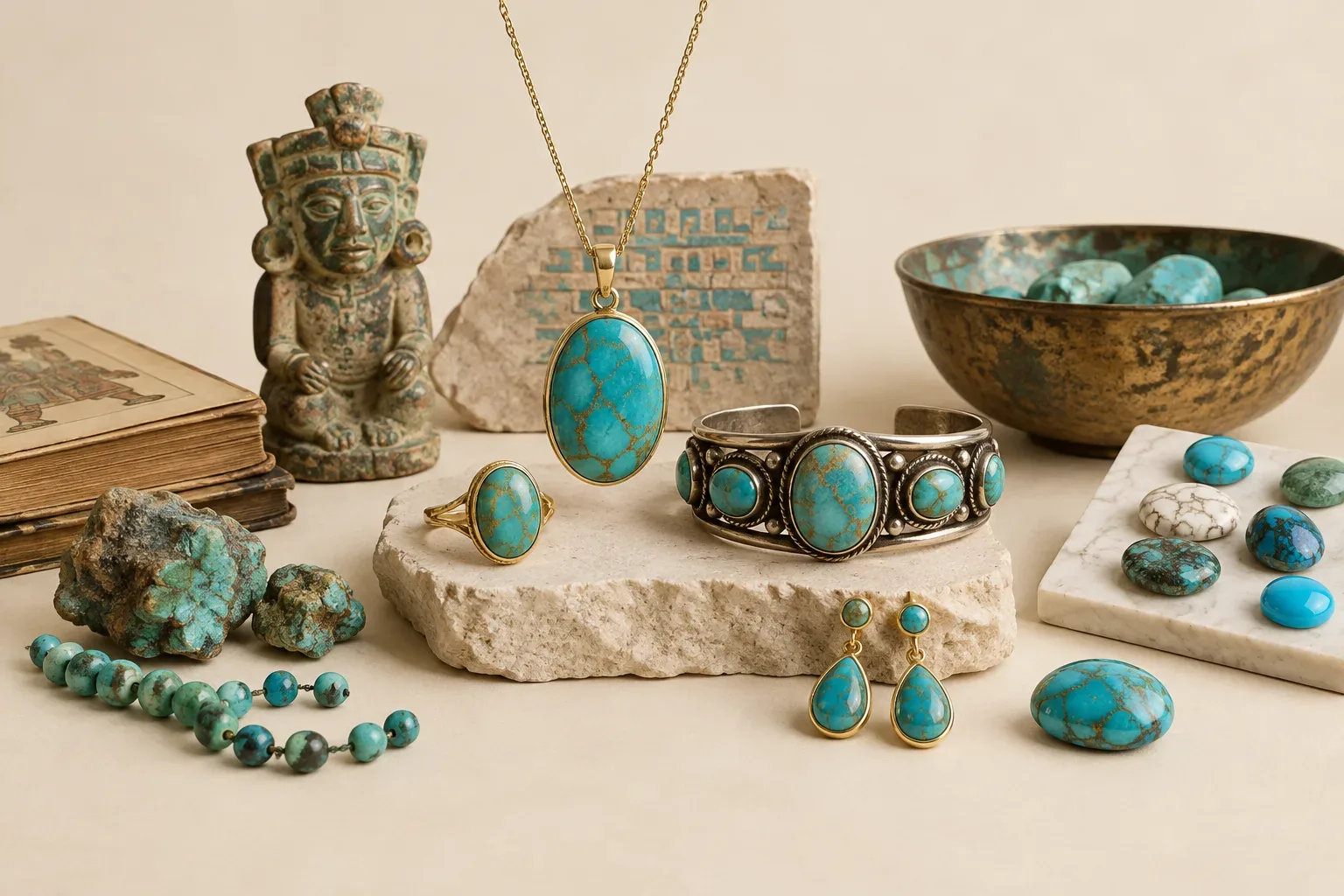
Museum descriptions and gemology references show turquoise appearing in multiple forms: as rounded beads, polished cabochons set into metal, small inlays forming mosaic patterns, and as carved plaques or beads. The stone is often cut en cabochon (smooth, rounded top) because its natural structure and fracture patterns suit that shape. The V&A’s guides on gemstones discuss these common historic treatments and settings as part of the broader history of jewellery-making.
Turquoise is also used to emphasize color contrasts in metalwork and is frequently paired with metals such as silver or gold, depending on regional tastes and technical traditions. How turquoise is mounted, the size of stones, and whether they are used as accents or dominant elements all changed with fashion and technology over time.
Common treatments and imitations to know about
There are three practical categories buyers will encounter: natural untreated turquoise, treated or enhanced turquoise, and imitations or synthetics. Treatments are often applied to improve durability or color and include stabilization (where a resin or similar material is used to fill pores and strengthen the stone), dyeing (to change or intensify color), and reconstitution (where small fragments are ground and bonded together to form a manufactured material).
Imitations include dyed howlite or magnesite that resemble turquoise, plastics, and wholly synthetic turquoise-like materials. Market terms vary, and some trade descriptions (for example “stabilized turquoise” or “reconstituted turquoise”) are accurate if clearly disclosed. The U.S. Federal Trade Commission requires that sellers not misrepresent natural gemstones and that they disclose treatments and imitations; this is the authoritative consumer protection guidance to rely on when buying.
Questions buyers should ask — simple, practical wording
When you are considering a purchase, ask the seller four core questions: Is this natural turquoise? If so, has it received any treatments (stabilized, dyed, reconstituted)? Do you have documentation or a test report, and what is your return policy if the description proves inaccurate? Where was the stone sourced, and can you describe how it is set and finished?
If the seller says the piece is treated or synthetic, ask for a clear explanation of the treatment and how it affects care, durability and value. Ask whether the seller’s receipt or certificate names the treatment. The FTC’s buying guidance indicates that sellers should disclose materially important information about treatments and imitations so consumers can make informed decisions.
Practical selection and respectful gifting guidance
Choose based on the recipient’s values and knowledge. If the person respects historical or cultural meanings, ask whether they prefer natural, untreated stones or pieces that acknowledge craft traditions. If the recipient belongs to a culture where turquoise has specific ceremonial or familial meanings, be especially respectful: ask family members or community contacts about appropriate practices rather than assuming a public-market piece is suitable.
Respectful gifting also means transparency. If you present a piece as an authentic historic object or a cultural token, verify provenance and be clear about treatments. If you prefer a brighter, more durable stone for everyday wear, a stabilized or reconstituted turquoise might be practical; explain that to the recipient. Conversely, if the recipient values natural, minimally altered material, prioritize stones described as natural and untreated, accompanied by seller disclosures or a gemological report when possible.
Care, durability and value considerations
Untreated turquoise tends to be softer and more porous than many other gems; it can stain or change color with oils, cosmetics or cleaners. Stabilized turquoise is treated to reduce porosity and improve durability, which can make it more suitable for everyday wear but may also affect resale value. Dye or reconstituted materials require careful handling because their surface appearance can wear or alter with time.
If long-term value is a concern, request clear written disclosure and, when practical, an independent test or certificate. The V&A’s materials on gemstones and the FTC’s guidance on buying recommend that provenance, treatment disclosure and conservative care instructions should all factor into a purchasing decision.
When to seek professional testing or certification
For high-value pieces or items presented as rare, historic or untreated, consider asking for a gemological report from a recognized laboratory. Professional testing can identify treatment types and distinguish natural stones from common imitations. The FTC’s consumer guidance supports seeking documentation when the seller’s claims materially affect your decision to buy.
Laboratory reports are not always necessary for lower-priced or novelty items, but when treatments materially affect durability or authenticity, a report can protect the buyer and confirm whether the seller’s disclosures are accurate.
Final takeaways
Turquoise has a long and diverse history in jewellery that museums such as the Victoria and Albert Museum document; its meanings and uses changed across cultures and time. Modern metaphysical claims about turquoise are contemporary personal interpretations and should be distinguished from documented historical uses.
Practically, ask sellers about natural versus treated material, request disclosure of any stabilization, dyeing or reconstitution, ask for provenance or certificates when appropriate, and be mindful of cultural contexts when gifting. The U.S. Federal Trade Commission recommends clear disclosure of treatments and imitations, and buyers should use that guidance to request the information they need.
Frequently asked questions
What are the most common treatments for turquoise?
Common treatments include stabilization (resin or polymer fillers to reduce porosity and strengthen the stone), dyeing (color enhancement), and reconstitution (ground fragments bonded into a new material). Sellers should disclose such treatments, and the FTC advises consumers to request that information before buying.
How can I tell if turquoise is real or an imitation?
Visual inspection alone can be misleading. Ask the seller for clear disclosure about treatments and whether the piece is natural, synthetic, or an imitation. For higher-value purchases, request a gemological report from a recognized lab. The FTC recommends relying on seller disclosure and documentation for important purchases.
Is stabilized turquoise still 'real' turquoise?
Stabilized turquoise is natural material that has been treated to improve durability. It remains turquoise, but treatment affects care and, often, market value. Sellers should be explicit about stabilization so buyers know what they are purchasing.
What should I ask if I plan to gift turquoise to someone from a culture where the stone has special meaning?
Ask family members or community contacts about appropriate practices, seek pieces with clear provenance if cultural authenticity matters, and be transparent about the stone’s origin and treatment. Avoid assuming a mass-market piece is appropriate for ceremonial or culturally specific use without verification.
Do I always need a certificate for turquoise?
Not always. For lower-priced or fashion pieces, clear seller disclosure and a fair return policy may suffice. For high-value, antique, or apparently untreated stones where authenticity materially affects the price, a lab report can provide important verification.
Sources and further reading
- Bedazzled: A History of Jewellery — Victoria and Albert Museum
- An A-Z of Gemstones — Victoria and Albert Museum
- Buying Gemstones, Diamonds, and Pearls — Federal Trade Commission