Meaning at a glance
This article explains the documented history and changing contexts of Art Nouveau jewelry symbols, distinguishes museum-attested meanings from later personal interpretations, shows how motifs and gemstones appear in jewelry, and offers practical guidance for selecting and gifting Art Nouveau–style pieces in the modern market.
What the historical evidence shows (and who says so)
The primary documentary evidence for Art Nouveau jewellery symbols comes from surviving objects, designers' archives, exhibition records and museum interpretation. The Victoria and Albert Museum places late 19th- and early 20th-century design changes in the broader history of jewellery, showing how makers responded to industrial change, new aesthetic movements, and tastes for naturalism and craftsmanship. That museum’s research interprets motifs such as stylised flowers, flowing lines, and figurative female forms as part of an aesthetic agenda rather than a single, fixed symbolic vocabulary.
Museum catalogues and contemporary criticism from the period record where artists and workshops drew their motifs. For example, designers drew on natural forms, Japanese art (Japonisme), medieval and Celtic revival sources, and an interest in the expressive possibilities of line and colour. The V&A’s coverage of jewellery history emphasises shifting social context and taste as the primary drivers of motif choice rather than a unified set of religious or philosophical symbols.
Identifying cultures and periods precisely
Art Nouveau is best understood as a transnational, late 19th- to early 20th-century movement that appeared across Europe and beyond; its manifestations differ by city and workshop. Paris, Brussels, Vienna and parts of Britain each produced characteristic work, and designers mixed local craft traditions with broader aesthetic currents. The V&A places these developments within an evolving history of jewellery, underlining that motifs associated with Art Nouveau were regional adaptations of shared interests in nature, craft and new visual sources.
Because Art Nouveau overlapped with other movements (such as Symbolism and the Arts and Crafts movement) and with revivals of older styles, each region’s motifs must be judged against local workshop practices, clientele, and artistic influences rather than treated as identical across cultures.
Documented historical meanings versus modern personal interpretations
Documented historical meanings: Museum interpretation based on objects and period documentation shows that many Art Nouveau motifs were chosen for aesthetic, commercial and cultural reasons. Designers favoured organic shapes and female figures as expressions of beauty, naturalism and artistic reform; these choices reflected an aesthetic program, market demand, and cross-cultural influences rather than a single symbolic doctrine. The Victoria and Albert Museum’s work on jewellery history highlights changing social contexts and how design choices communicate taste and identity in their original moments.
Modern personal and popular interpretations: In the 20th and 21st centuries collectors, writers and wearers have ascribed additional meanings—spiritual, romantic or eco-conscious—to Art Nouveau motifs. These later readings can be meaningful on a personal level but are not the same as the documented intentions of late 19th-century designers. It is important to distinguish when you are citing contemporary symbolic meanings (personal, spiritual or fashion-driven) and when you refer to the historical evidence recorded by museums and archives.
How motifs and gemstones appear in Art Nouveau jewellery
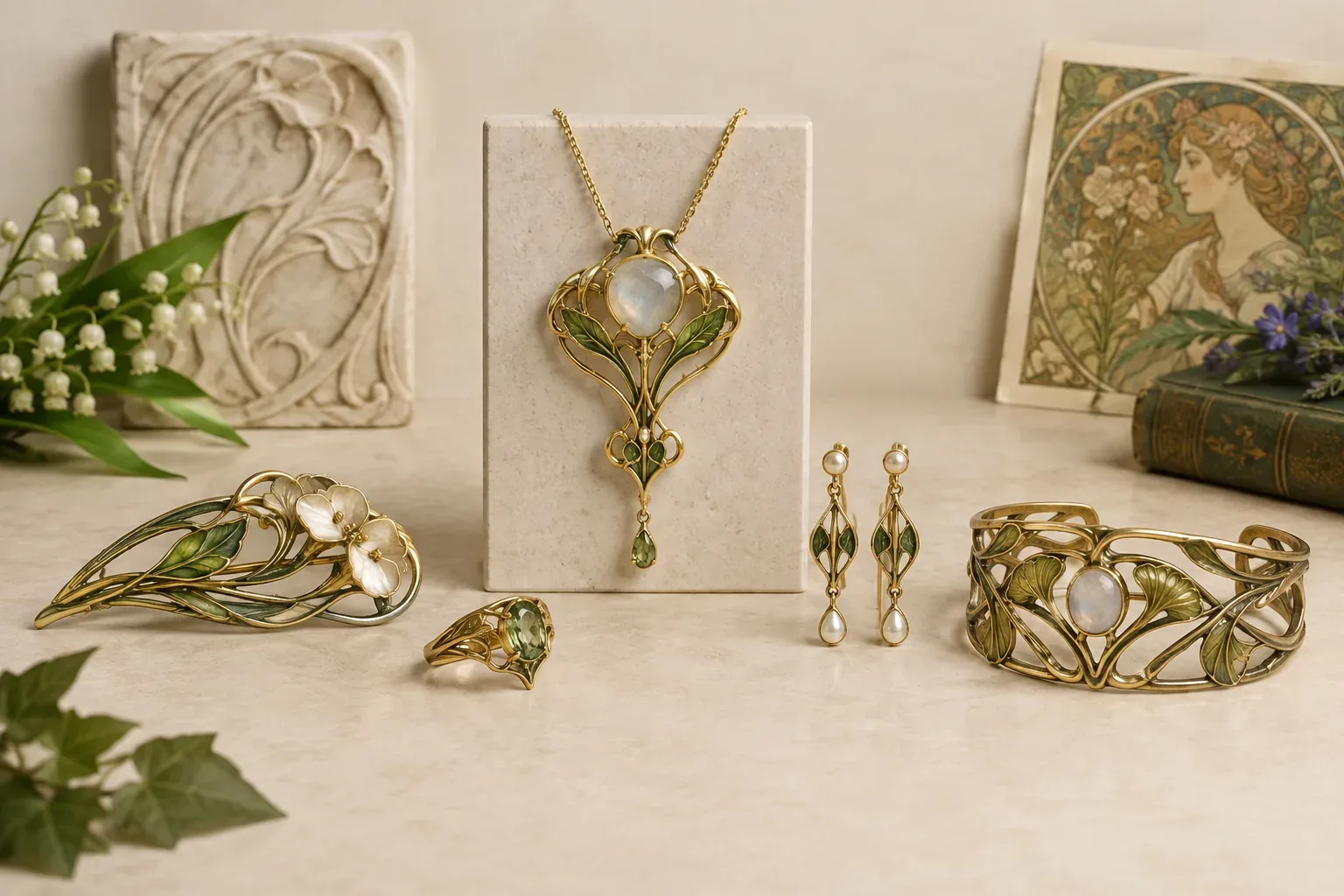
Motifs in Art Nouveau jewellery commonly translate onto the object as flowing lines, asymmetrical compositions, and detailed natural imagery. Makers used metalwork and surface techniques to emphasise line and colour; motifs show up as pendants, brooches, rings and necklaces that foreground silhouette and movement rather than rigid symmetry.
Gemstones and coloured materials were selected to support the motif’s visual effect. The Victoria and Albert Museum’s resources on gemstones explain that makers historically chose stones for colour, optical properties and how they complemented enamel and metalwork. In practice, gem choices in Art Nouveau pieces emphasised tonal harmony and visual effect rather than a codified gemstone symbolism: translucency, iridescence or soft colour were prized for their ability to suggest living forms and atmospheric moods.
Techniques and materials to recognise
Period and workshop techniques influenced how motifs were rendered. Enamel and detailed metalwork were often used to create colour and line; inlaid gems, cabochons and subtle use of coloured stones reinforced the organic look. The V&A’s coverage of jewellery history shows that changes in manufacturing and a renewed interest in handcraft affected materials and finish as well as motif selection.
If you are examining objects or shopping for pieces described as Art Nouveau, look for craftsmanship that emphasises line and colour integration, and be aware that modern reproductions may use contemporary methods or simulated materials to achieve a similar effect.
Practical guidance for choosing or gifting Art Nouveau motifs today
Decide what you want the piece to mean. If your priority is historical authenticity, seek documented provenance and museum-quality descriptions. If you want the motif for personal or aesthetic reasons, clarify whether you prefer an original period piece, a well-made vintage item, or a contemporary design that references Art Nouveau themes.
Ask sellers about materials and treatments. The Federal Trade Commission’s guidance on buying gemstones and pearls stresses the importance of disclosure for treatments, imitations and origin. Request written information about any enhancements, and if buying a high-value stone ask for independent grading or certification.
Respect cultural context and personal meaning. Art Nouveau motifs are not sacred symbols with universal meanings; they are historical design languages with variable interpretation. When gifting, consider how the recipient relates to the motifs—whether as art-historical interest, personal symbolism, or fashion preference—and choose materials and settings that match their lifestyle and values.
Condition and wearability matter. Period pieces may require professional conservation before wear. If you prefer wearable jewellery, contemporary makers often replicate Art Nouveau lines with durable modern alloys and settings that are safer for daily wear.
Budget and ethics: clarify whether you are buying an original or a reproduction. Originals command higher prices and often a need for conservation; contemporary pieces may offer ethical sourcing and easier maintenance. For gemstones, insist on transparency about treatments and origin as recommended by the FTC guidance.
Caring for Art Nouveau and Art Nouveau–style jewellery
Handle period pieces sparingly and consult professional conservators if the item is fragile. For modern pieces that reference Art Nouveau, follow standard jewellery care for the metals and stones used, and ask the maker about specific cleaning and maintenance instructions.
When in doubt, defer to specialist advice. Museums and qualified conservators can advise on safe cleaning and storage for antique materials and fragile enamels. The V&A’s work on jewellery history underlines the importance of understanding materials and techniques when deciding how to conserve or display objects.
Frequently asked questions
Were Art Nouveau motifs intended to carry specific symbolic meanings?
Museum research indicates that many Art Nouveau motifs were chosen primarily for aesthetic and cultural reasons—to express naturalism, movement and a modern visual language—rather than as part of a single, codified symbolic system. Later interpreters and contemporary wearers have often layered personal or spiritual meanings onto those motifs.
What gemstones were used in Art Nouveau jewellery and why?
Historical practice favoured stones chosen for colour and visual effect that complemented enamel and metalwork. The Victoria and Albert Museum’s resources on gemstones explain that makers selected stones for their colour, translucency and how they supported the overall design rather than following a universal symbolic gemstone code.
How can I verify whether an Art Nouveau piece is authentic?
Provenance, maker’s marks, documented exhibition or catalogue inclusion, and specialist appraisal help establish authenticity. For any high-value purchase, request detailed condition reports and documentation; if gemstones are involved, ask sellers to disclose treatments or provide independent certificates as the Federal Trade Commission advises.
Are modern pieces with Art Nouveau motifs acceptable gifts?
Yes—contemporary jewellery that references Art Nouveau can be an excellent, wearable choice. Clarify whether the recipient prefers authentic antiques or modern reinterpretations, and consider materials, durability and the personal meaning the motif will hold for them.
What should I ask a seller about treatments and imitations?
Ask whether any stones have been heat-treated, dyed, irradiated, fracture-filled or are synthetic or assembled. The Federal Trade Commission recommends that sellers disclose treatments and imitations, so request written disclosure and, for valuable stones, independent verification.
Sources and further reading
- Bedazzled: A History of Jewellery — Victoria and Albert Museum
- An A-Z of Gemstones — Victoria and Albert Museum
- Buying Gemstones, Diamonds, and Pearls — Federal Trade Commission