Meaning at a glance
This article explains the documented history and changing contexts of Art Nouveau jewelry techniques, separates cultural or religious evidence from later popular interpretations, and offers practical guidance for choosing and wearing Art Nouveau–style pieces today.
Quick answer
Art Nouveau jewelry techniques combine identifiable craft methods—particularly flowing, nature-inspired forms, enamelling (including translucent plique-à-jour styles), mixed-metal work, and inlays of glass and gemstones—with trade patterns that shifted jewellery from bespoke ateliers toward wider production and display. The Victoria and Albert Museum presents this style within the late nineteenth and early twentieth century jewellery context and documents how makers and consumers changed their approach to materials and design. Modern symbolic readings of Art Nouveau motifs are personal and varied; they are not universal and should be kept separate from the historical record.
Historical evidence and precise contexts
When discussing Art Nouveau jewellery techniques, it helps to separate the craft from later storytelling. The Victoria and Albert Museum situates Art Nouveau within the broader sweep of jewellery history and changing social contexts, describing how designers reacted against industrial mass production and embraced organic lines, new enamelling methods, and a wider palette of materials. The V&A places these developments in the late nineteenth and early twentieth centuries and links them to changes in taste, display, and consumer access to jewellery.
Art Nouveau was a transnational movement rather than a single regional tradition. Makers in France, Belgium, Britain, Austria, and beyond shared aesthetic tendencies while using local craftsmen and materials. The V&A’s account of jewellery history emphasizes this diversity: motifs and techniques circulated through exhibitions, catalogue trade networks, and the international market, producing regional variations rather than a single, uniform style.
Evidence for techniques and trade practices comes from museum collections, exhibition records, and maker archives that the V&A and similar institutions document. These records show which methods—such as enamelling and the inventive use of semi-precious gems and glass—were technically favored by certain workshops, and how trade and display changed the way people bought and wore jewellery in that period.
Documented historical meanings versus modern personal interpretations
The historical record, as surveyed by the Victoria and Albert Museum, links many Art Nouveau design choices to aesthetic responses to industrialization, an interest in natural forms, and the desire for new craft processes. Museums document how motifs—flowers, sinuous female figures, insects, and flowing vegetal patterns—functioned as stylistic language rather than as fixed religious or cultural symbols. In other words, historical documentation supports reading these elements as part of a design vocabulary rather than as carrying a single, universal meaning.
Modern readers often layer personal, romantic, or spiritual interpretations onto Art Nouveau motifs. These later interpretations are valid as private or contemporary meanings, but they are distinct from what the historical record shows. Where the V&A records the social and craft context of a technique or motif, that is evidence of historical practice. Personal attributions—such as assigning a single, universal symbolism to a motif across cultures or time—are contemporary interpretations and should be described as such.
When researching or presenting Art Nouveau jewellery, cite museum documentation for historical claims and label modern symbolic readings clearly as contemporary or personal. This approach respects both the documented provenance of objects and the legitimate modern desire to invest jewellery with personal significance.
How motifs, gemstones, and traditions appear in jewellery
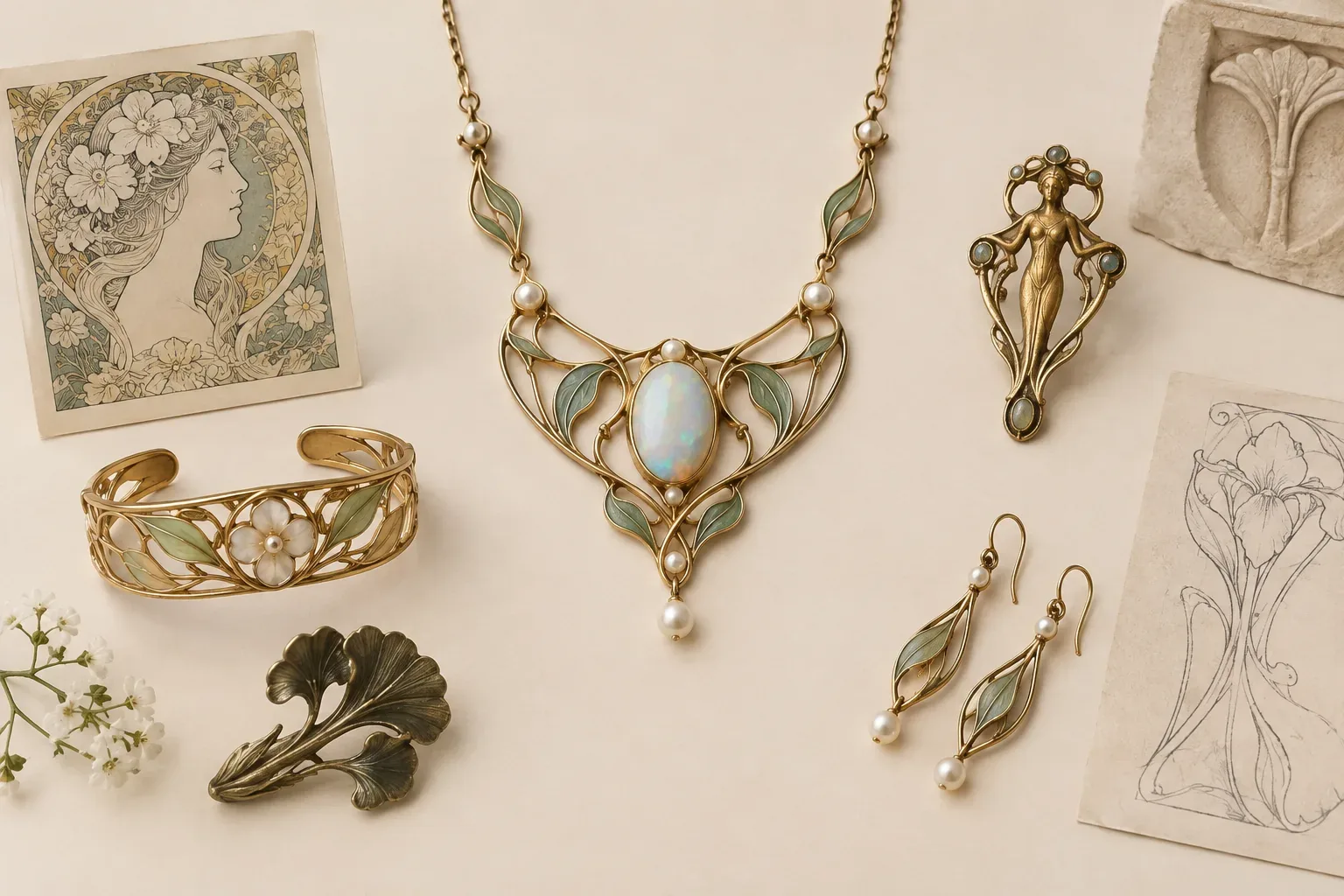
Museums such as the Victoria and Albert Museum explain how Art Nouveau makers translated motifs and materials into wearable objects. Motifs appear in the overall silhouette and in surface details: pendants, brooches, and hair ornaments often use asymmetrical, flowing outlines that echo plant stems or hair, while finer lines and enamel work describe leaves and petals within those shapes.
Enamelling is a recurring technical feature in Art Nouveau pieces. The V&A’s discussions of jewellery history describe translucent and opaque enamel techniques used to create luminous color fields and delicate shading. Plique-à-jour, a method that leaves small enamel cells without a backing so light can shine through, appears in museum-recorded examples and contributes to the style’s jewel-like luminosity.
Gemstones in Art Nouveau work are frequently chosen for color, texture, and optical effect rather than strictly for carat weight or conventional preciousness. The V&A’s A–Z of Gemstones provides context on the historical use of a wide range of stones, including semi-precious varieties and pearls, emphasizing how makers selected materials for their surface qualities and how treatments or cabochon cuts supported organic, tactile designs.
Mixed materials such as glass, niello, and varied metals are documented in museum records as part of the period’s experimental approach. These materials allowed designers to achieve contrasts of color and finish, and they appear in objects conserved and described by the V&A and similar collections.
Practical guidance for choosing, wearing, and gifting Art Nouveau jewellery
Decide first whether you want an original period piece, a documented vintage example, or a modern piece made in the Art Nouveau style. Museum provenance and maker marks help verify originals; reliable dealers and auction catalogues often provide the documentation that museums use for attribution. If a piece is offered as historic, request provenance and condition reports before purchasing.
Examine materials and treatments. The Federal Trade Commission’s guidance on buying gemstones, diamonds, and pearls emphasizes the importance of disclosure for treatments and imitations. Ask sellers to confirm whether stones have been heat-treated, dyed, assembled, or are simulated, and request written disclosure. For pieces described as having enamel or glass elements, inspect closely for condition issues such as losses, hairline cracks, or losses of attachment.
Consider wearability and care. Many Art Nouveau items use delicate enamels, thin wires, or fragile inlays that require careful wear and storage. If you plan to wear a late nineteenth or early twentieth century original, accept that some objects are best reserved for occasional wear or display; modern reproductions are likely more robust for everyday use.
On meaning and gifting, be explicit about your intentions. If you choose an Art Nouveau motif for a gift because of a modern interpretation—such as personal symbolism attached to a flower or female figure—explain that interpretation to the recipient. If you want to emphasize historical authenticity rather than symbolic meaning, include documentation or a short note describing the period and technique, citing museum references for context.
When buying gemstones and vintage jewellery online or from auction houses, request condition photographs and written disclosures. The FTC guidance recommends that buyers seek independent appraisals when value or treatment history is unclear, and that sellers disclose known treatments and any restoration work. For high-value purchases, professional conservation advice is sensible if you intend to display or wear the piece regularly.
Frequently asked questions
What are the most characteristic techniques of Art Nouveau jewellery?
Museum documentation identifies flowing, nature-inspired design, enamel work (including translucent effects), mixed metals, and the use of glass and semi-precious stones as characteristic techniques of Art Nouveau. These features appear across regional variations rather than as a single uniform technique.
How can I tell if an Art Nouveau piece is authentic or a modern reproduction?
Ask for provenance, maker marks, and condition reports. Museums and auction houses commonly use documentary evidence to attribute pieces; if a seller cannot provide provenance or detailed photographs, consider obtaining an independent appraisal before purchase.
Are certain gemstones more historically appropriate for Art Nouveau pieces?
Historical practice favored stones for color and surface quality as well as traditional gems. The Victoria and Albert Museum’s A–Z of Gemstones explains how semi-precious varieties, pearls, and certain cuts were chosen for visual effect, so consider stones that suit the design rather than assuming only high-carat gems are appropriate.
Should I expect modern sellers to disclose treatments and imitations?
Yes. The Federal Trade Commission advises buyers that sellers should disclose treatments, enhancements, and imitations. When in doubt, request written disclosure and consider an independent laboratory report for valuable items.
How should I care for delicate enamel or mixed-material Art Nouveau pieces?
Delicate enamels and thin metalwork benefit from gentle handling and storage away from extremes of temperature and humidity. For significant or fragile items, consult a professional conservator for specific advice rather than attempting aggressive cleaning at home.
Can I gift a piece with symbolic meaning tied to Art Nouveau motifs?
Yes. If the symbolic meaning is a modern or personal interpretation, explain that context when you give the gift. If you prefer to emphasize historical authenticity, accompany the piece with documentation or a short note outlining the design period and technique.
Sources and further reading
- Bedazzled: A History of Jewellery — Victoria and Albert Museum
- An A-Z of Gemstones — Victoria and Albert Museum
- Buying Gemstones, Diamonds, and Pearls — Federal Trade Commission