Meaning at a glance
Documented Ottoman attributions rely on workshop techniques, provenance, and official insignia; the same motifs are often re-used or reinterpreted in later or non-Ottoman work. Use materials, manufacture details, hallmarking and provenance to date pieces, ask sellers about treatments, and choose gifts with respect for cultural context and clear expectations.
Quick answer
Ottoman jewelry identification is best understood as an attribution built from a combination of motifs (for example tughras and certain court emblems), specific manufacturing techniques and materials, and documented provenance. Museum research shows that meanings and uses of motifs changed over time, and modern listings often apply the label “Ottoman” loosely. To identify, date, or buy with confidence, examine construction and materials, request provenance or condition reports, and ask about gemstone treatments from the seller.
What historians mean by 'Ottoman' in jewelry attributions
When curators and cataloguers use the word "Ottoman" they are referring to objects produced within the political and cultural sphere associated with the Ottoman courts and communities, not to a single uniform style. The Victoria and Albert Museum emphasizes that jewellery must be read in changing social and historical contexts; production could range from imperial workshops to provincial studios and local artisans, and design habits shifted across time and place. Using the term without further specification — for example "imperial court workshop" versus "19th-century provincial workshop" — is imprecise and can be misleading.
Motifs and their documented meanings versus later or modern interpretations
Some motifs have documentary links to specific Ottoman functions or tastes. The tughra (a stylized sultanic monogram) appears in archival and state contexts as an official signature; when it appears on a piece it is often an indicator of an association with court patronage or a commemorative object rather than a generic decorative motif. Museum catalogues and exhibitions use these links to anchor attributions to imperial contexts.
Other popular motifs — tulips, stylized palmettes and arabesque floral scrolls, the crescent and star, and calligraphic phrases — carry a range of historical meanings in different places and periods. Museums document the use of floral and vegetal ornament in Ottoman decorative arts, but the symbolic content is not always fixed. For instance, the tulip motif appears in courtly art of the 18th century in particular fashions, yet in modern jewellery the tulip is often read simply as a flower motif associated with 'Ottoman style' rather than a time-specific emblem.
Separately, amuletic elements such as the nazar (protective eye) were used across the region in many communities. While modern wearers may adopt such motifs as personal or spiritual talismans, museum evidence distinguishes folkloric and devotional uses from courtly display. In short, documented historical meanings derive from archival, religious or court contexts; popular meanings today can layer private or commercial interpretations on top of those histories.
How motifs, gemstones, and techniques appear in the work
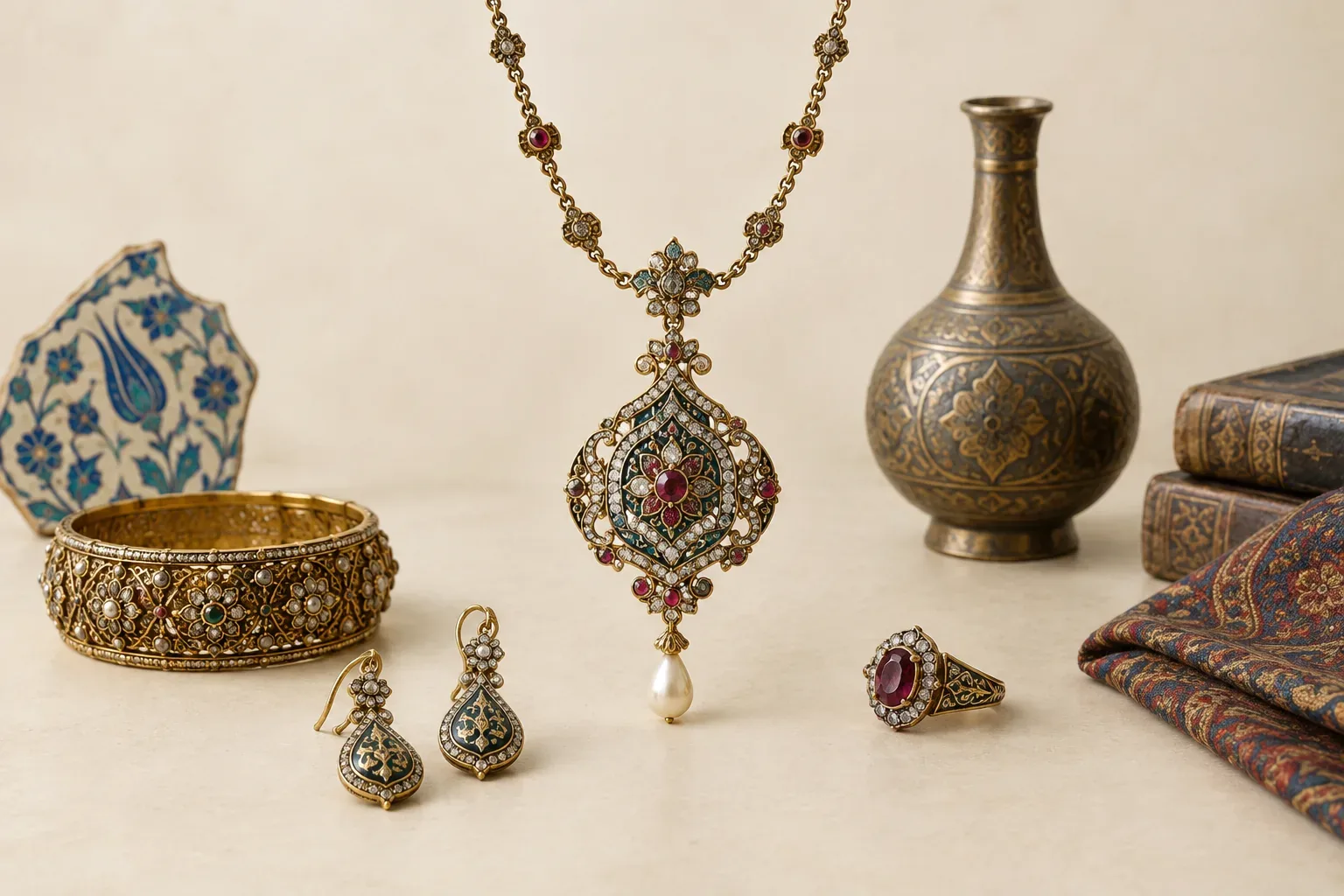
Motifs: Designers placed insignia and decorative motifs where they read clearly at scale. Tughras and inscriptions were commonly rendered in flat cartouches, on pendants or interior surfaces where legibility and association mattered. Floral and arabesque ornament appears in openwork panels, engraved surfaces and enamel fields. Crescent-and-star devices appear as applied forms, stamps or cutout silhouettes.
Gemstones: Historically used gemstones appear in settings appropriate to period practice. Museum collections and gemstone surveys show that pieces attributed to Ottoman contexts use cabochon and faceted stones set in bezels, closed-back settings, or in pavé and cluster arrangements. Gemstone choice often followed trade connections and local preference; the technical finish and mounting style help specialists attribute a piece to a time and place. The Victoria and Albert Museum's guidance on gemstones explains how cutting, polishing and setting methods change over time and affect appearance.
Techniques and materials: Filigree, granulation, repoussé, cloisonné or painted enamel, and controlled alloys of gold and silver are recurring technical markers. The way soldering is executed, edge finishing, and the presence or absence of modern machine marks helps separate older hand-made pieces from modern reproductions. Exhibition interpretation from the Victoria and Albert Museum underlines the value of technical and contextual evidence for attribution.
Dating a piece and common mislabels in the market
Marketplace descriptions frequently use 'Ottoman' as a catchall for a wide geographic and temporal span. Accurate dating requires combining stylistic clues with technical examination and provenance. Look for hallmarks or inscriptions that can be traced, consistent signs of age such as wear patterns on high points, and evidence of historical mounting techniques rather than modern machine-sawn settings. Provenance documentation, old photographs, or prior cataloguing add weight to an attribution.
Common mislabels include applying the Ottoman label to later 19th–20th-century revival pieces or to items made in neighboring regions that share visual vocabulary. Reproductions made for the tourist market or contemporary pieces made in historicizing styles can be confused with authentic historic work. Because the Victoria and Albert Museum stresses how jewellery's meanings and functions change, attributions that do not consider context and production methods should be treated cautiously.
Gemstone treatments, imitations, and buyer protections
Gemstones in historic and modern jewellery can be treated, dyed, heat‑altered, assembled or imitated. The Federal Trade Commission provides consumer guidance: sellers should disclose significant treatments, imitations, or enhancements that affect value. When identifying or purchasing a piece, request written statements about whether the seller or lab has tested gemstones, what tests were used, and whether any treatments were disclosed. For valuable purchases consider independent gemological reports that name treatments and note whether stones are natural, synthetic or assembled.
Practical and respectful guidance for selecting or gifting Ottoman-attributed jewellery
Choose with clarity about provenance and purpose. If you want a historical object, prioritize pieces with clear provenance, condition reports and conservative attributions from recognized dealers, auction houses or museum sales catalogues. If your interest is stylistic — a contemporary piece inspired by Ottoman motifs — accept that the item is a modern interpretation and select a maker whose work you trust.
Respect cultural context when gifting. A museum-informed approach is to present a piece with an honest note about its origin and what is known or unknown about it. If the motif has religious meaning to the recipient, be attentive to that context. The internal guide "How to Choose Meaningful Jewelry: A Practical Gift Guide" offers further practical pointers for choosing items that honour both wearer and history.
Practical purchase checklist. Request photographs of all surfaces and closures, ask for lab reports on gemstones, inquire explicitly about treatments and visible restoration, and check for consistent manufacturing techniques. For high-value items obtain an independent appraisal. If the seller claims museum or archival provenance, ask for documentation.
When to consult specialists
If an attribution affects price or your personal attachment, seek a specialist opinion. Curators, qualified appraisers and academic catalogues use combinations of archival research, technical analysis and comparative study to reach conclusions. The Victoria and Albert Museum's public resources and exhibitions are useful starting points to understand changing meanings and production contexts in jewellery history. For gemstone-specific questions, a qualified gemological laboratory can test for treatments, synthetics or assembled stones and provide written reports.
Final note
Attribution is an exercise in weighing evidence. Motifs that look "Ottoman" in the marketplace may be historic, revived, or invented. Use technical details, provenance and reputable reports to separate documented history from attractive modern interpretation, and choose or gift with transparency and cultural respect.
Frequently asked questions
How can I tell if a piece is genuinely Ottoman?
Genuine attributions combine stylistic analysis, technical markers (soldering, setting types, enamelling), hallmarks or inscriptions, and documented provenance. Ask the seller for condition reports and provenance, request high-resolution images of all surfaces, and seek a specialist appraisal for high-value objects. Museum resources emphasize that context and production methods are crucial to reliable attribution.
Does the tulip motif always mean a piece is Ottoman?
No. The tulip motif appears in specific Ottoman fashions historically, but it is also widespread and has been revived many times. Museums caution that a single motif is not definitive; dating and attribution require looking at technique, materials and provenance as well as design.
Are gemstones in these pieces likely to be treated or imitated?
Gemstone treatments and imitations occur in both historic and modern jewellery. The Federal Trade Commission recommends that sellers disclose significant treatments and imitations. For certainty, obtain gemological testing that identifies whether stones are natural, synthetic, treated or assembled.
Is it respectful to wear Ottoman-style motifs if I am not from the culture?
Wearing motifs inspired by Ottoman art can be respectful if done with awareness. Be honest about whether an item is historic or a contemporary interpretation, avoid claiming cultural ownership you cannot document, and consider the personal or religious meaning of specific symbols to the wearer.
Where should I go for a reliable appraisal or identification?
Consult qualified appraisers, museum curators with relevant regional expertise, or independent gemological laboratories for gemstone testing. Start with reputable auction-house departments or museum contacts and ask for written reports that document methods and findings.
Sources and further reading
- Bedazzled: A History of Jewellery — Victoria and Albert Museum
- An A-Z of Gemstones — Victoria and Albert Museum
- Buying Gemstones, Diamonds, and Pearls — Federal Trade Commission