Meaning at a glance
This article explains the documented history and changing contexts of Viking‑Age Scandinavian jewelry, separates archaeological and museum-supported evidence from later popular meanings, describes how common motifs and materials appear in objects, and gives practical guidance for selecting and wearing these styles respectfully today.
What the historical evidence shows (and how we know it)
Our understanding of Viking‑Age Scandinavian jewelry comes from archaeological finds interpreted in the context of broader histories of jewellery and material culture. Museum scholarship, such as overviews published by the Victoria and Albert Museum, frames jewelry across eras as makers' responses to technology, trade, fashion, and social structure rather than as fixed, universal symbols. The V&A emphasizes that jewellery objects change meaning over time and across contexts, which is a useful interpretive principle when reading finds from the Viking Age.
From that museum perspective, artifacts from the early medieval North are best read as evidence of material choice (what metals and gems were used), social practice (who wore what and when), and connectivity (how objects travelled through trade, plunder, or gift). The precise attribution of individual symbolic meanings—religious, magical, or clan‑based—often depends on contextual evidence such as burial assemblages, hoards, and written sources, and museums caution against projecting later or romanticized meanings onto objects without supporting documentation.
Which cultures and periods are we discussing?
When I refer to the Viking Age in this article I mean the north‑European early medieval contexts commonly dated in archaeology to roughly the late 8th through the 11th centuries, centered in what is now Scandinavia and including Norse communities that traded and settled across the North Atlantic and parts of Europe. These communities produced a wide range of personal adornment that changed over the course of that period and across regions.
It matters to separate Viking‑Age Scandinavian practices from later medieval or modern Scandinavian traditions. Museum histories make the same point about jewellery studies in general: an object's form and social role can shift significantly between periods. Treat late medieval, post‑Reformation, or 19th‑century revival jewelry as distinct traditions unless a direct lineage is documented.
Materials and techniques documented in general jewellery history
Museum surveys of jewellery history show recurring materials and workshop techniques that are relevant for interpreting Viking‑Age pieces. Metals such as gold, silver, and bronze were common choices in pre‑modern Europe because they could be worked, repaired, and recycled; the relative use of each often reflected access to resources and social rank. The V&A's overview of jewellery history highlights how societies used metalwork to display wealth and to craft durable, wearable forms.
Gemstones, amber, and glass were used for colour and trade value. The Victoria and Albert Museum's A–Z of Gemstones provides context for how different stones were valued and perceived in historic settings. For Viking‑Age Scandinavia specifically, amber and coloured beads feature prominently in many archaeological assemblages across northern Europe, while metalwork techniques such as casting, hammering, and granulation appear across the region. The V&A's resources remind us that gemstones and beads often arrived through trade networks and were incorporated into local styles.
Status, identity, and daily wear: what the evidence supports
Museum-based histories present jewellery as multifunctional: it could be money‑like portable wealth, an everyday part of dress, a marker of social rank, or an object used in ceremonial contexts. Applied to Viking‑Age Scandinavia, the documented pattern is that certain types of adornment signalled access to resources and networks—ornate metalwork and imported stones tended to indicate higher status—while simpler items fulfilled everyday decorative or practical needs.
Archaeology shows jewellery in graves, hoards, and settlement contexts, which indicates both everyday use and deliberate deposition. The V&A emphasizes that such contexts must be read carefully: a richly furnished grave does not automatically tell us the living patterns of daily dress, and objects in hoards may reflect economic behavior such as savings, offerings, or the deliberate removal of valuables in times of crisis.
Documented meanings versus modern interpretations
There is a clear distinction between meanings that are documented by archaeological or historical evidence and meanings that are modern reinterpretations. Museums like the V&A caution researchers and the public to avoid assuming a single, timeless symbolic meaning for motifs or gemstones. Documentary evidence—inscriptions, contemporary texts, or secure archaeological context—can support specific historical meanings, but such evidence is often incomplete for the Viking Age.
By contrast, modern popular culture, contemporary spirituality, and commercial narratives frequently layer new meanings onto Viking‑style motifs. These modern interpretations can be meaningful to wearers today but are not the same as documented historical usage. Treat modern readings as contemporary personal or cultural choices rather than as direct continuations of Viking beliefs unless you can point to strong supporting evidence.
How motifs, gemstones, and traditions appear in Viking‑Age jewelry
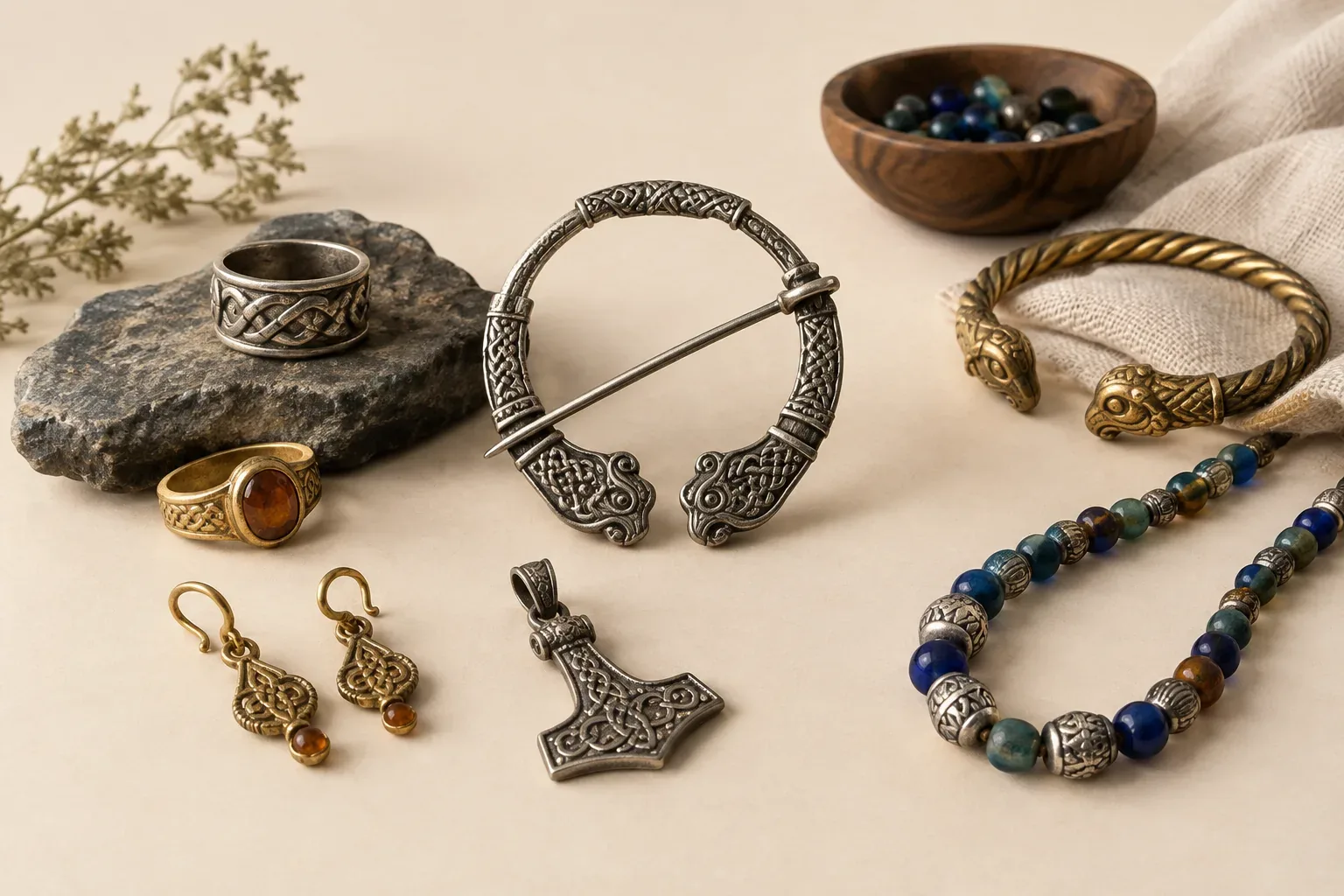
Motifs and forms appear in physical jewellery as worked metal shapes, inlays, bead strung necklaces, and applied ornament. The general historiography of jewellery shows common formal adaptations: pendants, brooches, arm rings, beads, and finger rings are ways people configured materials for wear. The V&A's history explains that the same functional categories—pendants and brooches, for example—recurs across cultures with local stylistic differences.
Gemstones and glass beads appear as settings, stringings, or inlays to provide colour and perceived value. The V&A's A–Z of Gemstones explains how certain stones were traded and how their qualities—colour, hardness, transparency—affected their use. In Viking‑Age contexts, locally available amber and imported glass and semi‑precious stones were worked into necklaces and applied to metal mounts, reflecting both taste and connection to broader trade networks.
Practical and respectful selection and gifting guidance
If you want to choose or gift modern jewelry inspired by the Viking Age, start by separating aesthetic preference from claims about historical authenticity or meaning. Decide whether you prioritize historical techniques and materials, a contemporary reinterpretation, or a symbolic meaning meaningful to the recipient today. Museum guidance on jewellery history encourages an informed approach: appreciate that modern pieces evoke a long, varied past rather than reproduce a single original.
When selecting materials, remember consumer‑protection guidance about gemstones and treatments. The U.S. Federal Trade Commission provides clear rules about disclosure of treatments and imitations; if a modern piece claims to use a particular stone or treatment, ask the seller for transparent information about origin, treatments, and whether any stones are lab‑created or dyed. This helps ensure you understand what you are buying and can communicate honestly when you gift it.
Respect living cultures and avoid merchandising that claims ownership of historic belief systems. If motifs are presented as sacred or religious, ask for evidence and consider whether the recipient would appreciate a purely aesthetic piece or one framed with modern personal meaning. For symbolic gifts, explain what the motif means to you today rather than asserting a single historical interpretation.
Wearing and caring for historically inspired pieces today
Wear historically inspired pieces in ways that suit modern life. Many reproduced motifs work well as necklaces, rings, or brooches integrated into contemporary outfits. Consider wight, fastening security, and the durability of materials if you expect daily wear; authentic techniques sometimes prioritized repairability over permanence, but modern consumers often prefer stable settings and secure clasps.
For care and provenance, examine sellers' descriptions for material specifics and treatment disclosures and follow recommended cleaning and storage for metals and stones. The V&A's general approach to jewellery emphasizes that understanding construction and material will guide appropriate care, while FTC guidance warns buyers to confirm claims about gemstones and treatments.
Final note on interpretation and respect
Viking‑Age Scandinavian jewelry history is best approached as a set of material practices embedded in particular historical and archaeological contexts. Museum scholarship encourages caution in claiming fixed meanings for motifs and stones, and consumer protection rules encourage transparency about materials today. Combining informed historical awareness with respectful personal meaning makes for thoughtful choices when wearing or gifting pieces inspired by this rich cultural past.
Frequently asked questions
What materials were commonly used in Viking‑Age Scandinavian jewelry?
Archaeological and museum scholarship indicates metals such as gold, silver, and bronze, along with substances like amber, glass beads, and imported stones, were used. The Victoria and Albert Museum's histories of jewellery highlight how these materials were chosen for workability, colour, and trade value.
Did Viking jewelry always have a religious meaning?
No. Museums caution that jewellery served many roles—practical, social, economical, and occasionally ritual. Specific religious meanings require independent evidence such as inscriptions or contextual information; absent that, assigning a singular sacred meaning is speculative.
How can I tell if a modern 'Viking' piece is authentic or accurately reproduced?
Ask the seller for clear information about materials, treatments, and whether objects are reproductions, modern designs, or genuine period artifacts. The FTC recommends disclosure of treatments, imitations, and origins for gemstones and metals to help buyers make informed choices.
Is it respectful to wear jewelry inspired by the Viking Age?
Yes, when done thoughtfully. Choose pieces with honest descriptions, avoid claiming antiquity or sacred meaning without evidence, and consider the recipient's feelings and cultural context when gifting such items.
How should I care for historically inspired metalwork and stones?
Care depends on material: follow seller or conservator guidance for cleaning and storage. Understanding the construction and material composition—information museums advise you to seek—will guide appropriate cleaning methods and storage to avoid damage.
Sources and further reading
- Bedazzled: A History of Jewellery — Victoria and Albert Museum
- An A-Z of Gemstones — Victoria and Albert Museum
- Buying Gemstones, Diamonds, and Pearls — Federal Trade Commission