Meaning at a glance
This ottoman jewelry buying guide explains the documented history and shifting contexts of Ottoman motifs and materials, separates museum-backed cultural evidence from modern interpretations, and offers practical, respectful advice for selecting and gifting revival pieces.
What historians and museums document about Ottoman jewellery
Surviving Ottoman jewellery and scholarly summaries collected by museums show that jewellery in the Ottoman world was diverse in form, technique, and social meaning. The Victoria and Albert Museum frames jewellery history as tied to changing social contexts, production techniques, and tastes, and uses museum holdings and historical sources to explain how jewels functioned as personal display, status signalling, and portable wealth rather than as a single symbolic language. Rely on that kind of museum-backed evidence when assessing historical claims about specific Ottoman pieces.
Distinguishing cultures and periods precisely
The term “Ottoman” covers a long imperial history across many regions and communities. Ottoman-period jewellery drew on Anatolian, Balkan, Levantine, Caucasian, and Central Asian workshops and customers. Treat references to “Ottoman” jewellery as shorthand: always look for precise attributions to a region, workshop, or century when a seller or label offers them. The Victoria and Albert Museum emphasises that jewellery forms and meanings shifted over time and across social groups, so provenance matters for understanding any historical association.
Documented historical uses versus later popular interpretations
Documented historical evidence supports a few consistent points: jewellery served as personal ornament, markers of status or family connection, and a store of value usable in times of need. Museums use surviving objects, inventories, and portraits to draw these conclusions. By contrast, many contemporary claims—such as a single motif always denoting a specific religious or talismanic meaning across the Ottoman world—are later popular interpretations without consistent documentary backing. Separate what is evidenced in museum catalogues and inventories from modern narratives used in marketing or popular culture, and treat broad symbolic claims as modern readings unless a reliable source is cited.
How motifs, gemstones, and techniques appear in Ottoman jewellery
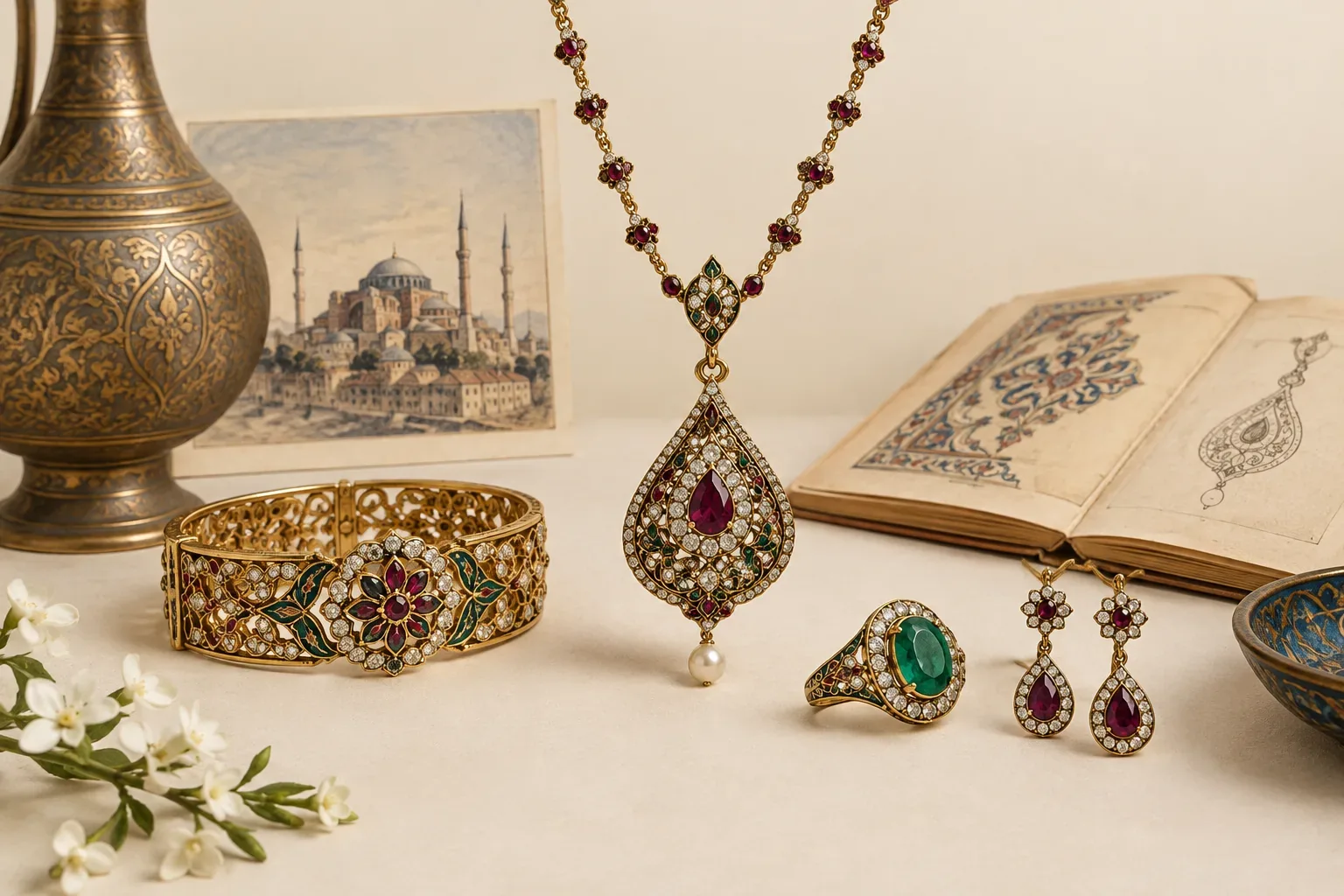
Common features found across Ottoman-period pieces include intricate metalwork, the use of enamel, engraved or chased decoration, and frequent setting of colored gemstones. The Victoria and Albert Museum’s guides to gemstones and jewellery history help identify the materials and techniques you will encounter when buying revival or antique pieces. Gemstones traditionally used in Ottoman jewellery include rubies, emeralds, sapphires, and various types of coloured glass and imitations in later tourist pieces; the material and how it was set or cut affect both appearance and value.
Reading a revival piece: what to check and what it might mean
Modern ‘Ottoman revival’ jewellery often borrows decorative motifs such as floral arabesques, tughra-like calligraphic shapes, or geometric forms that echo historical techniques without being direct copies of specific historical objects. When assessing a revival piece, ask the seller about the inspiration, whether any motifs are religious or cultural emblems, and whether the piece is an original antique, a reproduction, or a contemporary design inspired by Ottoman forms. If a seller links a motif to a sacred meaning, request documentary evidence or provenance rather than accepting broad claims at face value.
Material authenticity, treatments, and disclosure
Be aware that modern stones can be treated, imitated, or synthetic. The Federal Trade Commission provides consumer guidance on treatments and imitations and makes clear that sellers should disclose material treatments, enhancements, and whether a gemstone is synthetic or imitation. Ask for lab reports for valuable stones, request clear disclosure of metal fineness, and keep records of all seller statements to protect yourself if a later appraisal differs.
Practical, respectful selection and gifting guidance
Choose revival or antique Ottoman-style jewellery with attention to provenance, materials, and cultural sensitivity. If buying an antique, seek documented provenance and a condition report. If buying a contemporary piece inspired by Ottoman aesthetics, ask the maker how they researched and credited historical sources, and whether they worked with traditional techniques or makers from descendant communities. When gifting, avoid presenting items as sacred or culturally specific unless you understand the cultural or religious context and the recipient’s background. Acknowledge when a gift is inspired by history rather than claiming direct lineage to a particular community.
Caring for pieces and seeking expert help
Treat metals, enamels, and historic gemstones gently and consult a conservator or reputable jeweller experienced with historical pieces for repair and cleaning. For valuable gemstones, request lab verification rather than relying solely on seller descriptions. Museums’ conservation teams and the V&A’s publications outline the importance of appropriate care for historic materials; when in doubt, obtain a professional condition report before purchase or restorative work.
Ethical and legal considerations
Consider the ethical provenance of pieces, especially high-value antiques whose ownership histories may be incomplete. Sellers should disclose known provenance, and buyers should request documentation. When a piece originates from a region with complex histories of displacement or colonial-era collecting, fair and transparent disclosure helps buyers make informed, responsible choices. A respectful approach recognises that historical forms are part of living cultural heritages rather than neutral commodities.
Frequently asked questions
How can I tell if a piece is genuinely Ottoman-period or a modern revival?
Ask the seller for provenance documentation, condition reports, and clear photographs showing construction details. Museum-backed catalogues often describe identifiable marks, techniques, and materials; compare the piece to reliable museum examples and, when necessary, obtain an independent appraisal. Sellers should disclose whether a piece is antique, a period reproduction, or a contemporary design inspired by Ottoman forms.
Are specific Ottoman motifs always religious or talismanic?
No. Museums and historians caution that many motifs served decorative, social, or regional purposes rather than a single religious meaning. Treat claims that a motif universally signifies a particular belief as a modern interpretation unless a reliable historical source is cited. When in doubt, request documentary evidence or scholarly references.
What questions should I ask about gemstones and treatments?
Ask whether a gemstone is natural, synthetic, or imitation; whether it has been treated or enhanced; and whether the seller can provide a laboratory report for valuable stones. The Federal Trade Commission advises consumers to seek disclosure of treatments and imitations and to keep written records of seller statements for later verification.
Is it respectful to wear Ottoman-inspired jewellery if I am not from that culture?
Wearing historical or culturally inspired jewellery can be respectful if you acknowledge its origins, avoid presenting it as a sacred emblem without understanding the context, and choose pieces made or sold transparently. Seek makers who credit their sources and consider learning about the cultural history before wearing or gifting such items.
How should I care for antique Ottoman pieces?
Handle historic metalwork, enamels, and gemstones with care. Avoid DIY cleaning that could damage delicate finishes and seek a conservator or jeweller experienced with historic objects for advice. For significant purchases, obtain a condition report to understand existing repairs or vulnerabilities before any cleaning or restoration.
Sources and further reading
- Bedazzled: A History of Jewellery — Victoria and Albert Museum
- An A-Z of Gemstones — Victoria and Albert Museum
- Buying Gemstones, Diamonds, and Pearls — Federal Trade Commission