Meaning at a glance
Explain the documented history and changing contexts of the ottoman jewelry symbols motif, separate cultural or religious evidence from later popular interpretations, and give practical guidance for choosing and wearing the motif in modern jewelry.
Quick answer
Ottoman jewelry symbols carry meanings that changed across time, place, and community; museum scholarship shows many motifs began as decorative or courtly signs and later took on personal, national, or revivalist meanings. This article explains the documented historical evidence, distinguishes what museums and gem specialists have recorded from later interpretations, describes how motifs and gemstones are made into jewelry, and offers respectful, practical guidance for choosing and gifting pieces today.
What the historical evidence shows (and which cultures or periods it applies to)
Understanding symbols in Ottoman-period jewelry depends on context: who commissioned a piece, where it was made, and when. The Victoria and Albert Museum frames jewelry as materially and socially situated, showing that forms, materials, and motifs change meaning across centuries and social settings. Museum collections and cataloguing are primary ways scholars document those changes because surviving pieces record styles, techniques, and sometimes inscriptions or provenance.
When researchers describe "Ottoman" jewelry they generally refer to objects produced within the geographic and political sphere of the Ottoman state or in communities interacting with it. Styles and symbolic uses shifted between elite court workshops, provincial centers, and minority-community ateliers. The Victoria and Albert Museum's studies emphasize that what appears as a symbol in one context—an emblem worn at court, for example—may have been adopted elsewhere for decorative or social reasons.
Gemstone use and setting choices are also historically recorded. The museum's resources on gemstones explain how certain stones were prized in different eras for their color, hardness, or perceived rarity, and how cutting and setting techniques evolved. Surviving Ottoman pieces preserved in museum collections therefore provide direct material evidence, but museums also note limits to interpretation: a motif on a surviving object does not automatically tell us a single, universal meaning.
Documented historical meanings versus later or modern interpretations
Museum scholarship tends to separate functional and social uses from symbolic claims made later. Historic uses recorded by curators and historians include decorative representation of flora, geometric ornament, inscriptional identifiers, or courtly badges that signaled rank or patronage. The Victoria and Albert Museum highlights that changes in taste, trade, and technology shaped which motifs were fashionable and how they were read by contemporaries.
By contrast, many popular or modern interpretations—nationalist readings, spiritual attributions, or tourist-driven symbolism—have been layered onto Ottoman motifs long after the items were made. These contemporary readings are meaningful to wearers and collectors today, but they are modern meanings, not necessarily documented by the historical record in museum catalogues or archival sources.
A careful distinction matters when discussing any specific motif. For example, floral patterns in Ottoman jewelry were often part of a broader decorative vocabulary shared across workshops and regions, and while later commentators or modern owners may treat a flower as a personal emblem, museums cautions that such readings are not always supported by provenance or contemporaneous texts. Where inscriptions or well-documented provenance exist, they provide firmer evidence about intended meaning; absent that, museum practice is to describe the object and its documented context rather than assert universal symbolic interpretation.
How motifs, gemstones, and traditions appear in Ottoman jewelry
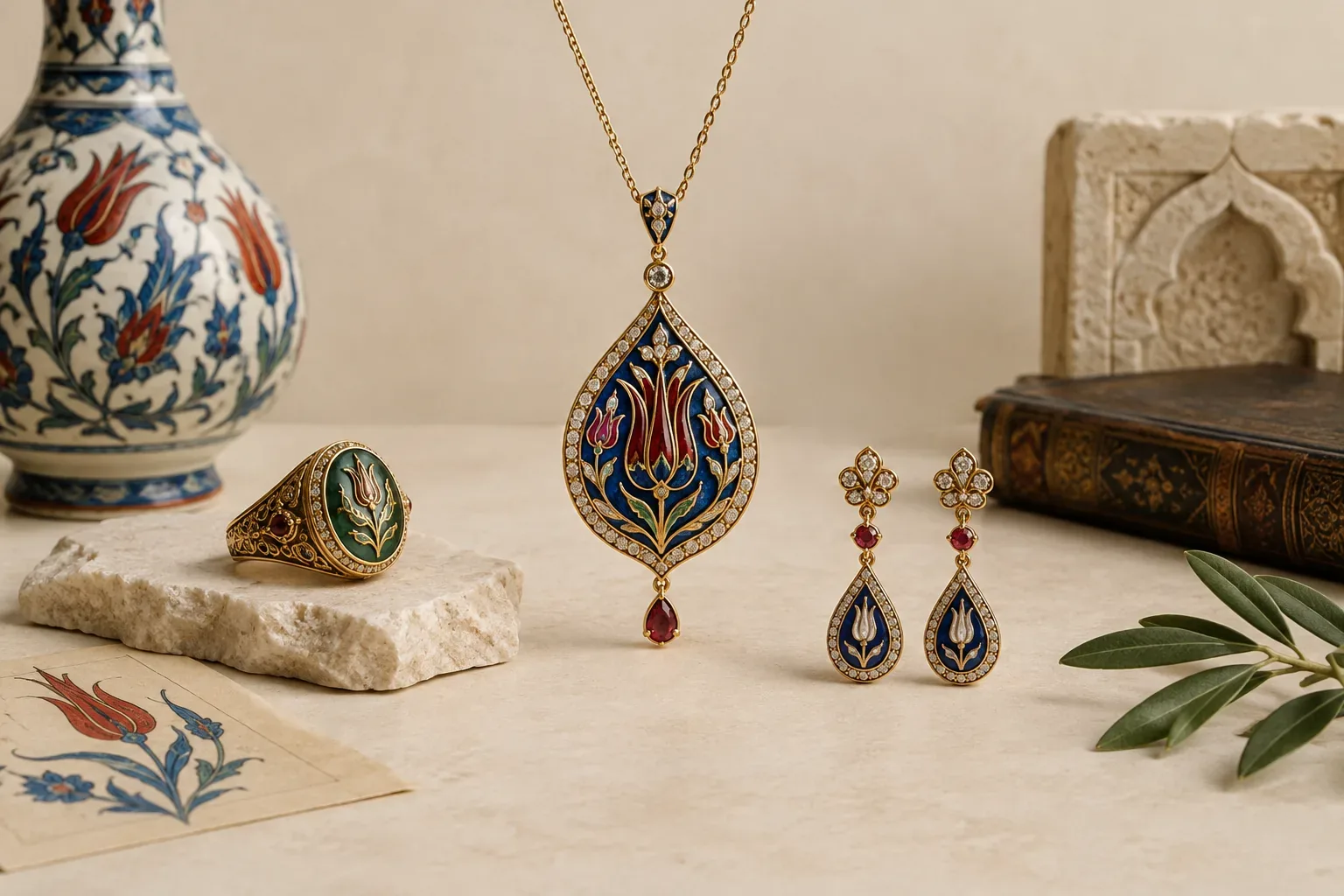
Ottoman-period jewelry appears in many techniques and materials that are recorded and demonstrated in museum collections. Common craft techniques include filigree work, granulation, inlay, enamel, and stone-setting in metal bezels. The Victoria and Albert Museum's exhibitions and catalogues illustrate how these techniques were used to make pendants, rings, bracelets, and other forms where motifs are reproduced in metalwork as engraving, openwork, or enamel panels.
Motifs show up in different ways: a repeated floral or geometric motif may be stamped or chased into a surface, a stylized form may be rendered in enamel on a pendant, and an inscriptional motif may appear as a calligraphic panel set into a signet or pendant. Gemstones and pearls often appear as focal points set into bezels or as rows of beads; the museum's A–Z of gemstones explains how choice of stone was influenced by local availability, trade links, and taste across time.
The physicality of surviving pieces matters for interpretation. Closed-back settings, the color and cut of stones, and signs of repair or re-setting all tell a story about how a piece was made, worn, and altered. The Victoria and Albert Museum’s approach is to combine close material study with documentary research to place motifs and materials in their production and social context rather than to assume a single symbolic meaning.
How modern makers and owners reuse Ottoman motifs
Contemporary jewelers and wearers often draw on Ottoman motifs for aesthetic, cultural, or personal reasons. Some designers revive historical forms and techniques as a way to reference craft traditions; others abstract motifs for new jewelry that speaks to heritage, identity, or fashion. Museums like the Victoria and Albert Museum document these continuities and revivals by showing how historical pieces influence modern design, while also noting how meanings can shift with new contexts.
Modern personal interpretations are legitimate as expressions of identity or taste, but they are not interchangeable with documented historical meanings. When a wearer chooses a motif because it 'represents' a specific belief or community today, that meaning is contemporary. Museum scholarship helps to trace the lineage of a motif so that wearers and gift-givers can make informed choices about whether they are prioritizing historical accuracy, contemporary symbolism, or simply aesthetic preference.
Practical and respectful guidance for choosing and gifting Ottoman-motif jewelry
Start with provenience and transparency. Ask the seller or maker about the piece’s history: is it an antique with museum-style provenance, a modern reproduction inspired by Ottoman forms, or an original piece altered or remade? The Victoria and Albert Museum’s curatorial practice underlines the importance of documented context for historical objects, and the Federal Trade Commission provides consumer guidance on disclosure of treatments and imitations when gemstones are involved.
Be mindful of cultural sensitivity. If the piece bears explicit religious text or symbols, learn whether it is appropriate to wear or gift in the intended setting. When in doubt, seek advice from knowledgeable community sources or reputable dealers who can explain the cultural or ritual associations. Remember that meanings assigned by modern wearers—heritage pride, fashion, or family memory—are valid, but that respectful use involves acknowledging the object’s origins and possible sacred associations.
Check materials and disclosures. If a gemstone or enamel is central to the piece, request information about treatments, synthetic substitutes, and repair history. The Federal Trade Commission’s consumer guidance explains that sellers should disclose treatments and imitations; insist on written confirmation where possible. For antique pieces, ask whether stones have been re-set or replaced, and whether the metal has been tested or repaired.
Consider condition and wearability. Antique pieces may require conservation, resizing, or mounting changes to be safe for regular wear. Consult a conservator or a jeweller experienced with historic pieces for advice, and note that altering a historically important object can reduce its historical value even while improving wearability.
Gift thoughtfully. When giving a piece that references Ottoman motifs to someone from a related cultural background, frame the gift with context—explain whether the piece is an original, a reproduction, or a modern interpretation—and respect the recipient’s preferences about public wear or display. If the recipient is not from that heritage, consider whether the object is being used in a way that could misrepresent living traditions; offering a modern designer piece that respectfully acknowledges its inspiration can be a considerate alternative.
Frequently asked questions
Are Ottoman jewelry symbols universally sacred or religious?
No. Museum scholarship cautions against assuming universal sacred meaning. Some elements on Ottoman-period jewelry are decorative or courtly identifiers, while others—such as inscriptions with religious texts—may have religious significance. The Victoria and Albert Museum emphasizes that context and documented provenance determine whether an element is ritual or decorative.
How can I tell if an Ottoman-style piece is an antique or a modern reproduction?
Ask the seller for provenance, conservation reports, or clear photographs of hallmarks and construction details. Museum curators rely on material study and documentary evidence to date pieces; for consumers, reputable dealers and certificates help, and the Federal Trade Commission recommends requesting disclosures about treatments, imitations, or restorations for gemstones and metals.
Is it respectful to wear jewelry with Ottoman motifs if I am not from a related background?
Wearing such jewelry can be respectful if you learn and acknowledge the object’s origins, avoid appropriating sacred symbols, and consider the wishes of communities related to the motif. If a piece bears explicit religious text or is a ritual object, seek guidance before wearing it publicly.
What should I ask about gemstone treatments when buying Ottoman or Ottoman-style jewelry?
Ask whether stones are natural, treated, or synthetic and whether any dyes, heating, or stabilization have been applied. The Federal Trade Commission recommends sellers disclose treatments and imitations; obtaining written confirmation is good practice, especially for higher-value stones.
Where can I find reliable information on a particular symbol found on a piece?
Begin with museum catalogues and scholarly resources that document comparable objects and their provenance, such as the Victoria and Albert Museum’s collections and articles. Our guide on how to research jewelry symbols also explains steps to trace motifs, inscriptions, and maker marks.
Sources and further reading
- Bedazzled: A History of Jewellery — Victoria and Albert Museum
- An A-Z of Gemstones — Victoria and Albert Museum
- Buying Gemstones, Diamonds, and Pearls — Federal Trade Commission