Meaning at a glance
This article explains the documented history and changing contexts of Ottoman jewelry techniques, separates cultural and religious evidence from later popular interpretations, and offers practical guidance for choosing and wearing Ottoman-inspired jewelry today.
What the historical record shows (and how we know it)
Museum collections and curated exhibitions provide the clearest documented evidence about Ottoman-period jewelry techniques, their materials, and how pieces changed over time. The Victoria and Albert Museum’s survey of jewellery history emphasizes that objects must be read in context: techniques, forms, and materials reflect trade connections, court fashions, local workshops, and social use rather than a single unchanging “style.”
From surviving examples and museum cataloguing, scholars and curators identify a range of metalworking practices and decorative treatments used across the Ottoman world. Because the Ottoman realm was large and diverse, the techniques and motifs recorded in museum collections vary by region and period; the V&A’s work highlights the shifting social meanings attached to jewellery as fashions and trade routes evolved.
Common techniques documented in collections
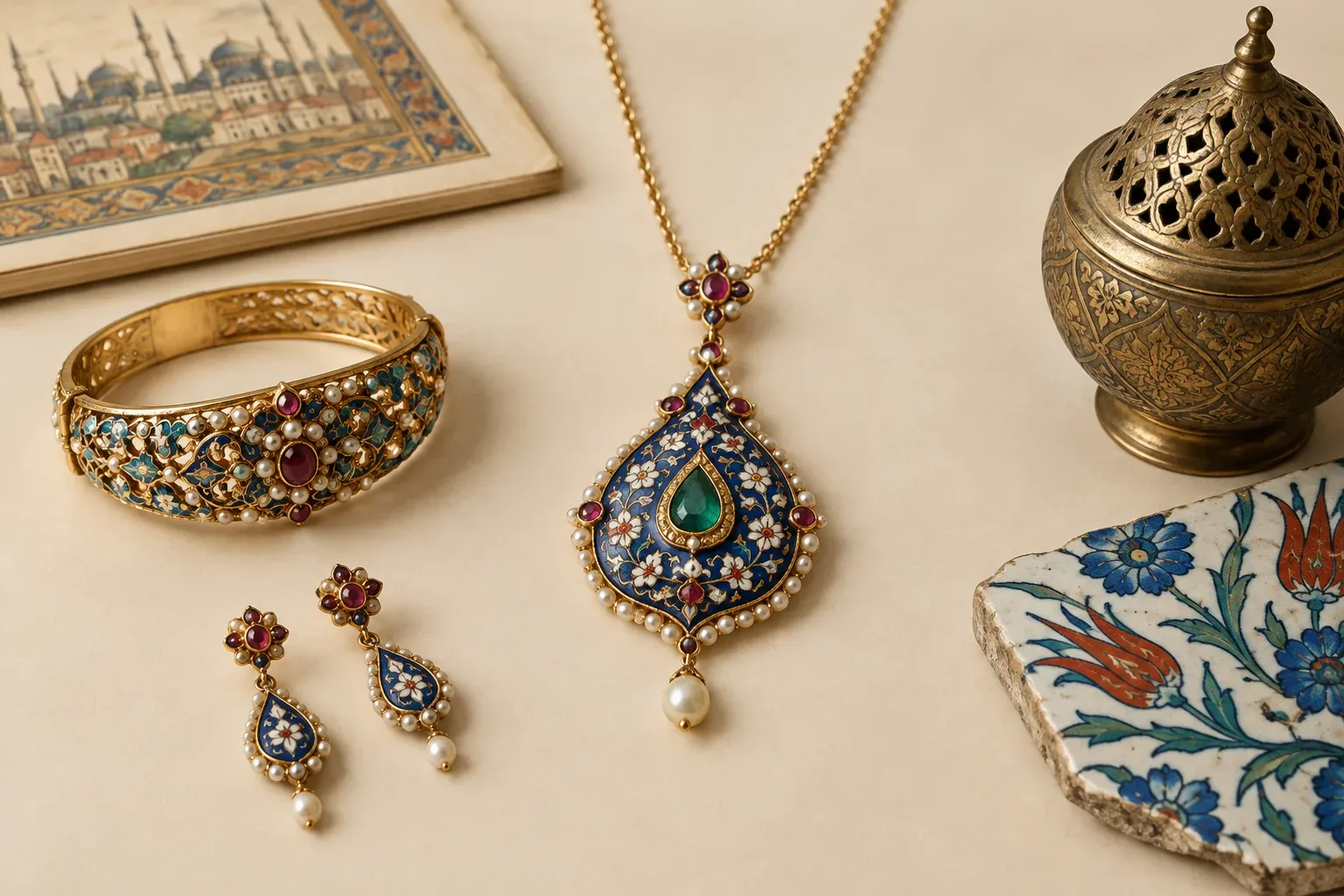
Historical objects preserved in museum collections show repeated use of fine metalworking practices such as delicate wirework, surface granulation, controlled soldering, and surface decoration with enamel and inlay. These techniques were applied to personal ornaments including earrings, rings, brooches, necklaces, and hair ornaments. Curators emphasize that these methods are visible in surviving pieces and in the material evidence recorded by museums rather than inferred from later popular accounts.
Gem-setting techniques—whether bezel setting, collet setting, or textile-like stringing of beads—also appear across collections. The appearance and execution of settings often reflect available local skills, the supply of particular gemstones, and the intended use of the piece (everyday wear, bridal, court, or ceremonial). The Victoria and Albert Museum’s resources on gems and jewellery provide context for how gem types and treatments were understood historically and displayed in museum interpretations.
How motifs, gemstones, and traditions appear in jewelry
Motifs that appear in objects associated with the Ottoman sphere are diverse: floral and foliate ornament, geometric patterning, and calligraphic or cartouche-like elements occur in museum holdings. These designs are visible as surface engraving, enamel panels, pierced metal, or openwork executed using fine metal tools. Museums indicate that the choice of motif often relates to local tastes, workshop specializations, and the object’s function rather than a single, uniform symbolism.
Gemstones recorded in collections include a range of commonly used stones—such as emerald, garnet, turquoise, and pearls—each appearing in different ways: as single focal gems in rings and brooches, as strings of beads in necklaces, or as pavé or clustered settings in more elaborate pieces. The Victoria and Albert Museum’s A–Z of Gemstones explains how different gems were historically valued and recognized in collections, which helps interpret the presence of particular stones in surviving Ottoman-related jewellery.
Documented historical meanings versus modern interpretations
Museum documentation and curatorial interpretation can identify uses that are well-attested—for example, jewellery functioning as bridal regalia, dowry pieces, or visible signs of social status in portraits and inventories. These functions are grounded in archival and object-based evidence cited by institutions such as the Victoria and Albert Museum, which emphasize social context and provenance in interpreting pieces.
Modern popular meanings—such as attributing a single, universal religious or protective power to a motif across the entire Ottoman world—are often later readings or personal interpretations. While certain motifs may have carried specific associations in particular times and places, those associations are not universally documented across all Ottoman regions and periods. The difference between historically evidenced use and contemporary symbolic attribution matters when wearing or presenting such jewellery today.
Trade, materials, and disclosure: what to ask and verify
Trade networks and workshop practices influenced the availability of metals and gemstones. Because the market for historic and historic-style jewellery now includes treated stones, imitations, and modern reproductions, consumers should ask sellers for provenance and treatment disclosure. The Federal Trade Commission offers practical guidance about asking for clear disclosure of material treatments, synthetics, and imitations to avoid misunderstandings when buying gemstones and pearls.
When assessing an object, request written information about provenance, condition, and any treatments or repairs. For historic pieces, museum-style labels and reputable auction or dealer catalogues are useful, but independent verification by a qualified appraiser or gemological laboratory provides stronger documentation for high-value items.
Practical guidance for selecting, wearing, and gifting Ottoman-inspired jewelry
If you are choosing a piece for personal wear or as a gift, start by considering what you or the recipient value: historical authenticity, visual style, quality of materials, or the cultural meaning of specific motifs. If historical authenticity is important, seek reputable dealers or museum-trusted reproductions that clearly state whether a piece is original, restored, or newly made in an historical manner. The Victoria and Albert Museum’s presentations on jewellery history recommend careful attention to context when valuing objects.
Be culturally respectful in selection and gifting. If a motif has a specific cultural or religious significance in a particular community, ask about that meaning and, where possible, consult voices from that culture. Avoid assuming that a decorative motif automatically carries the same meaning across all communities; the museum record shows variation across regions and social groups.
Practical buying steps include: ask for clear disclosure of material treatments and whether gems are natural or synthetic; verify metal fineness marks or get an assay when necessary; request photographs and condition reports for historic pieces; and obtain a written return policy. The Federal Trade Commission resources advise shoppers to require transparent disclosure about gemstone treatments and origins to protect value and trust.
Care and conservation
Historic and hand‑worked jewellery often needs careful handling. Avoid harsh cleaning methods that can remove delicate enamel, dislodge granulation, or damage patina that is part of an object’s history. When in doubt about cleaning or repair, consult a conservator or a reputable jeweller experienced with historic techniques.
For wearable modern pieces inspired by Ottoman techniques, follow standard care guidance for the materials used—store items separately to avoid abrasion, keep gemstones and enamels away from strong chemicals, and have settings checked periodically to ensure stones remain secure.
Contextual research and next steps
If you want to learn more about a specific object or motif, begin with museum catalogues and exhibitions that document provenance and technique. The Victoria and Albert Museum’s resources on jewellery history and gemstones are recommended starting points because they emphasize object-based evidence and changing social contexts.
For high-value purchases or items where cultural significance matters, consider independent appraisals, specialist dealers, or consultation with curators and conservators. These steps help preserve both the physical object and the cultural knowledge that surrounds it.
Frequently asked questions
What are the hallmark techniques used in Ottoman-period jewellery?
Museum collections and curatorial surveys identify fine wirework, granulation, enamel decoration, and careful gem settings among techniques visible in surviving objects. The specific combination used depends on region, workshop practice, and the object’s intended function; museum documentation emphasizes variety rather than a single uniform technique.
How can I tell if an Ottoman-style piece is a genuine historic object or a modern reproduction?
Ask the seller for provenance documentation, condition reports, and any laboratory or appraisal reports. Reputable sellers will disclose whether a piece is original, restored, or newly made in a historic style. For high-value items, independent verification from a qualified appraiser or laboratory is recommended.
Are there specific gemstones historically associated with Ottoman jewellery?
Museum records show a range of gemstones used historically, including emerald, garnet, turquoise, and pearls among others. The exact choice of stone varied by region, trade access, and social function. The Victoria and Albert Museum’s A–Z of Gemstones offers context on how different stones were used and regarded.
Should I avoid wearing certain motifs for cultural sensitivity reasons?
Because meanings vary by place and time, it's wise to inquire about a motif’s specific cultural or religious significance in the relevant community before wearing it as a symbol. If a motif is known to have liturgical or sacred meaning in a living tradition, consult representatives of that culture to ensure respectful use.
What questions should I ask a seller about gemstones and treatments?
Request written disclosure about whether gems are natural, treated, or synthetic, and whether any enhancements were applied. The Federal Trade Commission recommends clear disclosure of material treatments and imitations to ensure buyers understand what they are purchasing.
How should I care for vintage Ottoman-style jewellery?
Avoid abrasive cleaning, protect enamels and delicate settings from knocks and chemicals, and seek a conservator or experienced jeweller for repairs. For wearable modern pieces, follow care instructions appropriate to the metals and gemstones used.
Sources and further reading
- Bedazzled: A History of Jewellery — Victoria and Albert Museum
- An A-Z of Gemstones — Victoria and Albert Museum
- Buying Gemstones, Diamonds, and Pearls — Federal Trade Commission