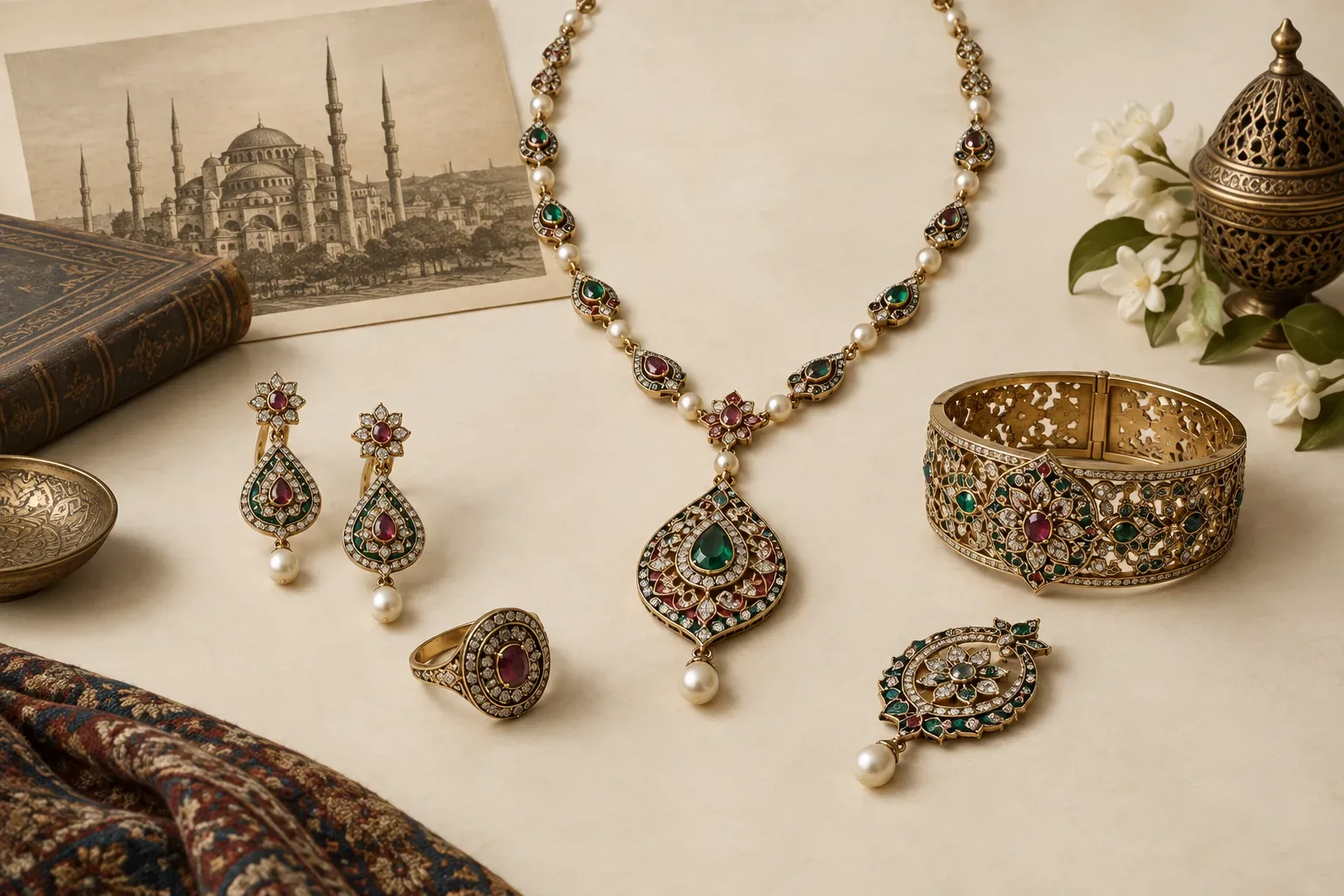
Meaning at a glance
Explain the documented history and changing contexts of the ottoman jewelry history motif, separate cultural or religious evidence from later popular interpretations, and give practical guidance for choosing and wearing the motif in modern jewelry.
Direct answer — the short thesis
Documented ottoman jewelry history shows that jewelry functioned as material display, personal ornament, and social signifier across different communities and periods; museum research emphasizes changing social contexts rather than single, timeless meanings. Modern uses of Ottoman motifs are varied: some draw on historical forms and materials, others reinterpret motifs for contemporary fashion. When choosing or gifting Ottoman-inspired jewelry today, prioritize clear provenance, respect for cultural context, and transparent information about materials and treatments.
What the historical evidence shows (which cultures and periods)
Surviving objects, inventories, portraits, and museum research make it possible to speak about Ottoman jewelry in historically specific terms rather than as a single monolith. The Victoria and Albert Museum frames jewellery history as a sequence of changing social contexts and meanings; similar museum-based approaches are useful when studying objects from the Ottoman imperial court, provincial elites, urban artisans, and religiously diverse communities that lived under Ottoman rule. Evidence for production techniques, stylistic trends, and materials comes from surviving examples and documented collections, which must be read alongside written records and trade evidence rather than assumed to represent all people within the empire.
Scholars and curators treat the Ottoman era as a long, multi-century cultural horizon with regional variation. Court jewelry and regalia, urban elite jewelry, and everyday personal ornaments can differ significantly. Where museum catalogues and exhibitions discuss particular items, they usually identify the likely social context of a piece—court, urban, rural, or minority-community production—rather than ascribing a single social meaning to all Ottoman jewelry.
Materials, gemstones, and techniques documented in collections
Museum collections and reference guides list the materials and gem types commonly found in pieces attributed to Ottoman workshops: gold and silver are frequent precious metals, often worked with chasing, filigree and granulation, and cloisonné or painted enamel surfaces are also documented. The Victoria and Albert Museum’s resources on jewellery history present these techniques and argue that changes in style and technique reflect shifting fashions and social roles rather than fixed symbolic systems.
Gemstones historically used in the region include emerald, ruby, sapphire, turquoise, and pearls; the V&A’s A–Z of Gemstones provides identification context and notes how particular gems were prized in different cultures for their material qualities and availability. Documentary and material evidence show that gem choice often reflected trade links, local tastes, and the economic means of the wearer rather than a single religious or cultural meaning attached to a stone across all communities.
How motifs and materials appear in Ottoman jewelry
Motifs familiar to museum collections—floral patterns, palmettes, arabesques, geometric borders, and stylized vegetal designs—appear across necklaces, earrings, rings, and hair ornaments. These motifs occur in metalwork, enamel, inlaid gemstones, and occasionally in small portrait miniatures or lockets. The way a motif appears (repeated border, central medallion, pendant form) helps indicate a piece’s likely use and status: pendants and brooches often served as focal ceremonial pieces, while smaller earrings or simple finger rings could be everyday items.
Gemstones appear as single focal stones in rings, as matched strings (pearls, beads of turquoise), or as pavé-like settings where many small stones emphasize surface decoration. Techniques such as bezel and collet settings, bezel with filigree surrounds, and enamel framing are documented in many museum-held examples. The V&A’s investigations into material and stylistic context can help a reader understand that how a motif or stone is used—its size, setting, and placement on the body—matters as much as the motif itself for historical meaning.
Status, gender roles, and daily wear in historical contexts
Historical evidence shows that jewellery functioned as a visible marker of status and wealth in many Ottoman social settings, but the precise meaning varied by class, gender, religion, and region. Court jewels and festival regalia often contained richer materials and more elaborate workmanship; such pieces were likely reserved for ceremonial use. At the same time, middle-class urban and rural populations used simpler, durable pieces in daily life. The V&A’s exhibitions on jewelry history emphasize that social meaning is contingent and changes over time and place.
Gendered use of jewelry also varied: women often wore multiple forms of ornament—necklaces, coin pendants, hair jewelry—while men might wear signet rings or jeweled dagger hilts in particular contexts. Documentary and material records indicate that some families held jewellery as movable wealth that could be worn or stored depending on need, which underlines the practical as well as symbolic functions of pieces.
Documented historical meanings versus later or popular interpretations
When museum sources describe historical uses of a motif or object, they rely on provenance, inventories, and comparative material culture; these documented meanings are limited to what the evidence can support. For example, a floral motif identified on a court pendant is documented as a decorative element within a princely context by curators, but evidence does not necessarily prove a single, fixed symbolic meaning across all Ottoman communities.
Modern popular interpretations—tourist labels, fashion descriptions, or commercial listings—often attach simplified symbolic meanings to motifs or stones (for example, claiming a single religious meaning or a universal protective function). Such interpretations may be sincere and meaningful to individuals, but they are not the same as documented historical meanings. Separating the two helps respect the complexity of the past and prevents claiming universality where evidence is specific or absent.
Practical guidance for selecting or gifting Ottoman-inspired jewelry today
If you are choosing or gifting an Ottoman-inspired piece, start by asking for provenance and clear information about materials and any treatments. The Federal Trade Commission provides consumer guidance on buying gemstones, diamonds and pearls and stresses disclosure of treatments, imitations, and whether stones are natural, lab-grown, or dyed. Such disclosure helps you compare value, care needs, and cultural authenticity.
Choose a piece that matches the intended wearer’s taste and lifestyle: historically accurate museum-style reproductions tend to be heavier and more ornate, while contemporary interpretations adapt motifs into lighter, wearable forms. If the recipient values cultural authenticity, look for makers who cite historical sources or regional techniques. When gifting across cultural lines, explain the piece’s provenance and avoid assigning assumed religious meaning; instead, present the object as inspired by historical forms with documented museum parallels, following the approach used by museum catalogues.
Care, conservation and ethical buying notes
Older or antique pieces may require conservation: fragile enamel, loose settings, and fragile filigree need a qualified conservator. For modern purchases, ask about metal hallmarks, gemstone testing, and any treatments; the FTC’s consumer guidance recommends requesting written disclosures for high-value purchases. If buying antique or vintage items, request documentation and a condition report and consider third-party authentication where appropriate.
Finally, be mindful of cultural context and legal issues: some historic items may be subject to export restrictions or provenance concerns. Respectful collecting and gifting starts with transparency about origin and an awareness that a decorative motif in a shop window and a specific historic object in a museum have different cultural and legal statuses.
Where to read further and related articles on JewelryMeaning.com
For broader context on cultural and historical jewelry, consult our Cultural & Historical Jewelry category. If you want practical shopping guidance, our gift and selection guide provides step-by-step advice on matching meaning, style and budget. For readers interested in related forms of sentimental ornament, read our history of lockets. If you are researching a specific symbol, our how-to research guide explains primary and secondary sources and questions to ask dealers and museums.
Frequently asked questions
What materials were common in Ottoman jewelry?
Museum catalogues and reference guides identify gold and silver as common metals, with gemstones such as emerald, ruby, sapphire, turquoise and pearls frequently used; techniques like filigree, granulation, and enamel work are documented in museum collections, as discussed by the Victoria and Albert Museum.
Did Ottoman motifs always have a religious meaning?
No single answer is supported by the primary museum evidence: curatorial studies show motifs served decorative, status, and stylistic roles in specific social contexts. Some motifs may have held local or personal symbolism, but museum research treats meaning as contingent and context-dependent rather than universally religious.
Is it appropriate to wear Ottoman-inspired jewelry if I’m not from that culture?
Wearing historical styles is common in global fashion, but be mindful of provenance, respectful presentation, and accurate information: disclose that a modern piece is inspired by Ottoman forms, avoid claiming sacred or communal meanings without evidence, and consider supporting makers who acknowledge the source and techniques.
How can I verify authenticity and know if gemstones are treated?
Ask sellers for written disclosures and testing reports; the Federal Trade Commission recommends requesting information on treatments, imitations, and whether stones are natural or lab-grown. For high-value items consider independent gemological testing and a documented condition report for antiques.
Should I buy antique pieces or modern reproductions?
Both have merits: antiques carry historical material evidence and may need conservation, while modern pieces can be lighter, wearable, and often come with clear material disclosures. Choose based on the recipient’s taste, care willingness, and the level of historical authenticity desired.
Sources and further reading
- Bedazzled: A History of Jewellery — Victoria and Albert Museum
- An A-Z of Gemstones — Victoria and Albert Museum
- Buying Gemstones, Diamonds, and Pearls — Federal Trade Commission