Meaning at a glance
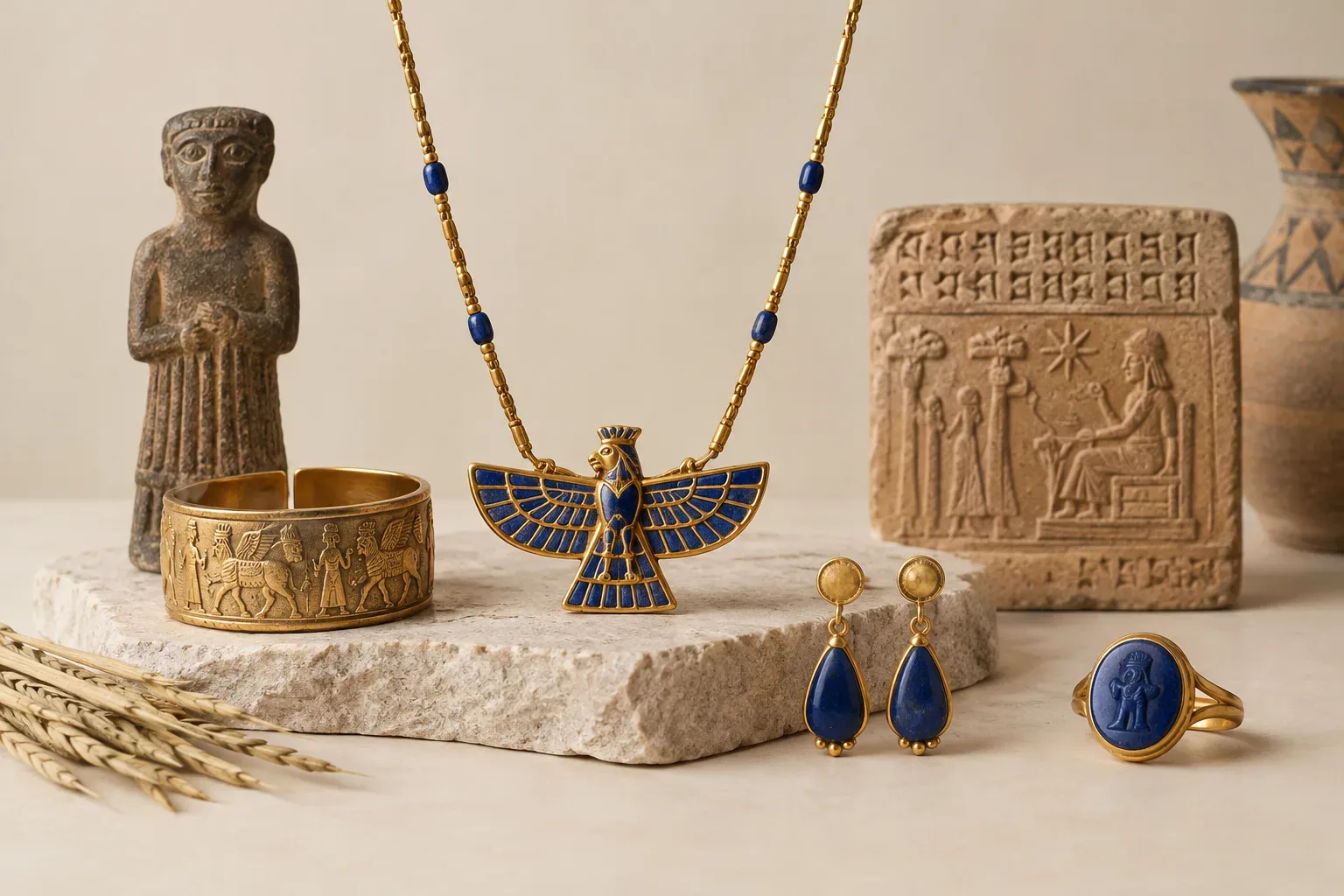
Documented museum research shows Sumerian jewelry used precious metals and imported gemstones to signify rank, religious function, and identity; later meanings are often modern reinterpretations. Choose and gift Sumerian-inspired pieces by considering materials, maker transparency, and respectful cultural context.
Quick answer
Sumerian jewelry history documents that jewelry in ancient southern Mesopotamia was made from metals, shell and imported gemstones and functioned as visible markers of social rank, wealth, and religious roles; museums emphasize changing social contexts rather than single, universal meanings (Victoria and Albert Museum). Modern spiritual or identity readings are personal or contemporary revivals and should be distinguished from what the archaeological and museum record directly supports.
Historical evidence and precise cultural contexts
When we speak of Sumerian jewelry, we refer to adornments produced in the Sumerian city-states of southern Mesopotamia and their immediate cultural successors and neighbors as studied by curators and historians. The Victoria and Albert Museum frames the story of jewellery across cultures as one of shifting social roles and technological change rather than static symbolism; their work places ancient Mesopotamian examples in the broader narrative of how adornment expressed status and identity.
Archaeological finds from southern Mesopotamia show that jewelry appeared in multiple contexts: worn on the living, deposited in graves, and offered or used in religious settings. Museum documentation emphasizes that these contexts—domestic, funerary, ritual—help researchers interpret function, but interpretation requires careful distinction between what is directly evidenced and what is later inferred or romanticized.
Materials, techniques and gemstones: what the evidence shows
The material record behind Sumerian jewelry history highlights a range of metals, organic materials, and imported gemstones. Curatorial summaries explain that gold and silver were used where available, while copper alloys and beads made from shell, bone, and faience filled other roles. Gemstones and semi-precious stones—often imported from distant sources—served as visible markers of wealth and trade connections. The Victoria and Albert Museum’s materials overviews discuss how particular stones acquired social value through rarity and trade.
Techniques visible in museum collections include metalworking, bead-stringing, inlay, and bead mosaics. These techniques produced necklaces, pectorals, diadems, earrings, and ornamented clothing fasteners that survive in fragments or as impressions in archaeological deposits. The presence of costly materials alongside skilled workmanship is the primary evidence for jewelry’s role in signalling status.
Status, function and daily wear documented from the record
Museum accounts emphasize that jewelry acted as both personal ornament and social statement. Finds from domestic contexts and burials show that certain pieces accompanied individuals in life and death, indicating a link between social identity and adornment. The Victoria and Albert Museum’s exhibition framing of jewelry history stresses that objects changed meaning as their social contexts shifted: a necklace might signify personal wealth in one setting and religious dedication or elite office in another.
Daily wear varied by material and social rank. Practical, less costly beads and metal fastenings would have been more suitable for everyday use, whereas elaborate gold and stone ensembles were likely reserved for formal occasions, high-status individuals, or temple personnel. Museum interpretation warns against assuming that every ornate object was in constant daily use; many valuable pieces had restricted or ceremonial use.
Documented historical meanings versus modern interpretations
Documented meanings come from the archaeological contexts recorded by excavators and the interpretive frameworks developed by museums and historians. These include uses as markers of rank, evidence of trade networks via imported materials, and associations with burial or temple deposits. The Victoria and Albert Museum’s narrative about jewellery highlights these context-led readings rather than single-symbol explanations.
Modern personal or popular interpretations—such as treating a particular Sumerian motif as a universal talisman or assigning a contemporary emotional meaning to every ancient motif—are contemporary overlays. They may be meaningful to a wearer today, but they are not the same as the meanings that can be directly demonstrated by the archaeological record. A respectful distinction keeps documented history and modern personal meaning side by side without conflating them.
How Sumerian motifs, gemstones, and traditions appear in jewelry today
Designs described as "Sumerian" in modern jewelry are usually adaptations inspired by archaeological forms—beaded necklaces, geometric inlays, and stylized animal or plant motifs familiar from southern Mesopotamian art. Contemporary makers translate those shapes into pendants, rings, earrings, and bracelets using modern metalwork and stone-setting techniques. The motifs are therefore a visual language borrowed from the archaeological record rather than a direct continuation of a living craft tradition.
Gemstones that evoke ancient Mesopotamia—deep blue stones like lapis-style materials, red carnelian-like beads, or bright faience-look ceramics—are commonly used to give a piece that historical character. When choosing such materials today it is useful to be aware of modern treatments and imitations: guidance from the Federal Trade Commission advises that sellers disclose treatments, substitutes, and imitations when marketing gemstones.
Practical and respectful guidance for selecting or gifting Sumerian-inspired jewelry
Decide whether your priority is historical accuracy, aesthetic reference, or wearable practicality. If you want a piece closely modeled on archaeological examples, look for makers who explain their sources and techniques and who show trustworthy photographs or museum references. If you want everyday wear, prioritize durable metals and secure settings that suit the recipient’s lifestyle rather than fragile reconstructions of museum pieces.
Ask sellers about materials and treatments. The Federal Trade Commission’s consumer guidance recommends that sellers disclose any gemstone treatments or imitations; as a buyer or gifter, request that information in writing. If provenance and ethical sourcing matter to you or the recipient, ask about the origin of stones and recycled or responsibly sourced metals.
Respect cultural context. Use the Sumerian label to describe inspiration, not to claim direct cultural continuity or religious authority. When gifting, explain why you chose the piece—whether for its craftsmanship, beauty, or historical interest—so the recipient understands whether the object is a historical reference, a personal talisman, or both.
Care, authenticity and everyday considerations
Think practically about care: delicate beadwork and ancient-style filigree need more careful handling than solid modern-mounted gems. For daily wear choose pieces with clean, sturdy fittings and ask about repair services. For valuable stones and metals, ask for documentation and hallmarks when available.
When assessing authenticity or claims of antiquity, prefer reputable dealers and museum-backed publications. For modern replicas or inspired pieces, clear labeling protects both buyer and cultural heritage by preventing misinterpretation of an object’s age or provenance.
Frequently asked questions
Was Sumerian jewelry worn every day?
Archaeological contexts show a range of use: some simpler pieces were likely worn daily, while the most elaborate items—made of rare metals or imported stones—were probably reserved for formal, religious, or funerary contexts. Museum interpretation emphasizes context rather than assuming universal daily wear (Victoria and Albert Museum).
What materials are authentically associated with ancient Sumerian jewelry?
The archaeological and museum record identifies metals, faience or glazed ceramics, shells, and imported semi-precious stones as common components. Museums note that choice of material often reflected access to trade networks and social rank.
Can I buy genuine ancient Sumerian jewelry?
True ancient artifacts should only be bought through reputable, legal channels with clear provenance, and such purchases raise ethical and legal concerns. For most people, high-quality modern pieces inspired by Sumerian forms are a more appropriate and affordable option.
How can I tell if a gemstone has been treated or is an imitation?
Ask the seller for written disclosure of treatments and imitations. The Federal Trade Commission recommends that sellers clearly state any enhancements, imitations, or substitutes used in gemstones.
Is it appropriate to wear Sumerian motifs as personal talismans?
Wearing a Sumerian-inspired motif as a personal talisman is a modern choice and can be meaningful for an individual, but this is a contemporary interpretation rather than a meaning directly documented in the archaeological record.
How should I care for a Sumerian-style necklace intended for daily wear?
Choose durable materials and secure mountings; avoid fragile beadwork for constant wear, and follow basic care such as keeping pieces dry, storing them separately, and arranging professional repairs for worn threads, clasps, or settings.
Sources and further reading
- Bedazzled: A History of Jewellery — Victoria and Albert Museum
- An A-Z of Gemstones — Victoria and Albert Museum
- Buying Gemstones, Diamonds, and Pearls — Federal Trade Commission