Meaning at a glance
Archaeological evidence shows that what we call Sumerian jewelry symbols developed in specific cultural and ritual contexts in ancient Mesopotamia; many meanings are reconstructed by specialists and changed through later reuse and modern imagination. This article distinguishes documented functions and contexts from contemporary symbolic readings, explains how motifs and materials appear in jewelry, and offers respectful, practical guidance for selecting or gifting items.
What the historical evidence shows (and which cultures or periods we mean)
When we speak of Sumerian jewellery symbols we are referring to objects and motifs recovered from archaeological sites in southern Mesopotamia that specialists attribute to communities conventionally labelled “Sumerian.” Museum catalogues and exhibitions collect those objects alongside jewellery from neighbouring cultures so that their style, materials and find contexts can be compared. For discussions of jewellery across long histories and changing social uses, see the Victoria and Albert Museum’s survey work on jewellery history, which places ancient Mesopotamian objects in broader chronological and cultural frameworks.
The principal kinds of evidence are the objects themselves—beads, inlays, pins, pendants, metalwork and items associated with seals or votive deposits—and their findspots and associated records. In museums, curators and conservators document materials and wear, and archaeologists note where items were found in relation to temples, burials or domestic layers. That archaeological context is the primary way meanings are assigned: an object placed with a deity’s temple or in a votive deposit suggests a religious or dedicatory function, whereas personal ornaments in graves speak to identity, status or memory.
Because the surviving evidence is fragmentary and interpreted within scholarly debates, it is important to specify that statements about function or meaning are reconstructions based on material context, comparison with texts when available, and stylistic parallels. For general background on how jewellery functions and changes across societies, the Victoria and Albert Museum’s resources are a useful guide to method and shifting social contexts.
Documented historical meanings versus later and modern interpretations
Documented meanings are those that follow from archaeological context, material study and contemporary records (where they exist). For example, jewellery found in temple offerings or in clearly religious assemblages is reasonably interpreted as serving votive or ritual roles; pieces from tombs or domestic deposits are interpreted in terms of personal identity, status and fashion. These are working interpretations grounded in how objects were used and deposited, rather than definitive statements about individual belief.
Later interpretations arise in several ways. Over centuries, motifs can be borrowed, adapted and redeployed by other cultures, so an image that once indicated divine association may later be used as mere decoration. In the modern era artists, historians and the jewellery trade often reassign symbolic meanings—for example, reading a geometric rosette or star motif as a universal symbol of protection—without clear archaeological backing. It is common for modern meanings to mix historical fragments with contemporary values such as romantic love, spiritual protection, or national identity.
A careful distinction matters: the archaeological record, as curated and interpreted by museums and scholars, tells us about contexts and plausible functions. Popular or personal meanings adopted today are valid for the wearer but should not be presented as unambiguous historical fact. For framing how jewellery meanings are read across time, see the Victoria and Albert Museum’s discussions of jewellery history and changing social context.
How Sumerian motifs, gemstones and traditions appear in jewellery
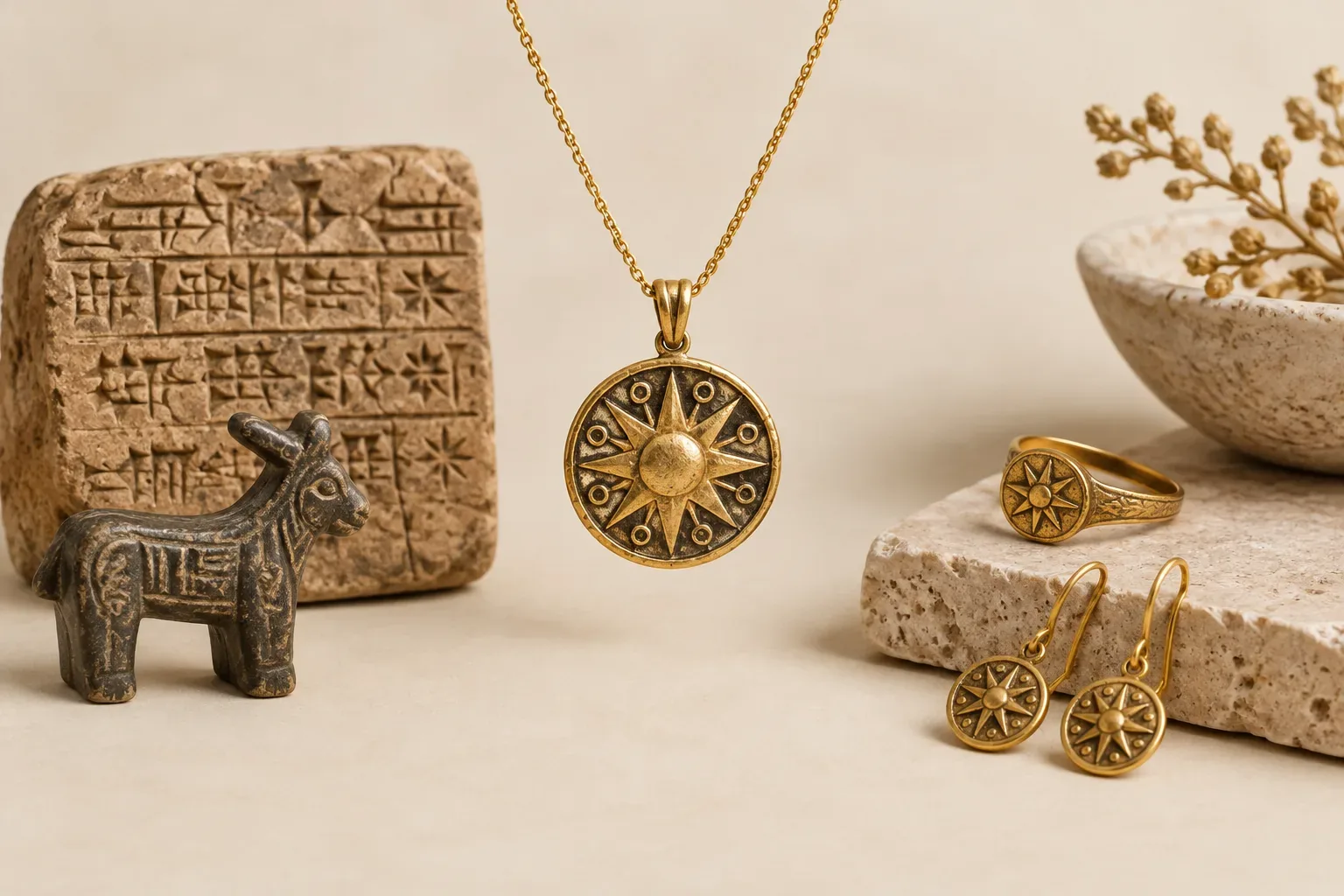
In museum collections and archaeological reports, what are often called Sumerian jewellery motifs appear in several forms: stylised animals and plant forms, geometric motifs such as rosettes or concentric patterns, and iconography associated with rulers or deities. These motifs are encountered on small personal ornaments, decorative inlays and items linked to seals and amulets. Because motifs frequently occur on portable objects, they are easy to replicate in modern jewellery designs.
Materials associated with ancient Mesopotamian jewellery include gold, silver, shell, and various stones worked into beads, inlays and intaglios. Gemstones used in ancient jewellery are discussed in museum gemstone overviews: museum guides explain how different materials were valued, worked and transported in antiquity, and how their appearance and rarity affected social meaning. When modern makers reference Sumerian motifs they may reproduce shapes and patterns in metalwork, or use historically associated stones such as dark blue semiprecious materials in necklaces and rings to evoke that ancient aesthetic.
Modern jewellery makers render Sumerian-inspired motifs in many forms: faithful museum replicas made for educational or collector purposes, contemporary interpretations that fuse Mesopotamian elements with current styles, and symbolic pieces that assign new meanings to old shapes. Whether a piece is cast from a museum example, hand-engraved, or printed, the visual language—animal figures, rosettes, stylised crowns—travels readily into modern necklaces, earrings, bracelets and signet-style rings.
Practical and respectful guidance for choosing, wearing, and gifting Sumerian-inspired jewellery
Be clear about your aim. If you want historical accuracy—an object that closely matches a museum piece—look for museum-approved replicas or jewellers who document their sources and methods. If you want an inspired piece that uses Sumerian motifs as a starting point for contemporary design, choose a maker who acknowledges the inspiration and explains what they have changed or added.
Consider provenance and disclosure. Ask sellers about the object’s provenance, whether the design is a documented reproduction, and whether any gemstones are treated or imitations. For guidance on disclosure and consumer protection when buying gemstones, consult the Federal Trade Commission’s consumer advice on buying gemstones, diamonds and pearls. Sellers should provide clear information about treatments, synthetic or imitation stones, and return policies.
Choose materials thoughtfully. Many people who wear historically inspired pieces prefer natural materials with clear labelling. If a piece claims to use a specific gemstone historically associated with Mesopotamia, confirm whether it is the natural stone, a stabilized specimen, a dyed material, or a modern substitute. This protects you financially and respects the archaeological heritage by avoiding misleading claims.
Be culturally respectful. Using motifs from another culture can be done respectfully when makers and buyers acknowledge origins and avoid trivialising sacred imagery. If a motif is clearly associated in scholarship with ritual or devotional practice, treat it with the same care you would afford other religious symbols—ask, learn, and frame it correctly when giving the piece as a gift.
Match the recipient’s knowledge and preferences. When gifting, consider whether the recipient is likely to appreciate historical context, symbolic reinterpretation, or merely the visual style. An explanatory note that names the motif, cites a museum or the artist’s source, and states whether the piece is a reproduction or an inspired design makes the gift more meaningful and avoids misrepresentation.
If conservation or wear is a concern, follow care guidance relevant to the materials. Museum guides on gemstones and jewellery note that different materials require different cleaning and storage practices; enquire with the maker or consult conservator-friendly sources when in doubt to ensure the piece lasts and does not degrade through improper care.
Putting it together: informed appreciation
Sumerian jewellery symbols are best appreciated when their archaeological origins and subsequent histories are both acknowledged. Museums and conservators provide the groundwork for documented meaning and social context, while modern makers and wearers contribute new layers of interpretation and personal significance.
When buying or gifting Sumerian-inspired jewellery, use the combined tools of provenance questions, material disclosure and respectful contextualization. That approach honours the historical record as described by museum scholarship and also recognises how living traditions continue to create meaning today.
Frequently asked questions
Were Sumerian jewellery motifs religious symbols?
Some motifs appear in religious or votive contexts and are reasonably interpreted as having ritual or devotional associations, based on where objects were found. Many other motifs appear in domestic or funerary contexts and are best read as indicators of identity or status rather than strictly religious symbols. Museum scholarship distinguishes these uses through archaeological context.
Can I wear a Sumerian-inspired motif as a protective amulet?
You may choose to wear an inspired motif as a personal protective symbol, but that modern meaning is a contemporary or individual interpretation. It should not be presented as an historically proven Sumerian belief unless supported by archaeological evidence and scholarly consensus.
How do I know if a gemstone in a Sumerian-style piece is authentic?
Ask the seller for disclosure about the stone’s identity, any treatments, and whether it is natural, synthetic or imitation. The Federal Trade Commission advises buyers to request clear information about treatments and origins; reputable sellers will provide this.
Is it disrespectful to use ancient motifs in jewellery today?
It depends on context and intent. Using motifs with acknowledgement of origin, avoiding trivialisation of clearly sacred imagery, and crediting sources or inspiration is a respectful approach. If the motif has documented ritual significance, treat it with sensitivity similar to other religious symbols.
Where can I find reliable reproductions or museum-approved pieces?
Look for museum shops or makers who document that their pieces are licensed reproductions or cite specific museum objects as sources. Transparency about provenance and methods is the key indicator of reliability.
Sources and further reading
- Bedazzled: A History of Jewellery — Victoria and Albert Museum
- An A-Z of Gemstones — Victoria and Albert Museum
- Buying Gemstones, Diamonds, and Pearls — Federal Trade Commission