Meaning at a glance
Explain the documented history and changing contexts of the mesopotamian jewelry identification motif, separate cultural or religious evidence from later popular interpretations, and give practical guidance for choosing and wearing the motif in modern jewelry.
Quick answer
Mesopotamian jewelry identification should emphasize material, workmanship and cultural context rather than assuming a single universal meaning: museum evidence shows particular motifs—such as rosettes, animal figures, and winged forms—recurring across named Mesopotamian cultures, and these motifs functioned in a range of social, political, and religious roles. Separate documented archaeological or museum-based interpretations from modern personal or commercial symbolism, check materials and disclosures, and choose pieces with respect for their origin and context.
Which cultures and periods matter for identification
When identifying Mesopotamian jewelry, treat Sumerian, Akkadian, Babylonian and Assyrian material as distinct traditions even where designs overlap. Museum collections and scholarship at the Victoria and Albert Museum emphasize that jewellery changed with social context over time, and that motifs migrated between courts, temples and markets rather than carrying a single fixed meaning across all places and periods.
Do not treat "Mesopotamian" as one monolithic culture. Look for stylistic markers used by curators and archaeologists: for example, combinations of intricate beadwork and early goldwork often appear in objects catalogued with Sumerian or early southern Mesopotamian contexts, while later Imperial court styles assigned by museums show different emphases in scale and iconography. The Victoria and Albert Museum’s work on jewellery history highlights this changing social context as central to identification.
Primary evidence and how historians document meanings
The primary evidence used by museums and scholars to identify Mesopotamian jewelry includes surviving objects in archaeological contexts, inscriptions and seal impressions, and comparative study across museum collections. The Victoria and Albert Museum frames jewellery within its social and historical contexts, reminding readers that objects entered museums through excavation, collection, and later display practices that affect how they are interpreted.
Because direct textual explanation of every motif is rare, curators combine object typology (technique, material, iconography) with archaeological provenance to assign likely cultural attribution. Where clearer documentary evidence exists—inscriptions, dedicatory contexts, or consistent burial associations—museums will report those links as part of the object’s documented history; where evidence is circumstantial, interpretations remain provisional and are often presented as such in museum catalogues.
Documented historical meanings versus modern interpretations
Documented historical meanings are those supported by archaeological context, inscriptions, or repeated use in clearly ritual or administrative settings as reported by museum scholarship. For example, when a motif repeatedly appears in objects associated with palaces or temples in a museum collection, curators may place it in the realm of status display or religious symbolism; these assessments reflect the object contexts recorded by institutions such as the Victoria and Albert Museum.
Modern personal or commercial interpretations—for instance, assigning a single protective or mystical power to a motif in all cases—are contemporary readings that may be meaningful to wearers today but are not the same as documented ancient belief. Distinguish carefully between what museum evidence supports and what is a modern or personalized meaning layered onto an ancient image.
Common Mesopotamian motifs and how they appear in jewelry
Rosettes and floral rosette panels appear frequently on Mesopotamian decorative objects and occur in jewellery-related forms in museum collections. In a jewellery context these motifs are typically rendered in inlay, stamped or incised metal, or as bead compositions within necklaces and pectorals.
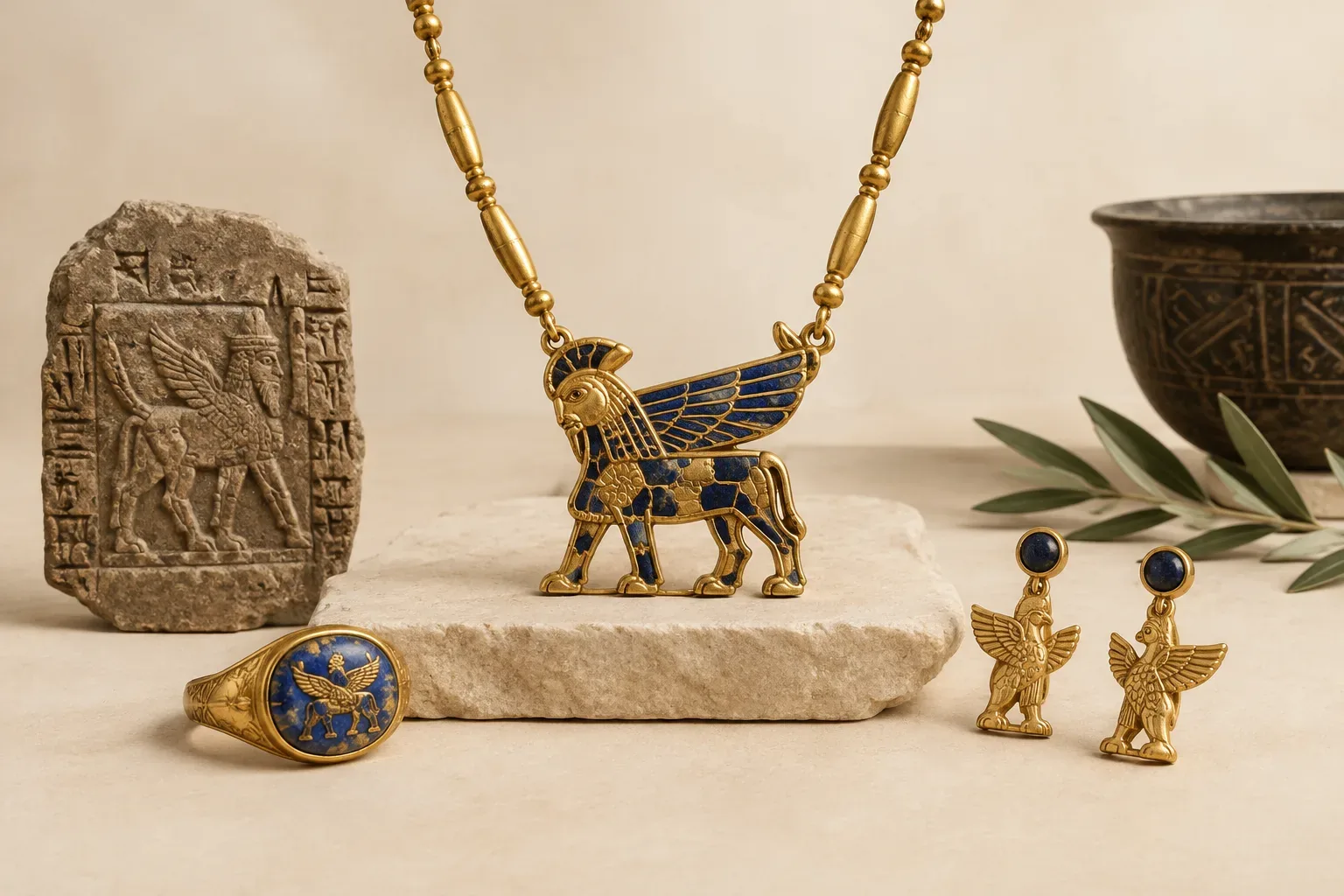
Animal figures—lions, bulls, and hybrid creatures—are another recurring motif. On jewellery they appear as amulet-like mounts, detailed carved beads, or relief elements set into collars and bracelets. The Victoria and Albert Museum’s surveys of historical jewellery stress that animal imagery often participates in broader iconographic programs tied to rulership or divine association in ancient contexts.
Winged discs, paired wings, and stylized thunderbolt or star shapes are motifs that show up in decorative metal elements and inlaid work. In wearable objects they are usually small, repeated elements or central mounts on larger neckpieces. Museum descriptions often link such imagery to symbolic programs visible across architecture and seals, though the exact meanings may vary with context.
Bead strings and stone inlay were central to the look of many Mesopotamian pieces preserved in museum collections. Semiprecious stones, glass, and faience appear as beads and insets; gold and electrum are recorded in metalwork mounts and settings. For gemstone identification and historical contexts, museum resources such as the Victoria and Albert Museum’s "An A–Z of Gemstones" provide useful background on which stones were historically prized and how they were used in decorative contexts.
How motifs get mislabelled or misattributed
Two common mislabels occur: calling something “Mesopotamian” when it is from an adjacent culture or period, and assigning a single symbolic meaning to a motif that had multiple possible uses historically. Because museums and dealers sometimes use broad geographic labels for accessibility, always check provenance notes, catalog entries, or museum labels to see whether the object is assigned to a specific culture such as Sumerian, Akkadian, Babylonian or Assyrian.
Another frequent error is treating later revival pieces or modern designs inspired by Mesopotamian art as ancient without clear documentation. Museum-based resources and responsible dealers make provenance and treatment disclosures; follow the Federal Trade Commission’s guidance on buying gemstones, which stresses transparency about treatments and imitations, to avoid acquiring pieces misrepresented as ancient.
Practical identification checklist
Begin with provenances and catalogue records: museum descriptions and labels provide the best starting point. Look for specific culture assignments (for example, Sumerian or Assyrian) rather than a generic "Mesopotamian." Examine the materials and techniques: recurring use of certain semiprecious stones, faience beads, and metal inlay noted in museum guides can support identification.
Check for modern treatments or reconstructions. The FTC’s consumer guidance on buying gemstones, diamonds and pearls advises buyers to ask about treatments, reproductions, or modern restoration. For suspected ancient pieces, professional conservation reports or museum catalogues are the most reliable sources of such information.
Respectful selection and gifting guidance
If you are choosing or gifting a piece with Mesopotamian motifs, prioritize provenance and good documentation. If the piece is an authentic ancient object, buy only from reputable dealers or auction houses that provide clear provenance and condition reports, or consider purchasing a documented museum-quality reproduction or contemporary work inspired by Mesopotamian motifs instead.
When selecting an inspired or contemporary piece, learn the motif’s documented background in museum sources first and avoid presenting speculative ancient meanings as fact. A thoughtful gift note can explain that the design is inspired by a historical motif and describe the documented contexts (as reported by museum scholarship), while leaving space for the recipient’s personal interpretation.
Wear and display with cultural sensitivity. Museums such as the Victoria and Albert Museum present jewellery within social and historical contexts; follow that lead by acknowledging an object's origins and by avoiding exoticizing language. For statements about material authenticity or treatments, insist on written disclosure per FTC recommendations before completing any purchase.
Conservation and authentication basics
For actual antiquities, conservation and authentication are specialist tasks. Museum practices are the benchmark: rely on institutional assessments, published catalogues, and laboratory testing reported by reputable conservators. If an object is described as ‘restored’ or ‘reconstructed,’ that affects its classification and market value and should be reflected in any purchase documentation.
For jewellery inspired by Mesopotamian motifs, consider modern makers who explain their research and methods. Museums encourage public education about materials and techniques; choose makers or retailers who disclose materials, treatments, and cultural references transparently.
Frequently asked questions
How can I tell if a piece labeled 'Mesopotamian' is actually ancient?
Check provenance and documentation first: museum catalogues, excavation records, or auction-house condition and provenance reports are the most reliable sources. Ask for laboratory reports or conservation assessments if available. If a dealer cannot provide clear provenance or if the piece lacks documentation, treat the object as unprovenanced and verify materials and treatments before assuming it is ancient.
Do specific motifs always mean the same thing across Mesopotamian cultures?
No. Museum scholarship, as reflected in resources from the Victoria and Albert Museum, shows that motifs were reused and adapted across different cultures and periods. A motif that appears in a religious context in one place may serve a decorative or status-related role elsewhere, so avoid assuming a single universal meaning.
What materials should I expect in authentic Mesopotamian jewellery?
Museum collections indicate that materials commonly found in objects attributed to Mesopotamian contexts include gold and electrum for metalwork, semiprecious stones, glass and faience for beads and inlay. For specific identification of gemstones and their historical uses, consult resources such as the Victoria and Albert Museum’s 'An A–Z of Gemstones.'
Can modern pieces inspired by Mesopotamian motifs be meaningful gifts?
Yes. Contemporary pieces inspired by historical motifs can be meaningful and respectful if the maker or seller is transparent about inspiration and materials. Provide context in a gift note about what is historically documented versus what is a modern interpretation to avoid presenting speculative ancient meanings as fact.
How do I avoid buying treated or imitation gemstones sold as ancient?
Follow the Federal Trade Commission’s guidance: ask for written disclosure of treatments, lab reports, and any restorations. Reputable sellers should disclose whether stones have been heat-treated, dyed, assembled from older components, or are modern reproductions.
Where should I start researching an unfamiliar motif on a piece of jewellery?
Begin with museum catalogues and trusted museum articles that discuss jewellery history and iconography, such as those from the Victoria and Albert Museum. Use those references to narrow cultural attribution, then seek specialist literature or professional appraisal for authentication and interpretation.
Sources and further reading
- Bedazzled: A History of Jewellery — Victoria and Albert Museum
- An A-Z of Gemstones — Victoria and Albert Museum
- Buying Gemstones, Diamonds, and Pearls — Federal Trade Commission