Meaning at a glance
Explain the documented history and changing contexts of Mesopotamian jewelry motifs, separate cultural and religious evidence from later interpretations, and give practical guidance for choosing, authenticating, and wearing revival pieces respectfully.
What the historical record can reliably tell you
When discussing 'Mesopotamian' jewelry we are referring to objects associated with the societies that lived in the rivers' alluvial plains usually described as Mesopotamia, including Sumerian, Akkadian, Babylonian and Assyrian contexts. Museum collections and historical surveys identify these as distinct cultural and chronological traditions rather than a single uniform style. For general statements about how jewelry functioned and changed over time in these societies, see the Victoria and Albert Museum's work on jewellery history, which places pieces inside shifting social, political and technological contexts rather than treating them as timeless symbols.
The archaeological record and museum research show that jewelry in these regions was made from a variety of materials, and that styles and techniques evolved as materials, trade networks and technologies changed. The Victoria and Albert Museum's writing on gemstones and jewellery history is a useful starting point for understanding the range of materials and the ways jewellery related to status, identity and trade over long periods.
Be precise about culture and period
Ask sellers which culture and period a revival piece references. A design inspired by Sumerian bead-strings is different from a motif traced to later Neo-Assyrian royal art. If a seller or maker claims a piece is a 'Mesopotamian motif,' request details: which site, which period, and whether the design is taken from a museum object or a general stylistic assumption. Museum publications and catalogues typically identify the provenance and contextual information you should expect from serious dealers, as the Victoria and Albert Museum’s historical material demonstrates.
Avoid buying on the basis of a single, broad label. The same visual element—an animal, a rosette, or a pattern—may have been used differently across centuries and places in ancient Mesopotamia. Knowing the specific cultural reference will help you judge historical plausibility and respectfulness.
Documented meanings vs modern interpretations
Documented meanings are what can be supported directly by archaeological context, inscriptions, or careful museum interpretation. Where such evidence exists, museums typically describe the object's findspot, its association with burials, temples or palaces, and any inscriptions or depictions that inform likely use. When a museum like the Victoria and Albert Museum explains how jewellery changed social roles over time, it is drawing on that kind of documented context rather than modern folklore.
Modern personal interpretations—what a buyer or contemporary designer feels a motif 'means' today—are valid as individual expression but are not the same as historical evidence. Contemporary meanings can be powerful and appropriate for personal jewellery, provided the wearer understands they are contemporary readings rather than recovered ancient beliefs. When a seller ties an emotional or spiritual claim to a 'Mesopotamian' symbol, ask whether that claim is based on archaeological publication or modern design narrative.
How Mesopotamian motifs, gemstones and traditions appear in modern jewellery
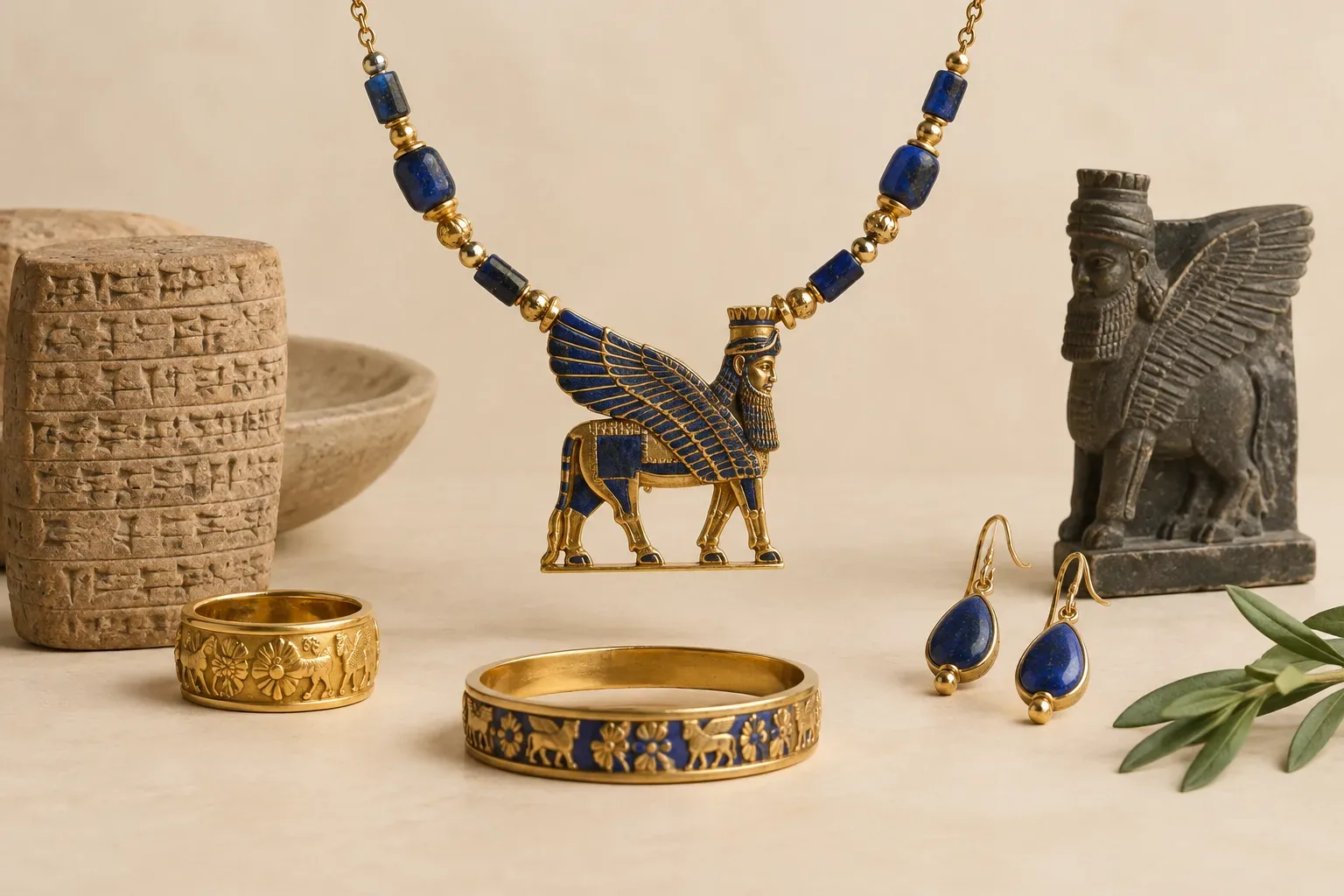
Revival pieces take inspiration from forms, techniques and materials found in archaeological collections. Makers may echo bead strings, repeating patterned bands, or engraved plaque forms and adapt them for modern wear. Some contemporary pieces copy the visual language of ancient objects—stylized animals, geometric rosettes or pattern friezes—while others translate archaeological details into modern silhouettes.
Gemstones associated with the ancient Near East—such as lapis lazuli, carnelian, and various turquoise and semi-precious stones—feature in revival jewellery because of documented use in antiquity. The Victoria and Albert Museum’s resources on gemstones provide helpful background on historical gemstone use and how certain materials were valued across different cultures, which can guide buyers who want stones historically associated with Mesopotamia.
Techniques that reference the past—bead-stringing, granulation-like textures, or bezel-set cabochons—may be executed with modern tools and alloys. Understand that a contemporary piece that 'looks ancient' is usually a modern interpretation rather than an archaeological replica, and sellers should be clear about that distinction.
Authenticity, materials, and seller disclosure
When assessing a Mesopotamian revival piece, insist on clear material disclosure and provenance statements. The U.S. Federal Trade Commission’s guidance on buying gemstones, diamonds and pearls emphasizes the importance of transparent disclosure about treatments, synthetics, and imitations. Ask whether stones have been treated, whether metal is hallmarked or tested, and whether any antiquing or patination is artificially applied to create an aged look.
If a seller claims that a piece uses 'ancient' components—beads, settings, or metalwork—request independent verification or documentation. Genuine antiquities trade is regulated, and reputable dealers should be able to provide provenance. If you want a piece made from newly mined or ethically sourced materials, confirm the supply-chain statements before purchase.
Cultural respect and responsible gifting
Be mindful of cultural sensitivity. A motif that is decorative in one context can be sacred or meaningful in another. Before gifting a Mesopotamian-inspired piece as a symbol of religious or spiritual significance, determine whether that interpretation is historically documented or a modern adaptation. If you are unsure, choose neutral wording that celebrates design and historical inspiration rather than asserting an ancient religious meaning.
When buying for someone from a culture with links to the region, consider asking them about their preferences rather than assuming appropriateness. Museums and cultural heritage organizations stress contextual respect: presenting a revival piece as inspired by a museum object and acknowledging the source is a simple gesture that honours the origin without claiming false authenticity.
Practical buying checklist and care
Before purchase, verify materials, treatments, and maker provenance. Compare the seller’s claims against independent references such as museum descriptions and gemstone guides. If a piece contains stones, ask about laboratory reports for high-value gems. The FTC recommends buyers request written descriptions of treatments or enhancements, as such information materially affects value and care.
For care, treat revival pieces according to their materials: avoid chemical cleaners on semi-precious stones, store gold and silver separately to prevent abrasion, and understand that any applied antiquing may wear with repeated polishing. If the piece is meant as a wearable homage to ancient forms, consider occasional professional cleaning and inspections to keep settings secure while preserving aesthetic patina.
Where to look and how to verify
Visit museum shops, museum publications and reputable galleries when you want historically informed revival pieces; museums sometimes collaborate with makers to produce items inspired by objects in their care. For background on materials and historical contexts, the Victoria and Albert Museum’s articles on jewellery history and gemstones are good starting references. When buying from independent makers, request clear provenance and try to see high-quality photographs or samples in hand.
For high-value gemstones and metals, ask for independent appraisal and a written receipt that specifies materials and any treatments. If you have any legal or export-import questions about ancient components, consult relevant cultural property laws—reputable dealers will comply and provide necessary paperwork.
Final considerations
A thoughtful Mesopotamian jewelry buying guide is less about romanticized authenticity and more about responsible choice: know the cultural reference, confirm material facts, respect contextual meanings, and be transparent about modern interpretation. With careful research and clear questions for sellers, you can enjoy revival jewellery that honors its inspirations without misrepresenting history or culture.
Frequently asked questions
How can I tell if a Mesopotamian-style piece is a modern creation or an ancient object?
Ask the seller for provenance documentation and a clear description of materials. Genuine antiquities are typically accompanied by archaeological provenance and export paperwork; revival pieces should be described as contemporary. If the seller makes historical claims, request specific references to museum catalogues or publications. For gemstones and treatments, consult the seller’s disclosure and consider independent gemological reports for high-value items.
Are there specific gemstones I should look for if I want historically inspired materials?
Gemstones historically associated with the ancient Near East include lapis lazuli, carnelian and various semi-precious stones; the Victoria and Albert Museum’s gemstone guides discuss historical use and value. If you want historically plausible materials, ask the maker which stones inspired the piece and whether they are natural, treated or imitations.
What should I ask about treatments and imitations?
Follow the FTC’s guidance by requesting written disclosure of any treatments, synthetics, or imitations. Ask whether stones have been heat-treated, dyed, stabilized or are man-made. Treatment information affects both value and care, so it should be part of the sale contract or receipt.
Is it appropriate to give Mesopotamian-inspired jewelry as a cultural gift?
Gifting can be appropriate when done respectfully: acknowledge the design’s inspiration, avoid asserting unfounded sacred meanings, and choose a piece that aligns with the recipient’s tastes and background. If the design references specific religious or ethnic symbolism, consult the recipient or choose a neutral, design-focused item instead.
Where can I learn more about the historical context for a motif I like?
Begin with reputable museum resources and published catalogues. The Victoria and Albert Museum’s materials on jewellery history and gemstones provide accessible context. For deeper study, request catalog references from sellers or consult academic catalogues in museum bibliographies.
Sources and further reading
- Bedazzled: A History of Jewellery — Victoria and Albert Museum
- An A-Z of Gemstones — Victoria and Albert Museum
- Buying Gemstones, Diamonds, and Pearls — Federal Trade Commission