Meaning at a glance
This article explains the documented history and changing contexts of Etruscan jewelry history, distinguishes archaeological evidence from later reinterpretations, describes materials, motifs and gemstones, and gives practical guidance for choosing and wearing Etruscan-style pieces today.
Historical evidence and precise cultural contexts
Archaeological finds and museum catalogues form the basis for what we know about Etruscan jewelry. The Victoria and Albert Museum has discussed how jewellery’s role, materials and techniques change with social context and display, and curators draw on excavated objects and comparative collections when describing Etruscan-related material culture (Victoria and Albert Museum).
When discussing Etruscan jewelry history it is important to keep the culture distinct from later Roman practices and from modern commercial uses of the term “Etruscan.” Museum descriptions place Etruscan goldwork within the material culture of pre-Roman central Italy; many surviving examples are recovered from tombs and ritual deposits, contexts that shape how scholars interpret their social and symbolic functions (Victoria and Albert Museum).
Because interpretation depends on archaeological context, scholars are cautious about attributing single, universal meanings to particular motifs or gemstones. Museums note that where objects are recovered in funerary contexts they may indicate status, family connections or ritual use rather than a single ‘religious’ statement (Victoria and Albert Museum).
Materials and techniques documented by museums
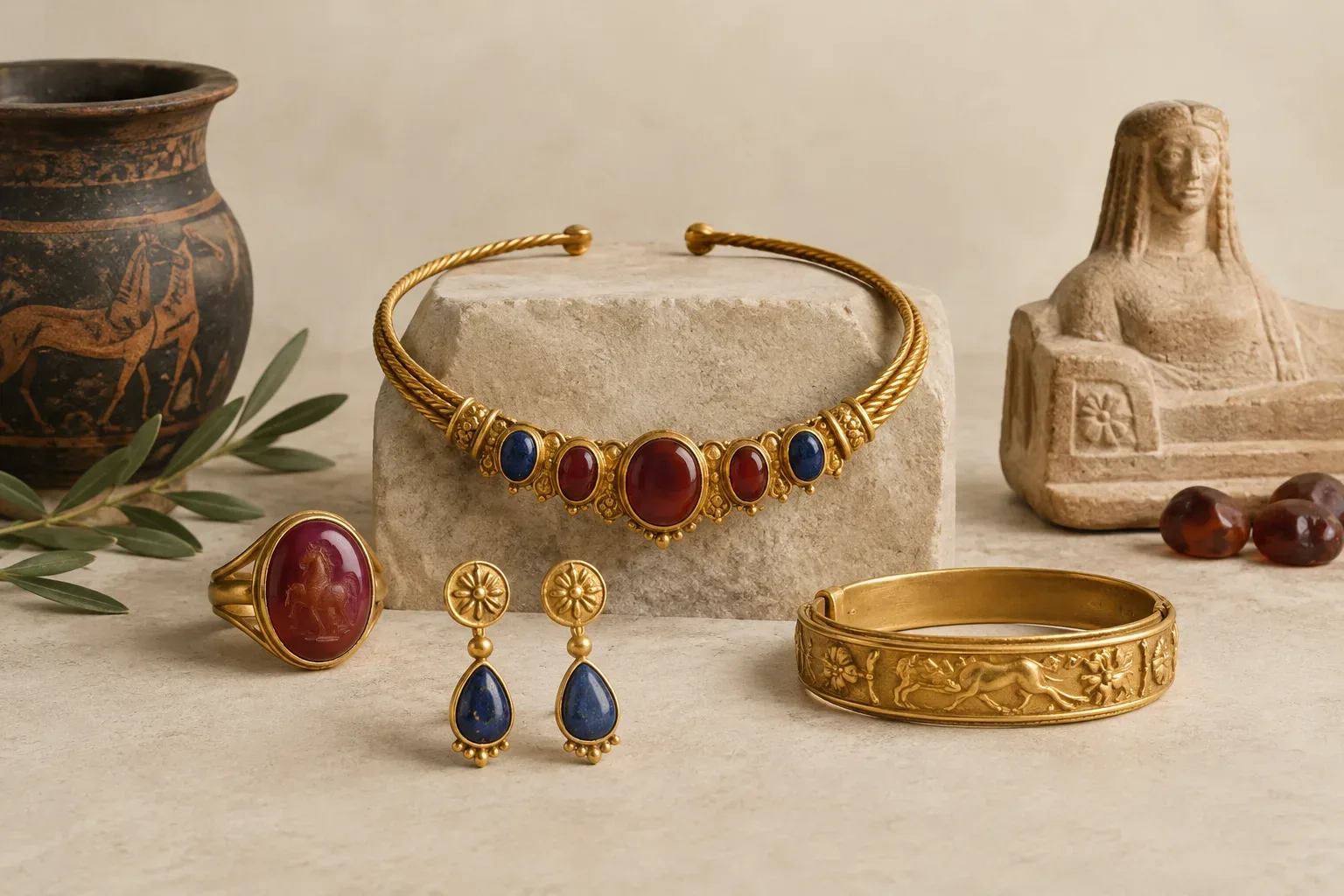
Gold is the dominant metal in what museums catalogue as Etruscan jewelry history, typically worked at high purity to enable methods such as granulation and filigree. Granulation, the application of tiny gold granules to a surface, and delicate twisted-wire work are recurring technical signatures identified in museum displays and literature (Victoria and Albert Museum).
Gemstones and inlaid materials appear frequently alongside gold. The V&A’s gemstone overviews link historical jewellery to commonly used stones—such as carnelian, garnet and rock crystal—and to later practices of cutting, mounting and imitating gems in decorative contexts (Victoria and Albert Museum; An A-Z of Gemstones).
Glass and faience were also used as bead materials and inlay, functioning visually like gemstones when polished. The combination of gold settings and colored inlays is consistent with museum descriptions of Mediterranean jewellery practice that value color and surface texture as much as preciousness (Victoria and Albert Museum).
How motifs, gemstones and traditions appear in jewelry
Motifs: Museum catalogues show recurring ornamental motifs in Etruscan contexts such as palmettes, rosettes, bead-strings and stylized animal or mythological details. These motifs appear as stamped or chased decoration on gold sheets, as arrangements of granules, and as settings for small inlaid stones (Victoria and Albert Museum).
Gemstones and inlay: Gemstones in Etruscan jewelry history typically appear as small cabochons or beads set into gold bezels or strung as necklaces. The V&A’s guides to gemstones explain how different stones were valued for color and optical properties rather than the modern emphasis on clarity or size; carnelian and garnet, for example, were prized for their rich reds (Victoria and Albert Museum; An A-Z of Gemstones).
Construction and wear: Necklaces, hinged bracelets, fibulae (brooches) and earrings recur in collections. Techniques such as repoussé (raising metal from the reverse) and granulation produce low-relief ornament that catches light—an effect suited to both display in ritual contexts and to public social display (Victoria and Albert Museum).
Documented cultural meanings versus modern interpretation
Documented meanings derive from object contexts and contemporary comparative evidence. Because many Etruscan pieces come from tombs, museums caution that they reflect funerary practice and elite display; in those circumstances jewelry can indicate rank, family affiliation or ritual role, but conclusions depend on the burial assemblage and site context (Victoria and Albert Museum).
Modern personal interpretations often layer new meanings—romantic, nationalistic or spiritual—onto these objects. Such contemporary readings are valid as personal symbolism but they are not the same as archaeological evidence. The Victoria and Albert Museum emphasises the difference between the changing social uses of jewellery over time and any single interpretation of past belief or ritual (Victoria and Albert Museum).
As a result, when wearing or gifting “Etruscan-style” jewellery today, treat historical claims as contextual and subject to scholarly qualification, and treat modern symbolic attributions as contemporary personal meanings rather than archaeological facts.
How Etruscan elements are used in modern jewelry
Contemporary designers borrow Etruscan techniques and motifs in two main ways: faithful reproductions made with traditional techniques and materials, and modern reinterpretations that use Etruscan visual cues—granulated textures, rosette motifs, warm gold tones—applied to contemporary settings. Museums and museums’ exhibitions often inspire both approaches by making forms and techniques visible to modern audiences (Victoria and Albert Museum).
Gemstone selection in modern pieces may imitate the palette of ancient pieces—deep reds, translucent whites and warm ambers—or use modern stones in Etruscan-inspired settings. When purchasing, refer to museum descriptions for historical reference on typical stones and to resources that explain modern gemstone treatments and disclosure practices (Victoria and Albert Museum; An A-Z of Gemstones; Federal Trade Commission).
Modern makers sometimes employ simulated stones or laboratory-grown gems to achieve traditional colors at lower cost; the FTC provides guidance on disclosure obligations and how treatments or imitations should be communicated to buyers (Federal Trade Commission).
Practical and respectful selection or gifting guidance
If you want a historically informed piece, look for makers who explain their techniques and materials. Authentic reproductions will describe the metal purity, whether traditional granulation or filigree techniques were used, and whether stones are natural, treated or synthetic. Museum catalogues can help you identify stylistic features to look for when evaluating claims (Victoria and Albert Museum).
Be transparent about modern materials and treatments. The Federal Trade Commission advises sellers to disclose material treatments, imitations and synthetics; as a buyer or giftee, request written confirmation of whether gems are natural, treated or lab-grown and whether any metal is plated or alloyed (Federal Trade Commission).
Consider the recipient’s cultural background and preferences. An item inspired by Etruscan forms can be an informed and respectful gift when framed as a historical or aesthetic reference rather than a claim to living cultural authority. If the recipient or their community has particular sensitivities about cultural appropriation, prioritize dialogue and opt for pieces that credit historical sources and contemporary makers.
Choose quality over novelty for everyday wear. If you plan to wear a piece daily, select durable construction and appropriate stones for the intended use. Gold of higher purity and secure bezel settings better withstand repeated wear, while delicate granulation and fragile inlays are more suited to occasional wear and careful conservation (Victoria and Albert Museum).
When in doubt, pair a modern appraisal with museum references. If an object is presented as antique or archaeological, request provenance documentation; if provenance is unclear, treat the piece as a modern reproduction and value it for craftsmanship and design rather than antiquity.
Conservation and daily wear considerations
Museum-conserved pieces show that many ancient gold items survive because gold and certain stones are chemically stable, yet delicate surface techniques and inlays can be vulnerable to abrasion and loss. For both reproductions and historical pieces, avoid harsh chemicals and manage exposure to knocks, soaps and perfumes that can degrade wirework and inlays (Victoria and Albert Museum).
For gemstone care, consult specialist guidance on each stone’s properties; the V&A’s gemstone overview is a useful starting point for understanding which materials are robust enough for everyday wear and which require occasional use (Victoria and Albert Museum; An A-Z of Gemstones).
If purchasing an archaeological object or a claimed antique, request condition reports and professional conservation documentation. For modern pieces, a jeweller’s guarantee and clear disclosure of materials and treatments will help you make an informed decision (Federal Trade Commission).
Frequently asked questions
What defines an Etruscan piece versus an Etruscan-style piece?
An archaeological Etruscan piece is an object excavated from a dated Etruscan context and usually documented with provenance; an Etruscan-style piece is a modern item inspired by Etruscan motifs or techniques. Museums differentiate original objects from later references in catalogue entries (Victoria and Albert Museum).
Which gemstones were common in Etruscan jewellery?
Museum guides note that stones prized historically for color and translucency—such as carnelian, garnet and rock crystal—appear frequently in Mediterranean jewellery and are typical references when discussing Etruscan-style pieces (Victoria and Albert Museum; An A-Z of Gemstones).
Can I wear Etruscan-style jewelry every day?
You can wear many modern Etruscan-style pieces daily if they are well made and use durable settings. However, delicate granulation, thin inlays or very high-purity gold details are more vulnerable and better reserved for occasional wear (Victoria and Albert Museum).
How can I check if a gemstone or treatment is genuine?
Ask the seller for written disclosure about whether a gem is natural, treated or lab-grown. The Federal Trade Commission outlines buyer protections and seller disclosure expectations for treated, synthetic or imitation stones (Federal Trade Commission).
Is it culturally insensitive to buy or wear Etruscan-style jewellery?
Wearing historically inspired jewellery is generally acceptable when the piece is presented honestly as a reproduction or inspired design and when you respect the historical source. If concerns arise about cultural sensitivity, discuss them with the recipient or communities involved and prioritize pieces that credit research and makers (Victoria and Albert Museum).
Where can I learn more about techniques like granulation and filigree?
Museum exhibitions and online catalogues provide accessible introductions to historic goldworking techniques. The Victoria and Albert Museum’s materials on jewellery history are a useful starting point for both technique descriptions and the social contexts that shaped their use (Victoria and Albert Museum).
Sources and further reading
- Bedazzled: A History of Jewellery — Victoria and Albert Museum
- An A-Z of Gemstones — Victoria and Albert Museum
- Buying Gemstones, Diamonds, and Pearls — Federal Trade Commission