Meaning at a glance
This article explains the documented history and changing contexts of Etruscan jewelry symbols, separates archaeological and museum evidence from later and personal interpretations, and offers practical guidance for selecting and wearing Etruscan-inspired jewelry in the present day.
What the historical evidence shows (and what it does not)
The primary documentary and material evidence for what we call “Etruscan” jewelry comes from archaeology, surviving metalwork, and museum cataloguing. The Victoria and Albert Museum presents jewelry history as a changing social practice, emphasizing material techniques, contexts of use, and revivals over time. From those perspectives, many identifiable Etruscan techniques—such as meticulous goldworking—are best read as indicators of craft skill and social display rather than as single fixed symbolic messages.
Archaeological finds place original Etruscan work in pre-Roman Italy, and surviving pieces are studied alongside Roman and later objects in museum collections. Museum scholarship tends to interpret ancient jewelry's functions in terms of status, identity markers, exchange, and funerary practice rather than precise, uniform iconography. Because written explanations from the original Etruscan culture are limited, the evidence does not support universal statements about a single symbolic meaning for any motif; meanings are inferred from find context, repetition, and comparison with contemporary Mediterranean practices.
Later periods, particularly the 19th-century Etruscan Revival, changed the context. As the Victoria and Albert Museum documents in surveys of jewelry history, designers and collectors in Victorian and later Europe selectively borrowed motifs and techniques, creating modern fashions that used “Etruscan” as an aesthetic reference rather than a faithful transmission of an original symbolic system. These revival pieces tell us as much about their own periods and fashions as about ancient beliefs.
Common motifs and the strength of the evidence for their meanings
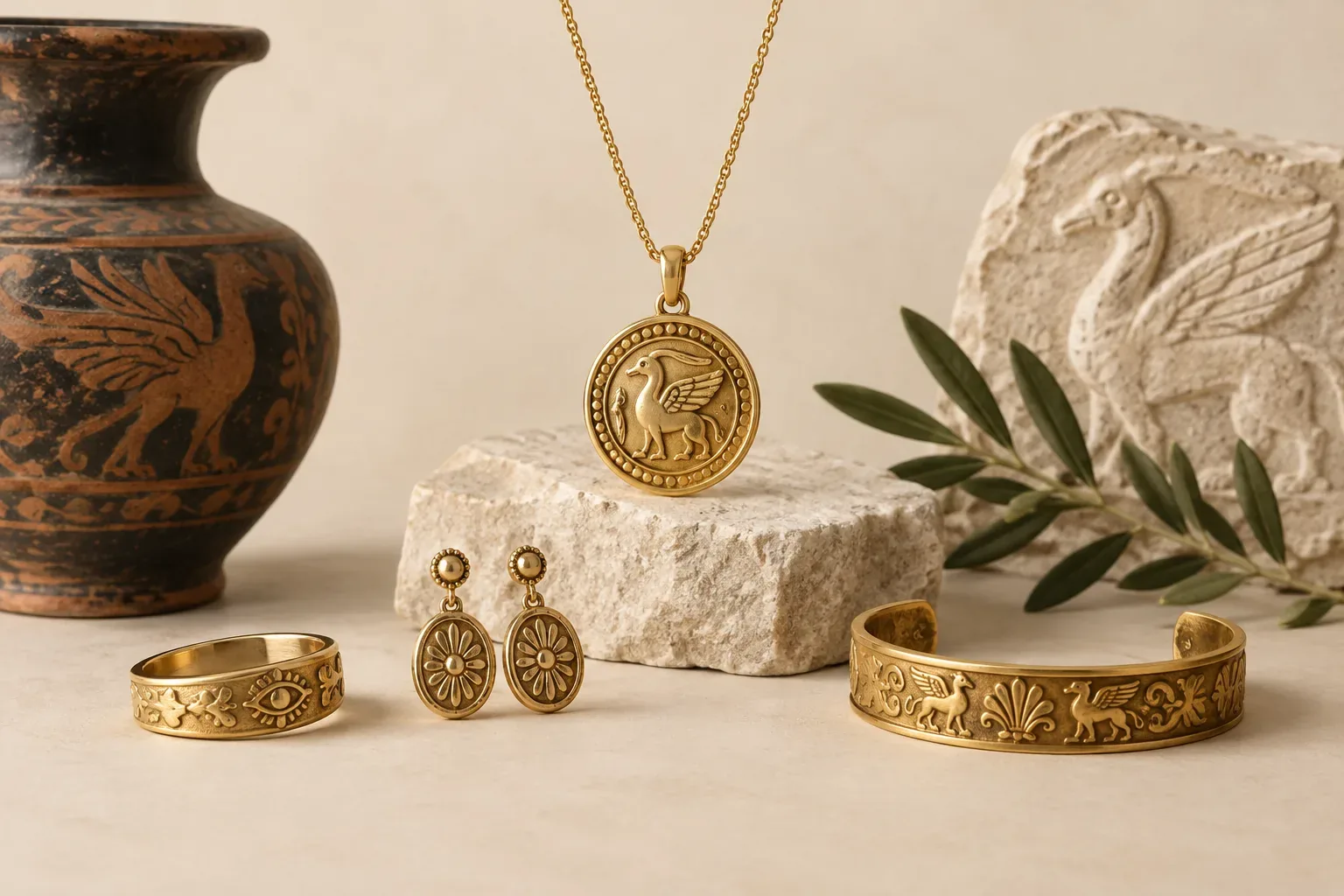
Many motifs now labeled “Etruscan” are geometric or vegetal patterns and animal forms frequently found in Mediterranean metalwork. The archaeological and museum record supports reading these motifs as decorative elements that conveyed craft prestige and social information about the wearer. For example, repeated rosettes, palmettes, spirals, and granulated surfaces are widely documented as part of the visual vocabulary of elite adornment across the region, but museums treat their interpretation cautiously, focusing on craft technique and context rather than on single symbolic definitions.
Techniques often associated with Etruscan-style work—such as granulation (tiny gold beads applied to a surface) and refined filigree—are well documented in museum collections as demonstrations of technical skill and luxury. The Victoria and Albert Museum frames these techniques within broader changes in jewelry fashion and social context, noting how skilled metalworking signaled wealth and specialist craftsmanship. The presence of such work in graves and hoards links it to status and funerary display more than to explicit theological statements in surviving texts.
Where gemstones appear in ancient Mediterranean jewelry, their selection is frequently a matter of availability, color symbolism in a particular culture, and trade connections. The Victoria and Albert Museum’s writings on gemstones emphasize historical context and identification: stones like garnet, carnelian, and other semiprecious gems are common across ancient collections. However, assigning a single, universal symbolic meaning to any given stone in Etruscan contexts is not warranted by the museum evidence; meanings vary by period, place, and cultural practice.
How motifs, gemstones, and traditions appear in jewelry (ancient and modern)
In ancient contexts, “Etruscan” techniques appear as worked gold necklaces, fibulae (brooches), earrings, and grave goods where granulation, filigree, and repoussé ornament show high-level metalworking. Museums describe these as material expressions of wealth and identity, often placed with the deceased or displayed by elites. The physical presence of these objects in burial contexts and settlements is key evidence for their social role.
In the 19th century and beyond, jewelers revived Etruscan forms and techniques as part of historicist fashions. The Victoria and Albert Museum’s surveys of jewelry history explain how revival practitioners adopted and adapted ancient motifs, sometimes combining authentic techniques with modern manufacturable methods, producing pieces identifiable as ‘Etruscan Revival’ rather than ancient originals.
Contemporary designers borrow motifs, textures, and techniques for personal or aesthetic reasons. Modern makers may use genuine granulation, cast reproductions, or surface treatments that mimic ancient finishes. When gemstones are included, their modern selection often prioritizes color, durability, and cost, while buyers may ascribe personal symbolism that is not directly rooted in the ancient record but meaningful to the wearer.
Separating documented historical meanings from modern interpretations
Documented historical evidence supports reading Etruscan-type jewelry primarily as material culture reflecting craft, status, and funerary practice. Museum interpretation tends to focus on context—who wore the object, where it was found, and what techniques it shows—rather than on fixed symbolic glosses. Where inscriptions or direct textual evidence exist in any culture, museums use them to constrain interpretation, but in many Etruscan cases those sources are limited.
Modern and popular interpretations often layer new meanings onto ancient motifs. Nineteenth-century revivalists reinterpreted ancient forms for Victorian ideals of antiquity, and contemporary wearers may read motifs as personal emblems, spiritual signs, or fashion statements. These personal and cultural reinterpretations are valid as modern meanings but should not be conflated with what the archaeological or museum record actually documents about original Etruscan intent.
Practical guidance for choosing, wearing, or gifting Etruscan-inspired jewelry
Consider provenance and maker transparency. If you are buying an object described as ancient or as a historic revival, check the seller’s documentation and ask for provenance details. Museum guidance about jewelry history highlights how revivals and modern reproductions can closely resemble older work, so clear labeling and seller transparency are essential.
Ask about materials and treatments. The Federal Trade Commission provides consumer guidance on buying gemstones, diamonds, and pearls, and stresses that sellers should disclose treatments, imitations, and enhancements. When gemstones are present, request written information on whether the stone is natural, treated, lab-grown, or an imitation, and whether a report from a recognized gemological lab is available.
Match the piece to the recipient’s values and the occasion. If you are gifting an Etruscan-inspired item to mark heritage or scholarly interest, choose pieces that are clearly presented as historically informed reproductions or museum-quality reproductions from reputable makers. If the recipient values contemporary design, artists who adapt ancient motifs in clearly modern ways can offer respectful references without implying false antiquity.
Respect cultural context and avoid appropriation claims by being transparent about the object’s age and origin. If an item is presented as ‘Etruscan’ but is a modern piece inspired by ancient forms, ensure that the label and description make that clear. Museums and educators emphasize the importance of accurate context in understanding historical jewelry.
Care and longevity: gold and many semiprecious stones used in Etruscan-type jewelry are durable but require proper care. Ask the seller for care instructions, and consider professional cleaning and conservation advice for very old or delicate items.
Final brief guidance for collectors and wearers
Use museum resources and trusted specialists when you need historical context or authentication. The Victoria and Albert Museum and similar institutions provide accessible overviews of techniques and historical change, which are useful starting points for assessing a piece’s style and probable period. For consumer protection regarding gemstones and treatments, rely on guidance from government consumer resources such as the Federal Trade Commission.
When choosing Etruscan-inspired jewelry, prioritize transparent labeling, documented provenance for antiques, and ethical sellers. Enjoy the motifs as part of a long visual tradition while recognizing that ancient meanings were diverse and often tied to social contexts that do not translate directly into modern symbolic dictionaries.
Frequently asked questions
Do Etruscan jewelry symbols have a single, documented meaning?
No. The archaeological and museum record indicates that such motifs functioned largely as markers of craft, status, and identity in their original contexts. Direct textual evidence that assigns a single symbolic meaning to most motifs is scarce, so museums and scholars interpret meanings cautiously and contextually.
How can I tell if a piece is genuinely ancient or a revival?
Ask the seller for provenance, documentation, and condition reports. Reputable dealers and auction houses provide clear provenance and scientific or scholarly reports when available. Museum surveys of jewelry history show that revival pieces intentionally echo ancient forms, so transparent labeling is essential.
What gemstones were common in Etruscan and ancient Mediterranean jewelry?
Museum overviews note that semiprecious stones such as garnet and carnelian appear frequently in ancient collections. However, the exact use and significance of stones vary by time and place, and modern buyers should request information on whether stones are natural, treated, or lab-grown.
Are there ethical or cultural concerns when wearing Etruscan-inspired designs?
Wearing historically inspired jewelry is common and can be respectful if the piece is accurately described and not misrepresented as an ancient artifact. Being transparent about whether a piece is an original, revival, or contemporary adaptation helps avoid misleading others and honours the historical context.
What should I ask for when buying gemstones in an Etruscan-style piece?
Request written disclosure of treatments, origin statements when available, and any gemological reports. The Federal Trade Commission recommends that sellers disclose treatments, imitations, and enhancements so buyers can make informed decisions.
Sources and further reading
- Bedazzled: A History of Jewellery — Victoria and Albert Museum
- An A-Z of Gemstones — Victoria and Albert Museum
- Buying Gemstones, Diamonds, and Pearls — Federal Trade Commission