Meaning at a glance
This article explains the documented history and evolving contexts of Anglo-Saxon jewelry, separates historically attested uses from later interpretations, describes how motifs and gemstones appear in pieces, and offers practical advice for selecting and gifting jewelry inspired by that tradition.
What the historical evidence shows (and which cultures or periods it documents)
Surviving objects and museum interpretation establish the basics of Anglo-Saxon jewellery history. The Victoria and Albert Museum presents jewellery across periods as part of a broad narrative of changing social context and material culture; that work frames Anglo-Saxon pieces as products of early medieval England with links to continental and insular craft traditions. Objects classified as Anglo-Saxon come from a range of local contexts within early medieval England and reflect contacts with other Germanic and insular artistic traditions rather than a single uniform style.
The archaeological and curatorial record underlines two points consistently: first, fine metalwork and gem-inlaid pieces were costly to produce and therefore associated with wealth and leadership; second, many types of jewellery also circulated as everyday items, repaired and reused, which shows they could combine status display with practical wear. The V&A emphasizes seeing jewellery in relation to how people lived and presented themselves across changing societies rather than as static symbols.
Materials, techniques, and gemstone use documented by museums
Anglo-Saxon jewellery in museum collections commonly incorporates worked gold and silver, glass and gemstone inlays, and skilled joining and setting techniques. The V&A traces jewellery across time to show how materials and techniques both reflect and shape social meaning, and their cataloguing and descriptive work is one of the main public resources for these observations.
Gemstones and glass are frequent inlays in early medieval pieces; museum guides that cover gemstones provide context on how different stones were identified, valued, and used. The V&A’s materials on gemstones discuss how appearance, rarity, and working properties affected choices. Because surviving pieces vary widely in materials and finish, historians rely on both scientific analysis and comparative study to reconstruct how workshops produced inlay and setting effects in metal.
Status, identity, and daily wear: the documented roles of jewellery
Curatorial interpretation stresses that many Anglo-Saxon items functioned as markers of social rank. Exhibitions and catalogue notes explain that elaborate metalwork and gem inlay were costly visible signs of wealth, political ties, or social standing. At the same time, the archaeological record and museum commentaries indicate that jewellery was not solely ceremonial; many items show evidence of repair or practical attachment that imply repeated wear in daily life.
This combination — ceremonial value and everyday use — is central to understanding how jewellery operated in early medieval societies. The V&A’s approach places objects within social practices: how people used jewellery to mark alliances, display wealth, or carry portable tokens of identity, while recognizing regional variation and changing fashions across generations.
Documented meanings versus modern personal interpretation
Museum documentation provides evidence for some functional and social meanings: for example, that high-quality metalwork and gemstone inlay signalled wealth and connections, and that certain object types served as brooches, pendants, rings, or dress fittings. These are grounded in the objects themselves and in context supplied by archaeological finds, conservation, and curatorial study as summarized by the V&A.
By contrast, many symbolic meanings assigned today — specific spiritual powers, universal ancestral meanings, or fixed talismanic properties — are contemporary readings rather than documented historical facts. Modern wearers and makers are free to adopt, adapt, and layer new meanings, but those contemporary interpretations should be presented as modern choices, distinct from what the surviving evidence demonstrates.
How motifs, gemstones, and traditions appear in Anglo-Saxon-inspired jewellery
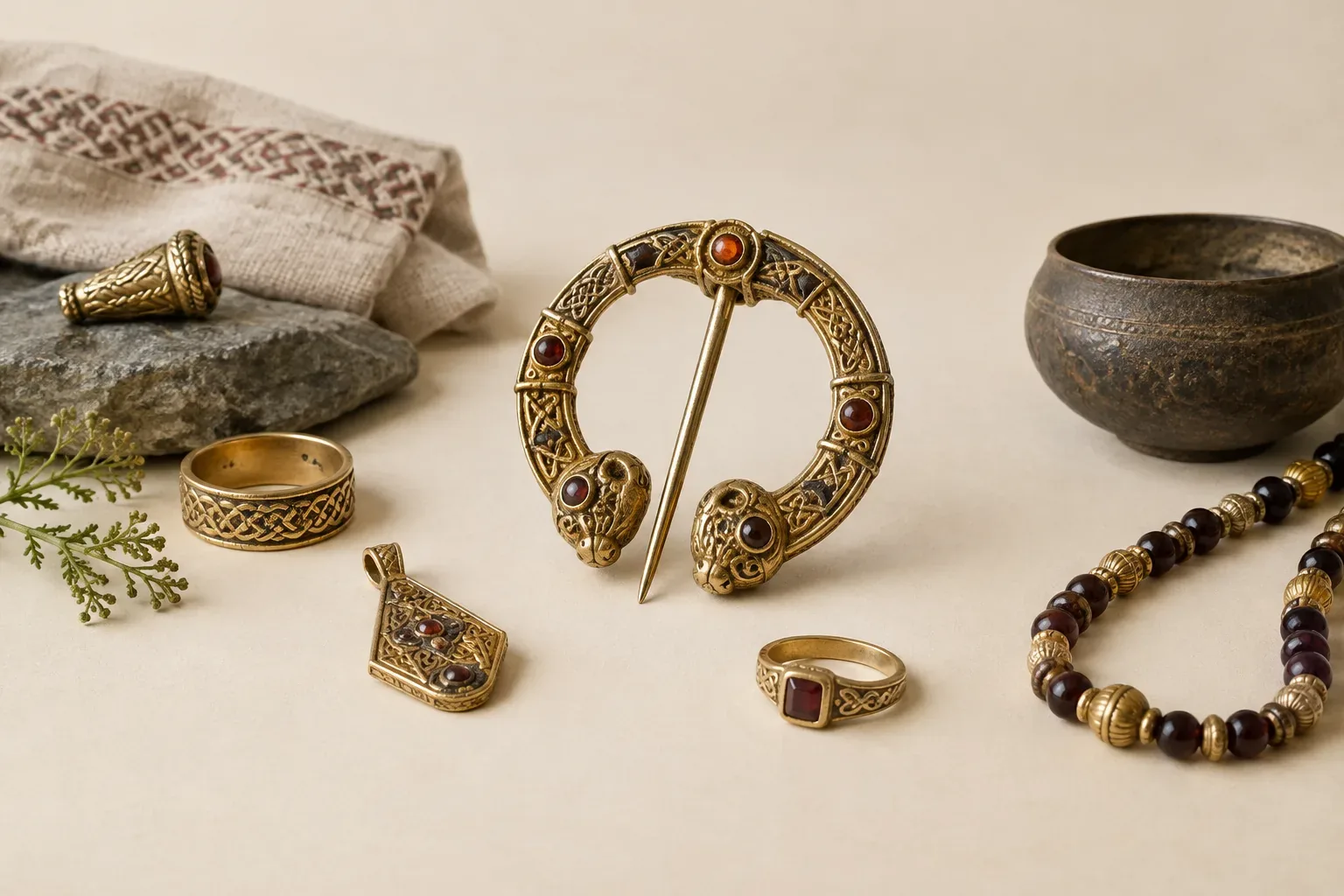
In both historic pieces and modern works inspired by them, motifs appear as decorative panels, inlaid settings, and metalwork relief. The same material vocabulary — worked gold or silver paired with colored inlay and patterned metal — reappears in brooches, pendants, finger-rings, and bead strings. Museums show that artisans combined pattern, color, and form to make jewellery visible from a distance and fine up close, which is why inlay and contrasting materials are common features.
Gemstones and colored glass typically appear as small inlaid elements rather than large cabochons. Museum discussions of gemstones explain how the stone’s color, translucency, and workability influenced its use. Contemporary makers who draw on Anglo-Saxon forms often reproduce these relationships between metal and inlay while using modern cutting and setting techniques.
Practical and respectful guidance for selecting or gifting Anglo-Saxon–inspired jewellery
If you are choosing or gifting jewellery inspired by Anglo-Saxon history, begin by deciding whether you want an object with explicit historic reproduction, a piece that uses historic motifs in a contemporary design, or an item that simply nods to the period. Museum reproductions will usually try to match form and technique, while contemporary pieces may reinterpret motifs and materials for modern wearability.
Consider provenance and materials: if authenticity or collectible value matters, request clear information about materials, treatments, and whether gemstones are natural, treated, or simulated. The U.S. Federal Trade Commission provides consumer guidance on buying gemstones, diamonds, and pearls and on disclosure of treatments and imitations; following those guidelines helps buyers avoid surprises and supports transparent selling practices.
Be mindful of cultural respect. Anglo-Saxon forms are part of an early medieval British visual and material culture; if you are presenting a piece as historically grounded, avoid asserting unverified symbolic meanings. If you or the recipient value contemporary personal symbolism, state that the meaning is a modern adaptation. Finally, choose a wearable scale and durable materials for everyday use, and check care recommendations for metal and stone so that the piece will age gracefully.
Care, authentication, and consumer safeguards
Treatments and imitations affect both appearance and value. Follow the FTC’s guidance when purchasing gemstones: ask sellers to disclose treatments and whether stones are natural, lab-grown, or simulants. If the piece claims to be an original historic object or an accurate reproduction, seek documentation from reputable dealers, museums, or qualified conservators.
For everyday care, simpler forms in solid metal and well-set inlays tolerate more wear. Fragile inlays, thin gold foil, or certain historic techniques used fine elements that are vulnerable to knocks, chemicals, and temperature change. If you are buying a museum reproduction or a modern piece inspired by historical techniques, ask the maker about recommended cleaning and storage.
Summary
Anglo-Saxon jewellery history is best understood through surviving objects, archaeological context, and museum interpretation. The documented record shows a mix of status display and everyday use, with materials and techniques chosen for visibility and durability. Modern wearers may find personal meaning in these forms, but those interpretations are contemporary and should be distinguished from what the evidence — as presented by institutions like the Victoria and Albert Museum — actually documents. For purchases, follow consumer-protection guidance on gemstones and treatments and seek transparent information about provenance and materials.
Frequently asked questions
Was Anglo-Saxon jewelry meant to be worn every day or only on special occasions?
The documented record, as presented by museum interpretation, indicates both uses: elaborate pieces signalled status and could be worn for display, while many items show repair and attachment evidence consistent with repeated or everyday wear. Museums treat these uses as complementary rather than mutually exclusive.
Do specific Anglo-Saxon motifs have one documented symbolic meaning?
No single, universal symbolic meaning for most motifs is documented in the surviving evidence. Museums and scholars emphasize context: motifs can indicate stylistic influences, workshop practice, or social affiliations, but modern spiritual or talismanic readings are contemporary interpretations rather than proven historical facts.
How can I be sure a gemstone in a historic-style piece is natural or untreated?
Ask the seller for full disclosure about the stone’s origin, whether it is natural, lab-grown, treated, or a simulant. The U.S. Federal Trade Commission provides guidance that sellers should follow on disclosing treatments and imitations; obtaining written confirmation or a gemological report helps protect buyers.
Is it respectful to wear jewellery inspired by Anglo-Saxon designs?
Yes, provided you avoid claiming unverified historical meanings or presenting a modern design as an original historic artifact. If you value historical accuracy, seek reputable makers, museum reproductions, or clear statements of provenance and interpretive intent.
Where should I look for reliable information about the history and materials of Anglo-Saxon jewellery?
Begin with museum resources and catalogues that contextualize objects, such as material from the Victoria and Albert Museum on the history of jewellery and gemstones. For consumer concerns about materials and treatments, consult government consumer guidance like the Federal Trade Commission’s advice on buying gemstones.
Sources and further reading
- Bedazzled: A History of Jewellery — Victoria and Albert Museum
- An A-Z of Gemstones — Victoria and Albert Museum
- Buying Gemstones, Diamonds, and Pearls — Federal Trade Commission