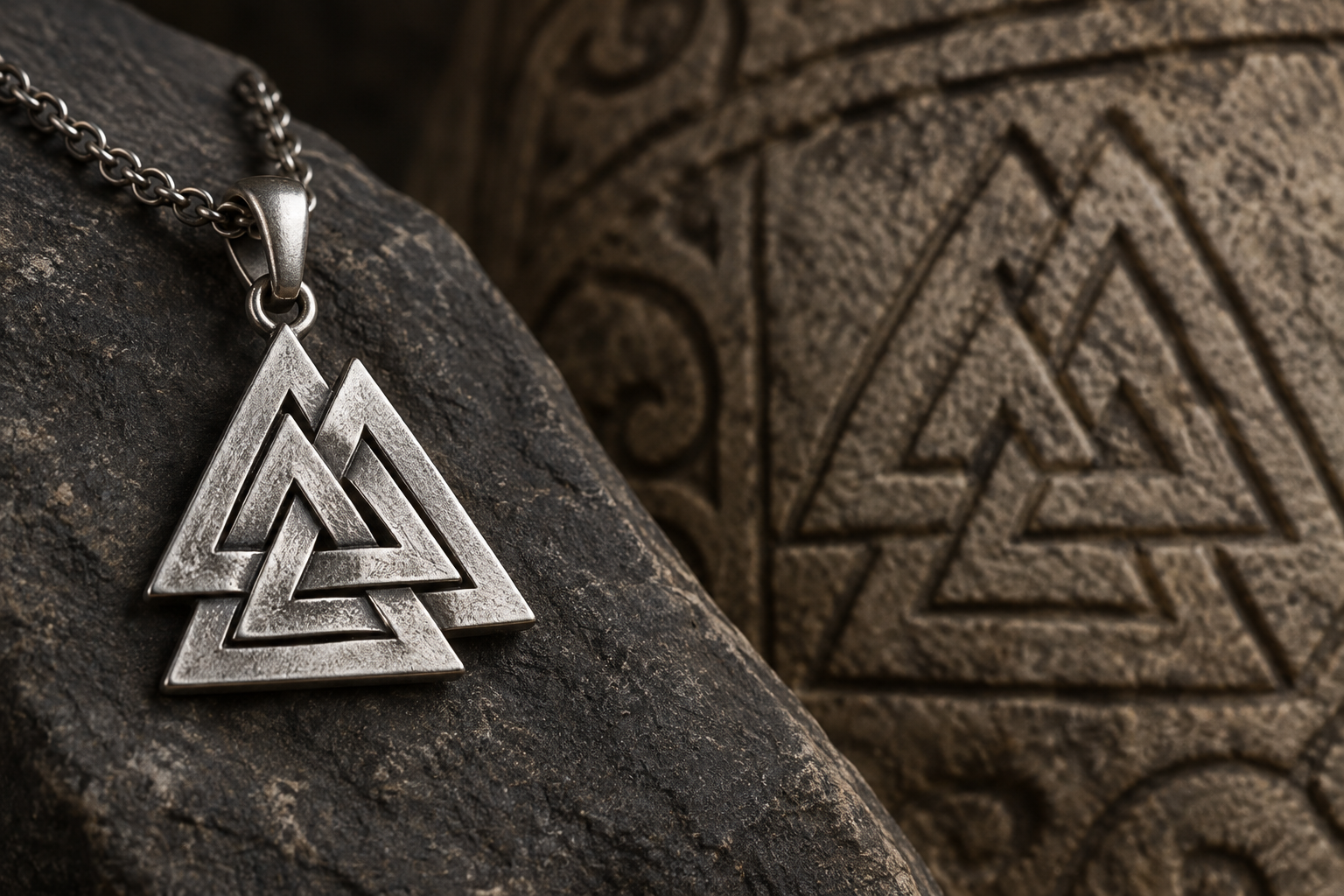
Meaning at a glance
The interlaced three‑triangle motif called the Valknut appears in Viking Age imagery, but its modern name and a single certain ancient meaning are not securely documented; jewelry meanings involving Odin, the slain, courage, or fate should be labeled interpretations.
Quick answer
The motif commonly called the Valknut — three interlaced triangles — appears in Viking Age imagery, yet the label "valknut" is a modern name and there is no single, securely documented ancient meaning for the symbol; claims that it definitively represented Odin, the slain, fate, or specific ritual use are modern interpretations rather than proven historical fact.
What the historical evidence shows
Archaeological and iconographic evidence places the three‑triangle motif in Viking Age contexts. Scholarly work surveying a range of artifacts and images shows that the interlaced triangle design occurs on objects and images that date to the Viking Age, and it is recorded and discussed by specialists in Viking iconography. As summarized in research published through Aarhus University, the motif appears in Viking Age imagery but the modern label "valknut" is not an attested Old Norse name for the device.
Museum documentation likewise cautions against treating a single ancient meaning as established. The Swedish History Museum notes that while the motif occurs on Viking Age objects, direct evidence that pins down one fixed purpose or belief attached to the symbol is lacking. Because the primary sources from the Viking Age do not include clear written statements that explain the symbol, modern attributions about its precise ancient meaning remain interpretive.
Separating documented history from modern interpretations
The safe historical claim is limited: the three‑triangle motif appears in Viking Age contexts and the name "valknut" is a later term. Any stronger statement about what the symbol meant in the minds of people in the Viking Age is interpretive rather than documented. Both the academic survey at Aarhus University and object records at the Swedish History Museum underline this distinction.
Modern narratives often link the motif to Odin, to the realm of the dead, to warriors slain in battle, or to abstract concepts such as fate and courage. Those associations can be meaningful today, and they frequently draw on broader Norse mythological themes, but they should be presented as modern readings or reasonable hypotheses rather than as incontrovertible historical facts. When presenting or wearing the symbol, responsible labeling that distinguishes historical evidence from contemporary meaning helps avoid confusing past and present.
How the motif, gemstone choices, and tradition appear in jewelry
In contemporary jewelry the three‑triangle motif is used in many forms: as small stamped or cast pendants, engraved ring motifs, inlaid metalwork, layered or openwork designs, and as repeating pattern bands. Designers use the simple geometric quality of the motif to create both delicate and bold pieces. While historical artifacts provide the motif, modern makers adapt it to current tastes and manufacturing methods, producing items in silver, gold, stainless steel, and mixed metals.
Gemstones and materials are modern additions to how the motif is worn and read. Jewelers may set black onyx, garnet, or other stones within the negative space of the triangles for contrast, or pair the motif with amber or ethical cabochons for a warm, historical feel. Gemstone choices typically reflect contemporary aesthetics or symbolic attributions chosen by the wearer or designer rather than any documented Viking Age practice linked specifically to the three‑triangle motif.
Designers and makers also combine the interlaced triangles with other Norse motifs such as runic inscriptions, Mjölnir‑style hammer shapes, or stylized trees. Those pairings are contemporary design choices that create layered meanings for modern wearers: some people use them to express interest in Norse myth, ancestry, or personal values such as resilience, while others enjoy the motif purely for its geometric form.
Practical and respectful selection or gifting guidance
If you are choosing or gifting jewelry featuring the three‑triangle motif, start by agreeing on what the symbol will mean to the wearer. Because historical sources do not establish one certain ancient meaning, it's considerate to label any intended meaning as a modern interpretation. A short accompanying note explaining whether you mean the motif as a nod to Viking Age imagery, a symbolic personal reminder, or simply an attractive geometric design helps recipients understand your intent.
Select materials and makers with care. Look for reputable artisans or manufacturers who provide clear descriptions of materials, sizes, and care instructions. If the recipient has metal allergies, choose hypoallergenic metals or properly plated options. If authenticity or provenance matters to you, prefer makers who are transparent about production methods and sourcing.
Be mindful of context. Because the motif is visually striking and has acquired layers of modern meaning, consider where and how the recipient might wear it. For a first gift, small, adjustable pieces such as a pendant on a simple chain or a modest ring are conservative choices. If you want to emphasize a personalized message, include a card that explains whether the symbol is presented as historical, aesthetic, or interpretive.
Frequently asked questions
What exactly does "valknut" mean?
The name "valknut" is a modern label for the interlaced three‑triangle motif; historical sources from the Viking Age do not record this name as an original term, so the word itself should be treated as a later designation.
Did Vikings use this symbol to represent Odin or the dead?
Some modern writers and makers connect the motif to Odin or to ideas about the slain, but the primary evidence does not establish a single ancient meaning. Museums and academic surveys note that interpretations linking the symbol definitively to Odin or to funeral rites are modern readings rather than secure historical facts.
Is it respectful to wear or gift Valknut jewelry?
Yes, it can be respectful when you are clear about what the symbol means to you or the recipient. Because historical meaning is not fixed, include a note if you present a modern interpretation or if you mean the piece as an aesthetic or heritage‑inspired object.
What should I look for when buying this motif as jewelry?
Choose reputable makers, check material and size details, consider the recipient's metal sensitivities, and prefer pieces accompanied by clear descriptions that state whether meaning is historical, interpretive, or purely decorative.
Can gemstones or added symbols make a Valknut piece more meaningful?
Yes. Gemstones, metal finishes, and pairings with other motifs allow wearers to layer personal meanings onto the motif. These are contemporary choices and do not change the historical fact that a single ancient meaning for the symbol is not established.
Sources and further reading
- A Valknut in the Capitol: Viking Age Symbol and Modern Myth — Aarhus University
- The sources for what we know — Swedish History Museum