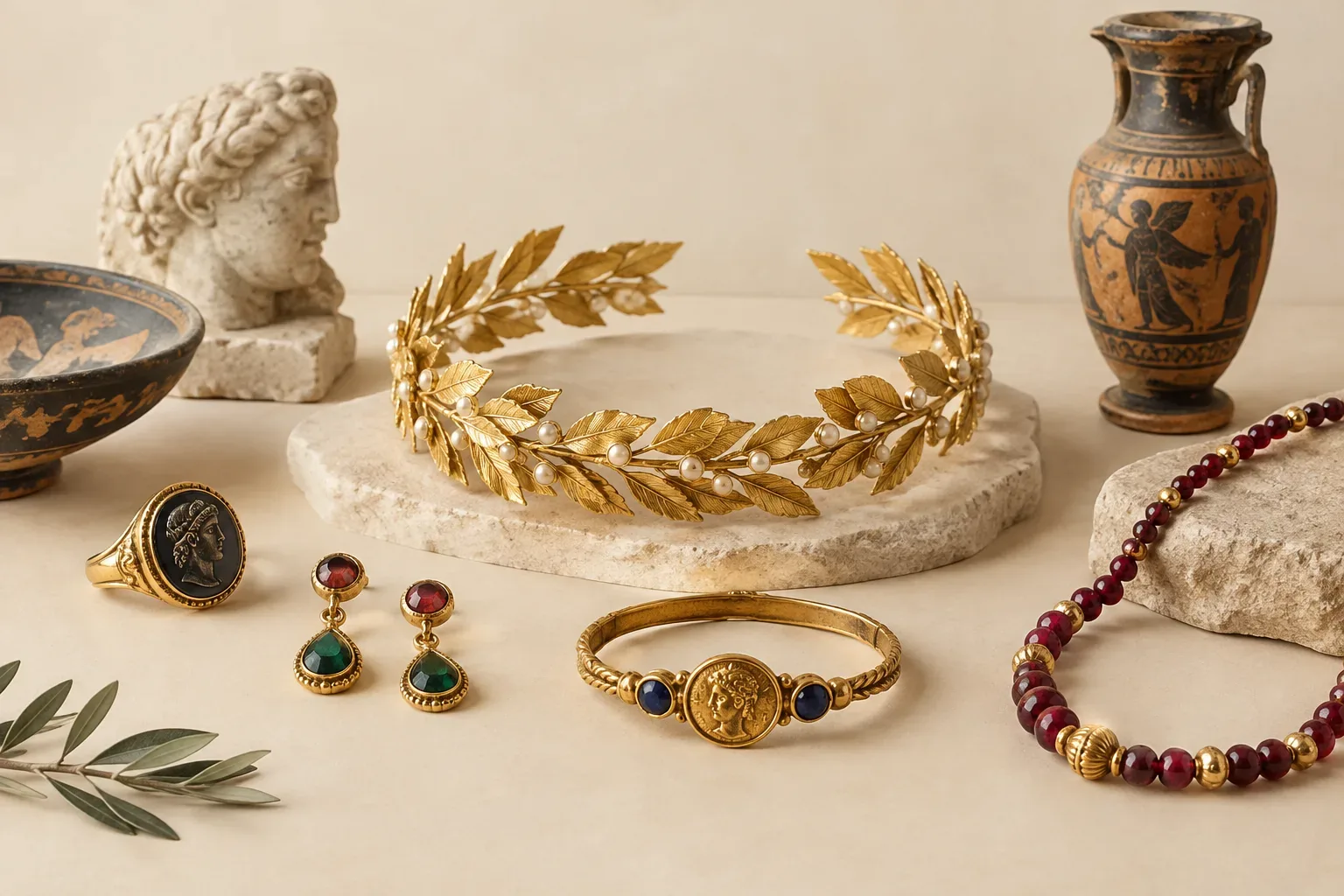
Meaning at a glance
This article explains documented features of ancient Roman jewelry history—materials, techniques, social meanings and daily use—separates historical evidence from later interpretations, shows how common motifs and gemstones are deployed in objects, and offers practical, respectful buying and gifting guidance for modern wearers.
What the historical evidence shows (which cultures and periods)
The interpretation of Roman jewelry comes from archaeological finds, burial assemblages, hoards, museum collections, and surviving objects catalogued by museums and scholars. The Victoria and Albert Museum presents jewelry history as a continuous conversation between cultures and periods, noting that Roman jewellery borrowed techniques and motifs from earlier and neighboring cultures.
Key cultural and chronological points to keep clear are these: Etruscan goldsmithing techniques influenced early Roman metalwork; Hellenistic art and gem-carving informed motif and iconography across the Mediterranean; the Roman Republic saw increasing personal display through rings and brooches; the Imperial period expanded production, regional styles, and access to imported gemstones; and Late Antiquity shows both continuity and changes in taste and function as Christianity and provincial traditions altered forms and iconography.
Materials and techniques documented in the record
Gold and silver were the primary precious metals for Roman jewellery, used both in high-status pieces and in a range of objects that signalled rank and wealth. Base metals and alloys, such as bronze, also appear in common personal items. The Victoria and Albert Museum outlines how jewelers worked gold with techniques such as casting, hammering, filigree, granulation and soldering—methods inherited and adapted from earlier Mediterranean metalwork traditions.
Gemstones, glass, and semi-precious inlays feature widely. The museum’s resources on gemstones explain that ancient owners used stones for color and durability, and that gem types circulated widely through trade. Glass and glass paste were often used where gemstones were expensive or to imitate rarer materials. Archaeological evidence documents both unworked beads and carefully carved gemstones—especially intaglios and cameos—set in rings, pendants, and brooches.
Documented social meanings versus modern interpretations
The archaeological and museum record supports some clear historical functions for Roman jewellery. Objects served as indicators of wealth and social status, as personal identity devices (for example, signet or intaglio rings used to seal documents), and sometimes as objects with protective or religious associations. The Victoria and Albert Museum stresses changing social contexts: the same technique or motif could mean different things in different regions or periods.
Modern personal interpretations—such as reading a particular Roman motif as a universal symbol of love, luck, or a specific modern identity—are contemporary meanings layered onto ancient objects. These modern meanings are valid as personal symbolism, but they are not the same as documented historical uses unless supported by evidence. Avoid treating any ancient symbol as having one fixed significance across the Roman world.
How motifs, gemstones, and traditions appear in Roman jewellery
Motifs in Roman jewellery commonly draw on portraiture, mythological scenes, animals, botanical forms, and geometric ornament. These appear in carved gem intaglios and cameos, in repoussé and chased designs on metal surfaces, and in small cast or sheet-metal elements attached to necklaces, bracelets and brooches. Museums catalogue many examples where the subject of a carved gem or a cast plaque reveals both aesthetic taste and social reference.
Gemstones appear either as set stones—mounted in bezels or collets in rings and pendants—or as strung beads in necklaces and bracelets. The museum's overview of gemstones notes that both natural stones and imitations (for example glass) were used; gem cutting and carving could transform a bead into a miniature narrative or personal device such as a signet. The visible placement of stones (rings, ear-hangings, collars) made gemstones a practical way to signal wealth and fashion.
Jewellery in daily life: wear, repair, and regional variation
Archaeological finds show that many Roman jewels were made to be worn regularly. Rings, earrings, brooches (fibulae), necklaces and hairpins appear in domestic contexts and graves, indicating everyday use alongside occasional or ceremonial pieces. The durability of metalwork and the repair traces on some objects demonstrate that jewellery could be maintained and reused rather than discarded.
Regional variation is well documented: provincial workshops adapted metropolitan fashions to local taste and available materials, producing distinctive regional styles in Gaul, Britannia, Egypt and elsewhere. The Victoria and Albert Museum’s surveys emphasize that studying context—where an object was found and how it was used—matters for understanding daily wear patterns.
Practical and respectful guidance for selecting or gifting Roman-inspired jewellery
When choosing or gifting Roman-style jewellery today, be clear about what you want the piece to represent. If your interest is historical authenticity, look for reliable provenance, conservation documentation, and expert attributions from museums or reputable dealers. The Victoria and Albert Museum’s approach to jewellery history highlights the difference between museum-quality objects and modern reproductions.
If you are buying a modern piece inspired by Roman designs, ask the seller about materials, treatments and any imitations. The Federal Trade Commission advises consumers to request accurate disclosure of gem treatments, synthetic stones, and imitation materials. Ensure that the seller labels natural, treated, and synthetic gems correctly and states metal content and any plating. Respect cultural and religious contexts: avoid claiming that a revived or reproduced motif carries the same spiritual or social power as it might have had in a different historical or cultural setting, and be cautious about using symbols that have known sacred or community meanings in ways that could upset contemporary communities.
For gifts, match style and scale to the recipient’s daily habits. A historically inspired signet ring may be meaningful for someone who enjoys history, while a lighter pendant or stud earring will suit everyday wearers. Consider practicalities: metals that contact skin daily may cause reactions in some people, so check metal content and hypoallergenic options and, if the piece includes fragile carved elements, advise gentle handling and appropriate insurance or conservation advice for valuable items.
Conservation, reproduction and ethical buying
If you encounter claimed 'ancient' jewellery on the market, seek professional verification. Museums and accredited dealers can help assess authenticity through provenance records and specialist analysis. For modern reproductions, confirm whether the piece intentionally replicates an existing object and whether the maker acknowledges that origin.
Ethical considerations include respecting laws and museum guidelines on antiquities, avoiding illicitly exported objects, and preferring transparent sellers who disclose treatment and origin. The Federal Trade Commission’s consumer guidance provides practical steps for verifying gem and material claims and for understanding treatment disclosures.
Closing: why context matters
Ancient Roman jewellery history is a story of materials, artisanship and social meaning that shifted across time and place. The Victoria and Albert Museum’s collections and interpretive resources underline that objects must be read in context: the same motif or material could signify status, identity, protection or fashion depending on the period, region and wearer. Modern wearers and gift-givers can appreciate the beauty and history of Roman-inspired pieces while making informed, respectful choices about authenticity, disclosure and cultural sensitivity.
Frequently asked questions
Were ancient Roman jewels worn by men and women?
Yes. Archaeological and museum records document that both men and women wore jewellery in ancient Rome, though types and styles could differ. For example, rings and signet intaglios are often associated with legal and administrative functions for men as well as display by women, and brooches, necklaces and hair fittings appear in a wide range of contexts for all genders. Context and regional practice determine much of the variation.
How can I tell whether a gemstone in a Roman-style piece is natural or an imitation?
Seek clear disclosure from the seller and, where possible, a laboratory report. The Federal Trade Commission recommends asking for details about treatments, synthetics and imitations. Modern reproductions often use glass or synthetic stones to imitate natural gems; reputable sellers will label these materials accurately.
Is it appropriate to wear ancient motifs today?
Wearing ancient-inspired motifs is appropriate when done with respect and awareness. Consider the historical and cultural context, avoid claiming ancient meanings as universal fact, and be sensitive if a motif has a contemporary sacred or community role. If authenticity matters, verify provenance; if the piece is a reproduction, the maker should disclose that clearly.
Do museums sell authentic ancient jewellery?
Museums typically do not sell ancient artefacts from their own collections. If you are offered an 'ancient' object, request provenance documentation and independent authentication. For historically accurate wearable pieces, consider buying reputable reproductions or commissioning contemporary makers who study period techniques.
Sources and further reading
- Bedazzled: A History of Jewellery — Victoria and Albert Museum
- An A-Z of Gemstones — Victoria and Albert Museum
- Buying Gemstones, Diamonds, and Pearls — Federal Trade Commission