Meaning at a glance
Explain the documented history and changing contexts of the ancient greek jewelry identification motif, separate cultural or religious evidence from later popular interpretations, and give practical guidance for choosing and wearing the motif in modern jewelry.
Quick answer
Use museum-documented features—stylistic motifs, gold-working techniques, mounting styles, and period-specific gemstone use—to identify ancient Greek jewelry and to distinguish historically documented meanings from modern reinterpretations. The Victoria and Albert Museum’s scholarship and collections provide the clearest comparative evidence for how motifs and materials changed across Greek periods, while modern buying guidance on treatments and imitations comes from consumer-protection authorities such as the U.S. Federal Trade Commission.
What we mean by "Ancient Greek" jewelry
“Ancient Greek” is a broad label used by museums and scholars to group objects made in the Greek-speaking world and in regions under Greek cultural influence over many centuries. Museums generally divide that span into recognisable periods (for example, the early geometric and Archaic periods, the Classical period, and the Hellenistic era), with each period showing different tastes in form, motif, and technique. The Victoria and Albert Museum’s historical surveys and collections emphasise these changing contexts when they describe ancient jewellery and how social meaning, technology, and trade affected style.
Evidence used to identify motifs and dates
Identification rests on stylistic comparison, known manufacturing techniques, archaeological find contexts, and comparative museum cataloguing. Museums like the Victoria and Albert document groupings of motifs and technical features that recur in objects attributed to particular periods or regions, and those groupings are the primary evidence scholars use to assign a piece to a cultural phase.
Technical features include goldworking methods (for example, use of granulation and filigree), the composition and cutting of gemstones, and the way elements are assembled—soldering versus looped or pinned constructions. Gemstone types and cutting techniques, discussed in museum resources about gems, also help narrow attributions because different stones and cuts were fashionable at different times and places.
Common motifs and their historical contexts
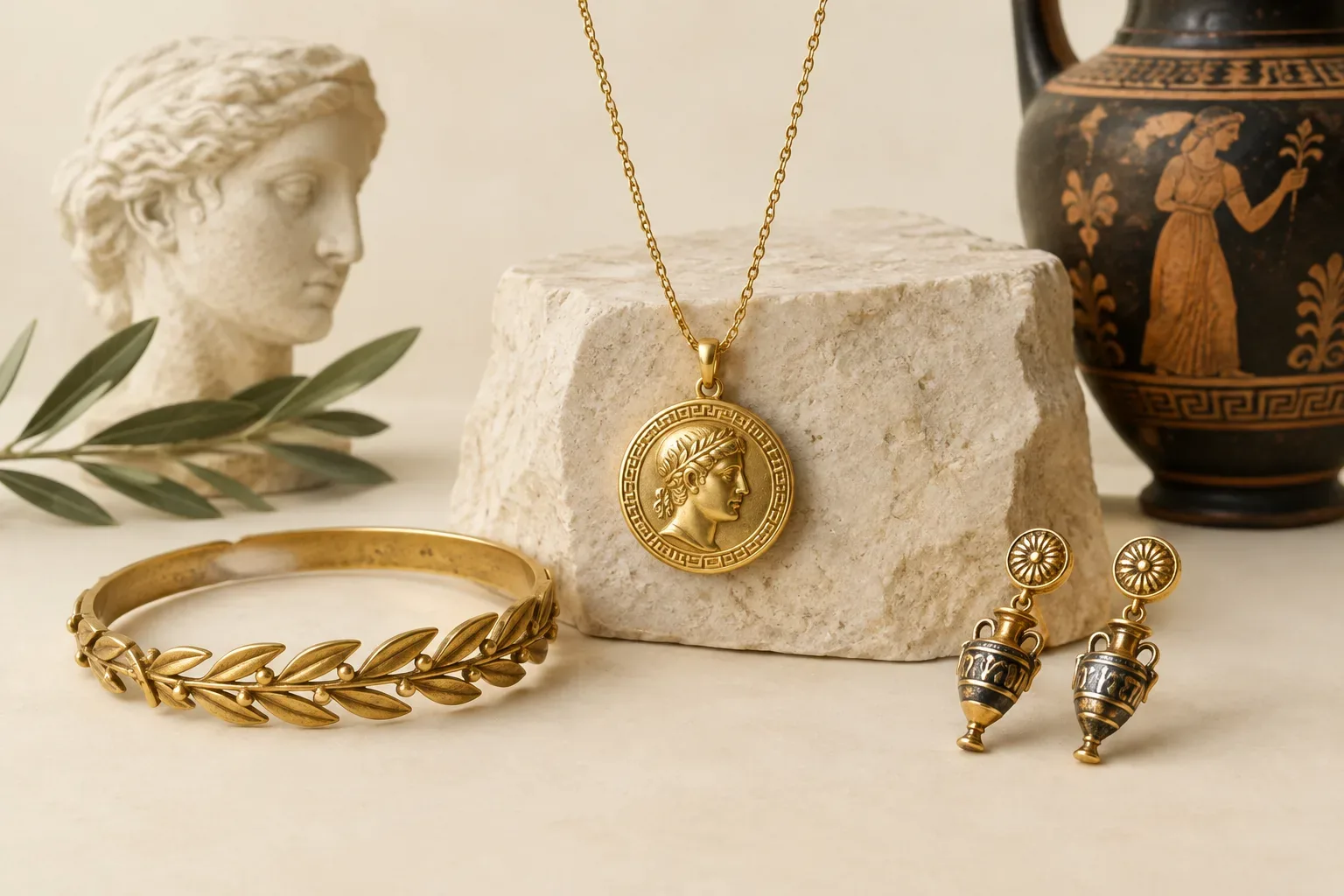
Geometric patterns such as the meander or “key” motif are widely found across Greek-period objects and often function as decorative borders rather than explicit religious symbols. Museum descriptions place these motifs within long decorative traditions rather than assigning a single fixed meaning to them.
Natural and plant-inspired designs—palmettes, lotus shapes, and laurel or olive wreaths—appear in jewellery and often reflect broader decorative vocabulary used on architecture, pottery, and metalwork. In museum contexts these designs are documented as shared decorative language rather than evidence that every wearer held the same belief about them.
Figural motifs, including depictions of mythological figures, animals, or protective faces, do appear in ancient Greek jewellery. Museum catalogues record some pieces used in funerary contexts or as protective emblems, but museums caution that the exact significance can vary by region and period and that surviving pieces rarely carry written explanations from their original owners.
Signet rings and intaglios were practical as well as decorative: engraved gems could serve as seals, personal marks of ownership, or display of status. The Victoria and Albert Museum’s materials on gemstones and jewellery history underline that carved gems functioned in multiple roles across the Greek world.
How motifs, gemstones, and traditions actually appear on pieces
Motifs show up as punch-work or repoussé on gold plaques, as tiny granulated patterns worked into a surface, or as raised reliefs on small cast panels set into necklaces, diadems, or finger rings. Museums often point to technique as a key identifier: for example, where granulation and minute soldering are present, specialists look to established typologies to place the piece in a probable workshop tradition or period.
Gemstones appear in settings appropriate to their hardness and cutting: harder stones were used for intaglios and signets, while softer or translucent stones were mounted as inlays or beads. The Victoria and Albert’s summary of gemstones explains how different stones have been cut and used in decorative arts across history, which helps conservators and curators identify likely period uses.
Wear patterns, corrosion of metal components, and the way mounts are constructed also tell a story. Museum conservators use those physical clues, alongside documented find-spots and comparative examples, to support identifications.
Documented meanings versus later or modern interpretations
When museums interpret an object’s meaning, they rely on archaeological context, comparative material, and contemporary texts when available. That kind of documented interpretation is different from modern personal or commercial readings. For example, a laurel wreath motif may be associated in modern culture with victory or achievement, but museum documentation shows the motif circulated as part of a wider decorative vocabulary and could indicate civic, religious, or aesthetic associations depending on context.
Modern sellers and designers may attach new symbolic language to ancient motifs—such as assigning a single spiritual meaning to a geometric border—without historical evidence. The Victoria and Albert Museum stresses changing social contexts and multiple uses for motifs, which means no single ancient symbolic meaning is universal across time and place. Treat modern symbolic attributions as contemporary meanings rather than proven ancient beliefs.
Common mislabels to watch for
The phrase “Greek key” is often used in commercial listings to mean any meander pattern; museum cataloguing prefers the term meander and explains its decorative role rather than implying a single ancient meaning. Similarly, objects described simply as “amulets” may actually be decorative pendants, signet rings, or funerary offerings—labels that can conflate form with function without supporting context.
Another frequent issue is treating an object described as “ancient” without provenance or professional attribution; museum practice emphasizes provenance and comparative study. Also be cautious when motifs associated with later folk practices are retroactively attributed to ancient religious uses without evidence.
Material authenticity, treatments, and buyer protection
Modern detection of treated or imitation gemstones is a routine part of authentication. The U.S. Federal Trade Commission’s buying guidance explains that treatments, stabilization, and imitations must be disclosed to buyers and that sellers should be transparent about enhancements or lab-created materials. That guidance is useful when evaluating whether a piece is an unrestored ancient object, a later historic revival, or a modern piece inspired by ancient forms.
Ask for documentation about material tests, treatment disclosures, and any conservation reports. For gemstones, request whether the stone is natural, treated, composite, or lab-grown and whether any stabilizing resins or fills have been applied. For metalwork, look for conservation records that describe cleaning and stabilisation, because aggressive modern polishing can remove evidence used for dating.
Practical and respectful selection or gifting guidance
Decide whether you want authentic antiquities, museum-quality historic pieces, or modern jewellery inspired by ancient Greek motifs. Each choice requires different due diligence: authentic antiquities should have secure provenance and professional certification; historic pieces may need conservation histories; modern inspired pieces should be honest about being contemporary and not claim false antiquity.
If gifting a motif with cultural resonance, consider the recipient’s knowledge and values. Choose a design whose modern meaning you can explain if it differs from historical uses, and avoid implying ancient religious beliefs as the wearer’s personal creed unless that is deliberate and informed. Museum sources remind us that motifs circulated across civic, religious, and decorative contexts, so an explanatory note or card that separates documented history from contemporary interpretation is a respectful and informative approach.
When buying, prefer reputable dealers, auction houses, and institutions that provide clear provenance and condition reports. For gemstones and treated materials, insist on full disclosure in line with consumer-protection guidance, and consider independent appraisal when price or authenticity is important to you.
Frequently asked questions
How can I tell if a piece is actually ancient Greek or a modern reproduction?
Look for secure provenance, professional condition reports, and comparative museum references. Museums such as the Victoria and Albert rely on find-spot data, stylistic comparison, and technical analysis to date objects. For buyers, ask dealers for documentation and consider independent expert appraisal; the U.S. Federal Trade Commission recommends obtaining clear disclosures about treatments and lab-grown or imitation materials.
Does a common motif like the meander have a single fixed meaning?
No. Museum documentation treats motifs like the meander as part of a broader decorative vocabulary used in many contexts. While later popular interpretations may assign a specific symbolic meaning, that is a modern reading rather than a universally attested ancient belief.
Are gemstones used in ancient Greek jewellery the same as modern gemstones?
Many of the same minerals were used historically, but cutting styles, treatments, and trade sources changed over time. The Victoria and Albert’s gemstone guides explain historical uses and help specialists match stone types and cuts to probable periods. Modern treatments and synthetic alternatives should be disclosed by sellers under consumer-protection guidance.
Is it respectful to wear ancient motifs adapted into contemporary jewellery?
Yes, provided you avoid falsely claiming antiquity and you acknowledge the difference between documented historical meanings and contemporary personal symbolism. A short note explaining historical context and your personal reasons can be both informative and respectful.
What documentation should I request when buying a supposedly ancient piece?
Request provenance records, conservation or lab reports, photographs of any finds or collection history, and full disclosure on gemstone treatments. If the piece lacks provenance or appears recently surfaced, treat the attribution as unverified and seek specialist advice.
Can a jeweller reliably replicate ancient techniques like granulation?
Highly skilled modern goldsmiths can reproduce many ancient techniques, including granulation and filigree. However, reproduction does not equal antiquity; replicas should be clearly presented as modern and should not be marketed as original artefacts.
Sources and further reading
- Bedazzled: A History of Jewellery — Victoria and Albert Museum
- An A-Z of Gemstones — Victoria and Albert Museum
- Buying Gemstones, Diamonds, and Pearls — Federal Trade Commission