Meaning at a glance
Ancient Roman jewelry symbols carried social, religious, and practical functions documented in museum collections and scholarship; modern uses often layer personal or revivalist meanings on top of those historical functions. The Victoria and Albert Museum records the changing contexts of motifs and materials, and the FTC provides consumer guidance on gemstone treatments and disclosure.
Historical evidence and precise contexts
What we know about Roman jewelry symbols comes largely from archaeological finds, surviving objects in museum collections, and historic commentary preserved by later collectors and scholars. The Victoria and Albert Museum explains that jewellery must be read as part of changing social context: objects recorded in museum collections reflect production techniques, materials, and uses that shifted across periods and regions, from late Republican Rome through the Imperial era and into later antiquity.
Different cultural and chronological strands affected Roman jewellery. Etruscan metalworking techniques and Hellenistic gem-carving traditions influenced early Roman pieces, and imperial fashions changed shapes, motifs, and gemstone preferences over time. Museum catalogues and exhibitions treat these influences and transitions separately rather than as a single monolithic ‘Roman’ meaning, showing how style and function varied by region, class, and date.
Documented historical meanings (as distinguished from later interpretations)
The best-documented roles of Roman jewellery are social and functional. Signet rings with engraved gems (intaglios) appear in museum collections as practical tools for sealing documents and asserting identity; their carved images identified the wearer in legal and social transactions. The Victoria and Albert Museum emphasises how such objects function within social systems, not just as ornament.
Certain motifs and objects had clear communal or religious associations in antiquity. Amuletic items and pendants, including objects with phallic imagery or repetitive apotropaic shapes, are found in archaeological contexts interpreted by curators as protective or talismanic. The museum literature places these finds in their funerary, domestic, or votive contexts to show how they were used rather than to assert a single symbolic translation.
Gemstones were valued for material properties, rarity, and aesthetic qualities as much as for any attributed symbolic powers. The Victoria and Albert Museum's discussion of gemstones highlights that preferences for particular stones changed with trade, fashion, and availability; claims about intrinsic mystical powers are later or popular layers that must be separated from the archaeological record.
Later periods — notably the Renaissance and the 18th–19th centuries — revived and reinterpreted Roman motifs. Museums note that many modern meanings assigned to Roman symbols reflect revivalist aesthetics, national or sentimental movements, and personal reinterpretation rather than continuous ancient practice. In short, the historical record supports social, functional, and ritual uses of jewellery; many present-day attributions (for example, assigning a single emotional meaning to a motif) are modern reinterpretations.
How motifs, gemstones, and traditions appear in jewelry (historical forms and modern presentations)
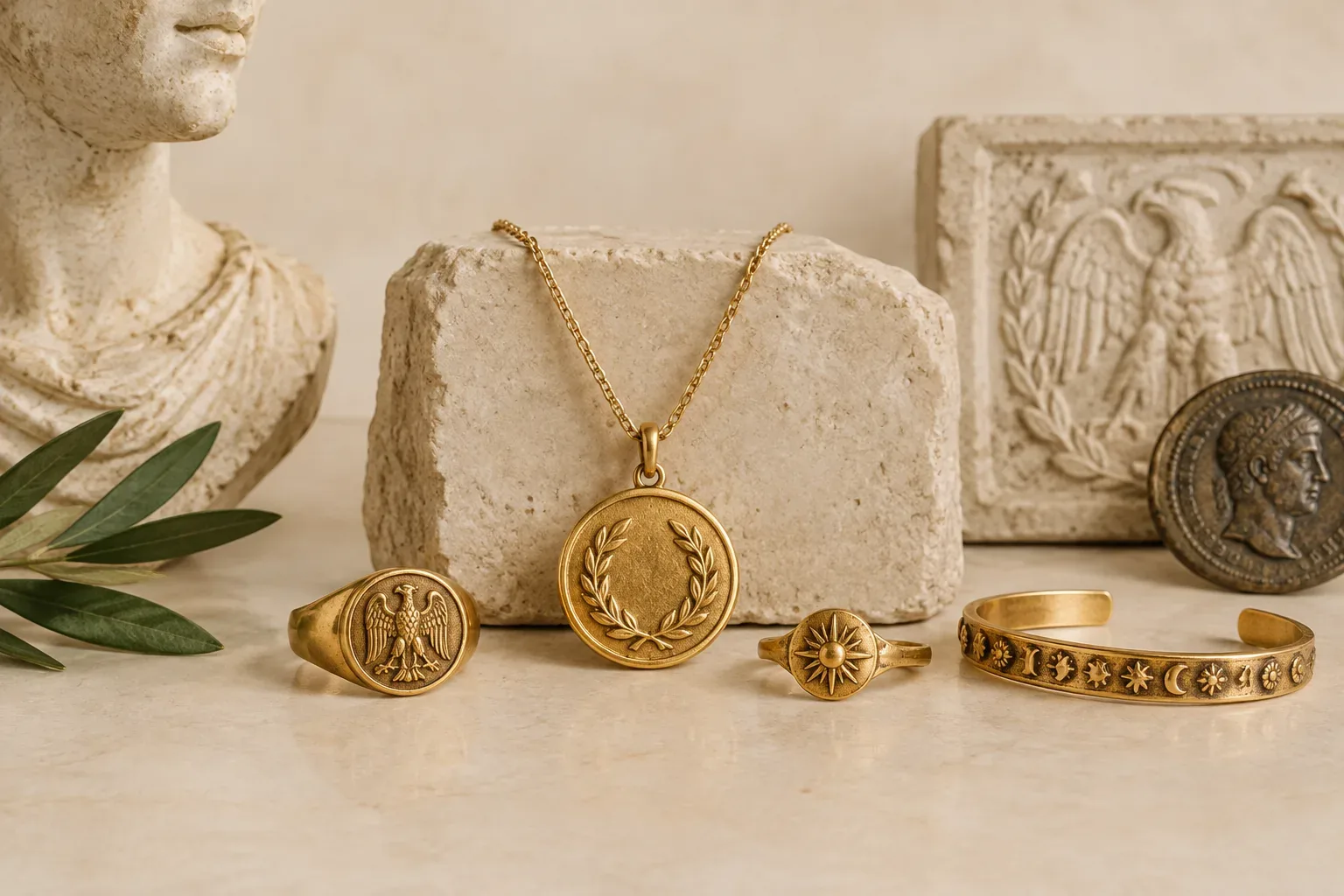
Motifs: In ancient objects preserved in museums, Roman motifs appear as engraved gem portraits, mythological scenes, animals, laurel wreaths and military symbols, and clasped hands that appear on rings and fibulae. These motifs were produced in relief or intaglio on hardstones and in goldwork and served as personal identifiers, decorative elements, or ritual items. Contemporary jewellers often borrow these visual languages directly — reproducing intaglio-style portraiture in cameo pendants or using laurel and eagle motifs in signet-style rings — but today those motifs are as likely to signal taste, heritage interest, or fashion as any original ancient social meaning.
Gemstones and materials: Museum writing on gemstones explains historical preferences and working methods. Hardstones such as carnelian and sard, as well as semi-precious stones worked for intaglios and cameos, are common in Roman-period collections. Pearls and gold were markers of wealth. Modern pieces invoking Roman style typically reproduce these materials or use substitutes (for example, synthetic or treated stones) to achieve a similar look at lower cost. When material authenticity matters, museum practice suggests checking provenance, material reports, and technical descriptions.
Techniques and traditions: The physical techniques — gem-carving, granulation, filigree, and casting in gold — are recorded in museum collections and described in exhibition materials as markers of technical skill and cultural exchange. Contemporary makers may replicate these techniques or simulate their appearance with modern methods; the visual continuity can be strong even when materials or production methods differ.
Practical and respectful guidance for choosing or gifting Roman motifs
Decide what you want the object to communicate. If you want historical authenticity, seek pieces with clear provenance, museum-style descriptions, or reputable dealers who document period, materials, and condition. If you prefer a modern piece inspired by Roman motifs, choose designers who are explicit about inspiration rather than making unsupported claims about ‘authentic ancient power.’ The Victoria and Albert Museum emphasises interpreting jewellery within its social history; follow that example by clearly distinguishing original antiquities from modern interpretations.
Ask about materials and treatments. The Federal Trade Commission requires truthful disclosure about treatments, synthetics, and imitations. When a seller cannot or will not confirm whether a stone has been heat-treated, dyed, filled, or is synthetic, treat that as a risk. Request written confirmation or a gem lab report for higher-value purchases.
Be mindful of cultural and religious sensitivities. Some ancient motifs had ritual or protective roles; modern use of such imagery should be done respectfully and with awareness that meanings can vary by community. When gifting, consider the recipient’s background and whether a motif that references religious or funerary practice could be misinterpreted or cause discomfort.
Consider scale and wearability. Roman jewellery often used substantial forms suited to different occasions and social settings. Modern adaptations may be more delicate; consider how often the recipient will wear the piece and whether it suits contemporary daily life. For heirloom intentions, prioritise durable materials and documented care instructions.
When authenticity matters, prefer documentation over marketing copy. Provenance, conservation reports, and clear material descriptions are the closest contemporary equivalent to museum-level attribution. If a piece is being sold as an ancient object but lacks documentation, treat its claimed age as unverified.
Closing thoughts
Ancient Roman jewellery symbols have layered meanings: practical and social functions documented in museum collections form the historical core, while later revival movements and personal choices add new interpretive layers. Museums like the Victoria and Albert Museum provide the best starting point for understanding how motifs and materials functioned in their original contexts, and consumer protection guidance from agencies such as the Federal Trade Commission helps modern buyers navigate material truth and disclosure.
If you choose a Roman-inspired piece, do so with an appreciation for the historical nuance and an eye for accurate information about materials and provenance. That approach respects both the objects’ pasts and the contemporary people who will wear them.
Frequently asked questions
What were common symbols found on Roman jewellery?
Common symbols recorded in museum collections include intaglio portraits and mythological scenes, animal motifs, military emblems, laurel wreaths, clasped hands, and amuletic shapes. These appear in engraved gems, signet rings, pendants, and brooches and are understood in context as markers of identity, affiliation, or protective practice rather than a single uniform meaning.
Did Romans believe gemstones had special powers?
Museums note that gemstones were prized for beauty, rarity, and status, and some stones were associated with particular uses or preferences. Claims about universal mystical powers are generally later or popular interpretations; for historical context on gemstone use and identification, see museum resources such as the Victoria and Albert Museum's A–Z of Gemstones.
How can I tell if a piece is an actual ancient Roman object?
Authenticating antiquities requires provenance, expert assessment, and condition analysis. Reliable indicators include documented provenance, conservation reports, and scientific testing performed by recognised institutions. If a seller cannot provide clear documentation, treat their age claims as unverified.
What should I ask a seller about gemstones and treatments?
Ask whether stones have been heat-treated, dyed, filled, irradiated, or are synthetic, and request written disclosure or lab reports for higher-value purchases. The Federal Trade Commission recommends truthful disclosure of treatments and imitations; lack of transparent answers is a red flag.
Is it respectful to wear Roman religious or amuletic symbols today?
It depends on the motif and context. Some symbols had ritual or funerary associations in antiquity; wearing them in a fashion context may be acceptable, but consider the recipient’s background and the possibility of unintended meanings. When in doubt, choose pieces described as ‘inspired by’ Roman motifs rather than claimed sacred antiquities.
Sources and further reading
- Bedazzled: A History of Jewellery — Victoria and Albert Museum
- An A-Z of Gemstones — Victoria and Albert Museum
- Buying Gemstones, Diamonds, and Pearls — Federal Trade Commission