Meaning at a glance
This guide explains the documented history and changing contexts of ancient Greek jewelry motifs, separates cultural and religious evidence from later popular interpretations, and gives practical guidance for choosing and wearing revival pieces responsibly.
What the historical evidence covers — and how museums classify periods
Museum collections and exhibitions are the primary places where the material history of ancient Greek jewelry is documented. Institutions such as the Victoria and Albert Museum present jewelry from archaeological finds and later collections and emphasize how jewelry’s role and appearance changed through time. Curators and catalogues typically divide ancient Greek material into commonly used archaeological period labels such as Archaic, Classical and Hellenistic, and they also note later Roman and Byzantine interactions with Greek styles. These labels are organizational tools used by museums and scholars and point to different styles, technologies, and social contexts recorded in surviving objects.
Evidence for how jewelry was made and worn comes from multiple sources: surviving metalwork and gemstones in museums, archaeological contexts reported in museum catalogues, and comparative study of techniques. The V&A’s exhibitions and interpretive materials demonstrate how forms and materials shift across periods and social settings rather than presenting a single, static ‘Greek’ style.
Separate documented historical meanings from modern interpretations
Documented meanings for ancient jewelry arise from archaeological context, inscriptions, and contemporary textual references that museum professionals and historians evaluate. Where such context exists, museums distinguish practical uses (decoration, status display, funerary offering) from religious or symbolic use. The V&A’s historical interpretation stresses that jewelry’s social functions changed over time and between communities, so any single symbolic reading is often too narrow.
Modern popular interpretations — for example, assigning a single spiritual meaning to a motif or claiming that a specific gem always conferred a precise power — are frequently later attributions or modern marketing narratives. These personal or revivalist meanings have value to the wearer but are not the same as documented historical evidence. Treat museum-based claims as the baseline for what is historically supported and treat modern symbolic claims as contemporary meanings unless they are explicitly grounded in archaeological or documentary evidence.
How motifs, gemstones and traditions appear in jewelry (what to look for)
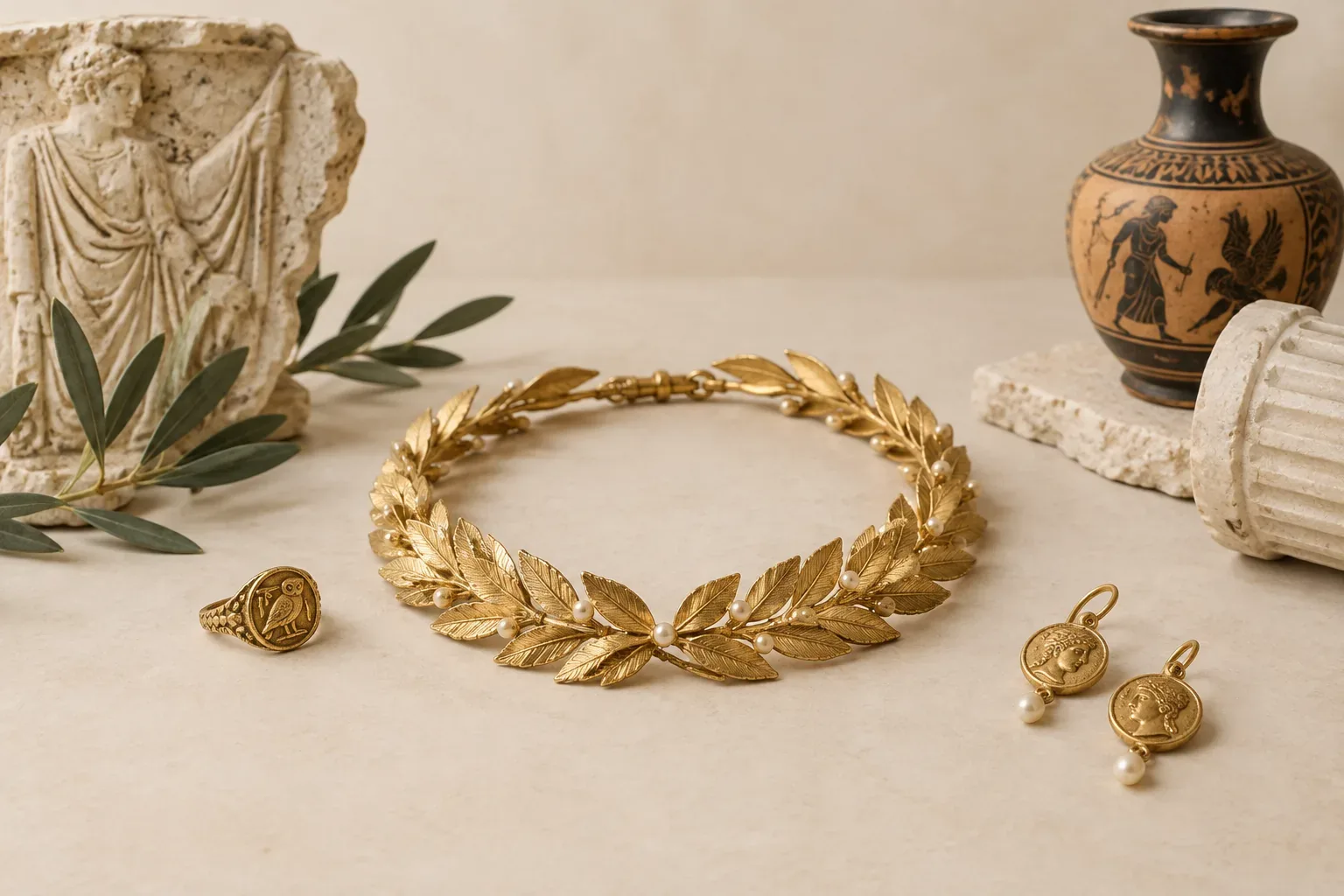
Motifs: Common decorative motifs associated with ancient Greek material culture and shown in museum displays include geometric meanders (Greek key patterns), stylized wreaths and palmettes, figural scenes transferred from ceramics and reliefs, and sometimes animal representations such as owls. Museums use these visual categories to describe objects in collections, but a motif’s presence does not, by itself, prove a single symbolic meaning across periods or places.
Techniques and forms: Surviving objects in museum collections show techniques such as granulation, filigree, casting, and repoussé. These technical terms are often used in catalogues and interpretive labels to describe how pieces were made, and they help specialists date and contextualize objects. Modern revival pieces may emulate these techniques visually or use contemporary methods to suggest an antiquarian look.
Gemstones and materials: Museums document the range of materials used historically and provide accessible guides to gemstone identification and historical context. The Victoria and Albert Museum’s A–Z of Gemstones is a useful reference for how specific gems have been used and valued in different historical contexts. When buying, note whether a stone is natural, heat-treated, dyed, or an imitation; museum labels often record such treatments when known, and consumer guidance from the Federal Trade Commission explains what sellers should disclose about treatments and imitations.
Practical steps for evaluating authenticity and disclosure
Ask for clear provenance and descriptions. Sellers should describe whether a piece is an original archaeological object, a faithful reproduction based on a museum example, or a contemporary design inspired by ancient motifs. Established museums and reputable dealers label objects carefully; follow their model by asking for the same clarity from any seller.
Request treatment and material disclosures. The Federal Trade Commission advises consumers to seek information about treatments, synthetics, and imitations. Ask whether gemstones have been heat-treated, dyed, stabilized, or recreated using modern processes. Obtain written confirmation of metal content, hallmarking, and any restoration work.
Prefer documented reproductions over vague ‘antique’ claims. Genuine antiquities often have legal and ethical issues attached; reputable sellers will provide provenance records and ownership histories. If a piece is marketed as an archaeological find without clear paperwork, treat the claim with suspicion and consult a specialist or museum before purchasing.
Respectful selection and gifting guidance
Acknowledge cultural and religious context. If a motif has a documented sacred or funerary role in museum literature, consider how wearing or gifting it may be perceived. The V&A and other museums present context that helps buyers understand social uses; use those institutional descriptions to inform respectful choices rather than relying on marketing narratives.
Choose makers who credit their sources. If you want a revival piece, favor designers who reference specific museum examples or scholarly sources and who make clear which features are historic and which are modern adaptations. This transparency respects the original contexts and helps recipients understand what the piece represents.
Gift with explanation. When giving a revival or historically inspired piece, include a short note explaining whether the design is a reproduction, a reinterpretation, or a contemporary piece inspired by ancient forms, and reference the museum or catalogue example if applicable. Clear explanations reduce the risk that the recipient will assume an unwarranted historical claim.
Avoid purchasing looted or undocumented archaeological objects. Responsible collecting and museum ethics caution against the trade in undocumented antiquities; asking for provenance and supporting legal, ethical sellers aligns with museum best practice and conserves heritage for future generations.
Care, repair and conservation considerations
Modern revival pieces usually have straightforward care instructions from the maker, but authentic antiques and archaeological objects require conservation-grade care. Museums like the V&A keep objects under controlled conditions and advise specialized conservation practices for fragile or corroded metals and treated gemstones. If you own or are offered an old or antique piece, consult a qualified conservator rather than attempting amateur repairs.
For gemstones and soft materials, follow seller guidance informed by gemological practice. The V&A’s gemstone guidance can help you understand how different stones respond to wear and cleaning, and FTC guidance reminds buyers to check for treatments that affect cleaning and durability.
Final checklist before you buy
Confirm whether the piece is an antique, a reproduction, or a contemporary design inspired by ancient Greek forms. Ask for provenance or maker information. Verify material and treatment disclosures and request written confirmation. Consider the cultural context and whether the motif had a documented religious or funerary use; when in doubt, consult museum sources. Prefer sellers and designers who cite museum examples or scholarly sources and who are transparent about which elements are historic and which are modern modifications.
Frequently asked questions
How can I tell if a piece is an authentic ancient Greek artifact or a modern reproduction?
Ask the seller for documentation of provenance and any conservation records. Authentic archaeological objects should have clear ownership histories and paperwork; reputable museums and dealers label such items carefully. If provenance is vague or absent, treat the piece as a reproduction or modern creation and seek independent verification from a museum or qualified specialist.
Are gemstones in revival pieces the same as those used historically?
Revival pieces may use the same types of gemstones by name, but modern gems are often treated, synthesized or cut differently. Consult museum gemstone guides for historical context, and ask sellers to disclose any treatments, synthetics or imitations—disclosures the Federal Trade Commission recommends consumers demand.
Is it disrespectful to wear motifs that had religious or funerary uses in antiquity?
It depends on the motif and context. Museums provide documentation on how items were used historically; if a motif is known from funerary or sacred contexts, consider that history when choosing or gifting. Transparent labeling and an explanatory note when gifting help address concerns and show respect for cultural significance.
What questions should I ask a seller before buying?
Request provenance or maker information, material and metal content, gemstone identification and any treatment disclosures, and whether the piece is an original, a reproduction of a museum example, or a modern design inspired by ancient motifs. Ask for photographs, hallmarks and written confirmation of details.
Where can I learn more about the historical uses of motifs and techniques?
Start with museum resources and exhibition catalogues. The Victoria and Albert Museum’s materials on jewelry history and gemstones provide accessible introductions, while specialist publications and museum catalogues can offer deeper, object-level evidence and context.
Sources and further reading
- Bedazzled: A History of Jewellery — Victoria and Albert Museum
- An A-Z of Gemstones — Victoria and Albert Museum
- Buying Gemstones, Diamonds, and Pearls — Federal Trade Commission