Meaning at a glance
Document the techniques, materials, and trade networks used by ancient Greek jewelers (as described by the Victoria and Albert Museum), distinguish historical meanings from later interpretations, explain how motifs and gemstones appear in surviving objects, and offer practical guidance for selecting and gifting modern pieces inspired by ancient Greek jewelry while advising buyers on disclosure and treatments (per the Federal Trade Commission).
Direct answer (thesis)
Ancient Greek jewelry techniques combined sophisticated metalworking—lost-wax casting, granulation, filigree, repoussé and chasing—with the use of gold, silver, and a range of gemstones; these methods evolved across Archaic, Classical, and Hellenistic contexts and were shaped by craft traditions, trade networks, and changing tastes (Victoria and Albert Museum). The documented historical record can be separated from later or personal symbolism: museums and archaeological reports show what was made and how, while modern wearers may layer new meanings when they choose these motifs today. Practical modern buying guidance should include attention to provenance, disclosure of treatments or imitations, and respect for cultural context (Victoria and Albert Museum; Federal Trade Commission).
Historical evidence and cultural periods
The principal modern synthesis on technique and style available for non-specialists is provided by museum scholarship; the Victoria and Albert Museum presents accessible overviews that trace development across the standard period labels used by historians: the Archaic, Classical and Hellenistic periods of ancient Greece. Those labels describe changing styles, workshop practices and market patterns rather than a single monolithic culture (Victoria and Albert Museum).
Archaic-period objects show early experimentation in fine metalwork and decorative motifs. During the Classical period, refinements in proportion and detail appear alongside continuing use of ritual and personal adornment. In the Hellenistic era, wider exchange across the Mediterranean altered tastes and introduced new materials and motifs into Greek-style jewellery. The V&A collections and exhibitions discuss these chronological shifts and the ways techniques were transmitted, adapted and combined over time (Victoria and Albert Museum).
Archaeological context is important: securely dated finds, workshop debris, and hoards give the strongest evidence for how pieces were made and used. Museum cataloguing and conservation records distinguish securely documented functions (for example, funerary or votive finds) from uncertain or modern attributions. For historical claims about materials and craft processes, the V&A’s work on jewelry history is the primary supporting source cited here (Victoria and Albert Museum).
Documented techniques and materials
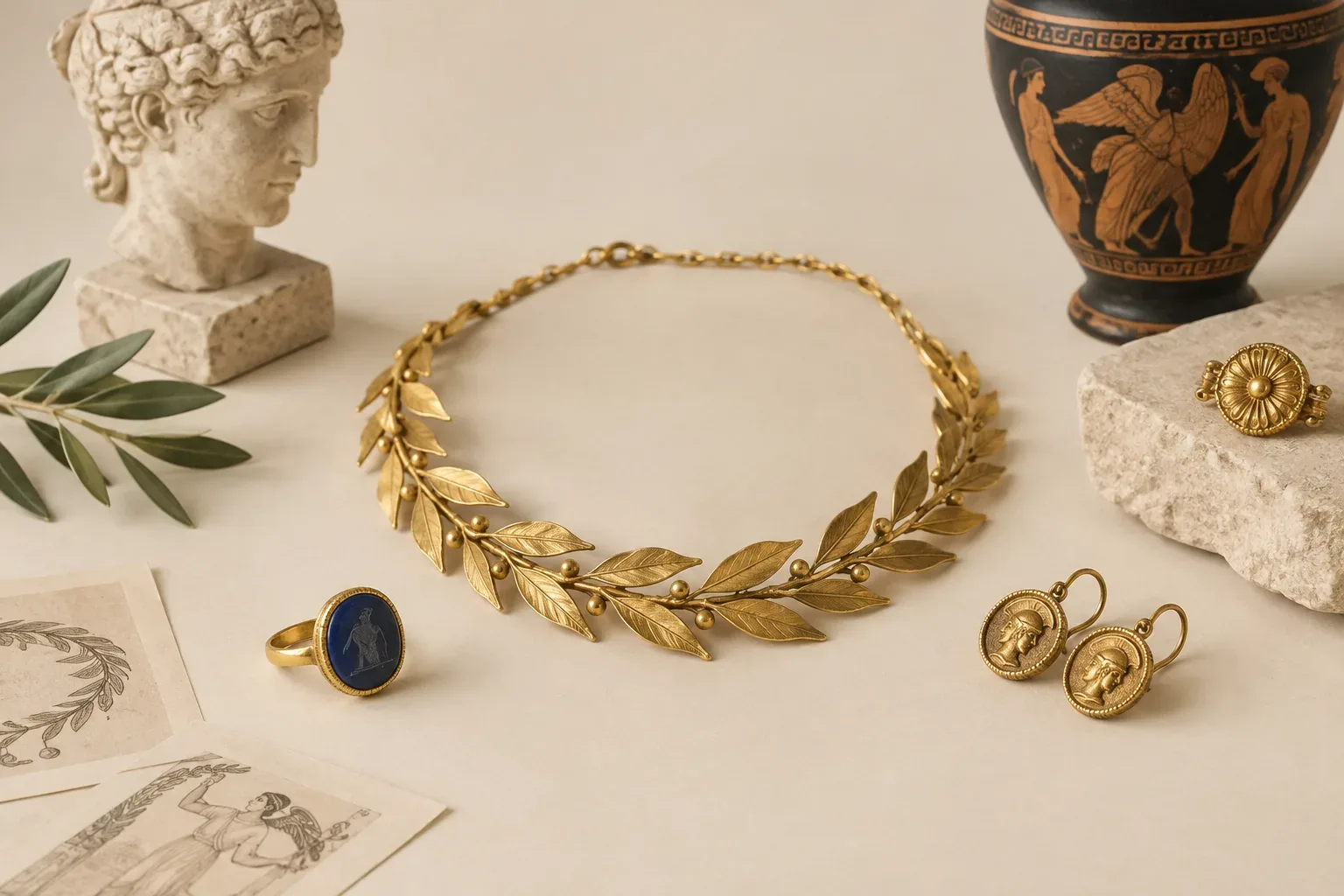
Written and material evidence summarized by museum scholarship identifies several recurring techniques in Greek jewellery making. Lost-wax casting allowed hollow and detailed forms to be made, often as a first step before surface finishing. Granulation and filigree—tiny beads and fine threads of metal fused to a surface—appear on surviving gold work as decorative surface texture. Repoussé and chasing were used to create relief by hammering metal from the front or back. Stone inlay, intaglio carving, and simple bezel settings secure gemstones. Conservation notes and exhibition texts at the Victoria and Albert Museum highlight these processes as central methods in ancient practice (Victoria and Albert Museum).
Gold and silver are the most commonly preserved metals; alloys and surface treatments were used to change color and hardness. Gemstones identified in museum collections include carnelian, garnet, amethyst, and pearls, each with documented historical use and sourcing implications discussed in the V&A’s gemstone overviews (Victoria and Albert Museum; An A–Z of Gemstones).
Motifs, gemstones, and how they appear in jewelry
Certain motifs recur in Greek ornament: geometric patterns such as the meander (so-called Greek key), leaf patterns like the palmette and laurel, and human or mythic faces such as the gorgoneion. The Victoria and Albert Museum describes these motifs as decorative vocabulary found across media—stone carving, pottery and metalwork—which helps archaeologists and curators link objects to stylistic periods and centers of production (Victoria and Albert Museum).
Motifs often appear as stamped or chased decoration on a metal surface, as separately cast or repoussé elements soldered in place, or as engraved designs on signet rings and gem intaglios. Gemstones appear set in raised bezels, used as inlaid colour in cloisonné-like work, or carved as cameos and intaglios for rings and pendants. The V&A’s A–Z of Gemstones gives context for which stones were prized in antiquity and how their appearance and color contributed to a piece’s visual effect (Victoria and Albert Museum; An A–Z of Gemstones).
Because many motifs also had associations in ancient Greek visual language, museum labels carefully separate artistic convention from fixed religious meaning: a laurel wreath might indicate athletic victory, a gorgoneion may function apotropaically on some objects, but the presence of a motif alone does not prove a single use or intention. The V&A emphasizes contextual evidence—where an object was found, how it was worn, and what else it was associated with—before assigning function or meaning (Victoria and Albert Museum).
Trade, workshops and the movement of materials
The distribution of finished jewellery and the supply of raw materials are part of the historical record summarized in museum accounts. Trade links across the Mediterranean and into Anatolia brought gemstones and luxury metal goods into Greek markets and allowed technical practices to travel between centers. Changes in style during the Hellenistic period reflect new tastes stimulated by wider cultural contact. Museum studies point to workshops and itinerant craftsmen as vectors for technique transmission, visible in shared tool marks and technical recipes recorded on surviving objects (Victoria and Albert Museum).
Gemstone identification and sourcing are complex; the Victoria and Albert Museum’s gemstone guidance helps place stones historically but does not provide exhaustive provenance for every archaeological find. Modern buyers should therefore expect variability in origin, treatment and dating of stones displayed as ancient or ancient-style (Victoria and Albert Museum; An A–Z of Gemstones).
Separating documented historical meanings from modern interpretation
Museum scholarship is cautious about meaning. Curators typically present the form, technique, findspot and likely function before suggesting symbolic significance; they highlight when evidence is direct (for example, an object found in a sanctuary) and when meanings are inferred. The Victoria and Albert Museum specifically distinguishes changing social contexts and historical uses in its accounts of jewellery history and era-specific styles (Victoria and Albert Museum).
Modern personal or commercial interpretations—romantic, spiritual, or nationalistic readings of motifs—are not the same as documented ancient belief. For example, a wearer today might choose a meander pattern as a symbol of continuity or a gorgoneion for protection; these are contemporary meanings layered onto motifs that originally circulated in specific artistic and cultural contexts. When presenting or gifting ancient-style pieces, make a distinction between archaeological facts shown in museum records and the new meanings an individual may attach to the object.
Practical and respectful selection and gifting guidance
If you are choosing or gifting jewelry inspired by ancient Greek techniques, begin by clarifying whether you want an authentic ancient object, a historically informed replica, or a contemporary piece with ancient motifs. Authentic archaeological objects require specialist authentication and often have legal and ethical restrictions on sale and export; museum provenance records are the best starting point for evaluating such claims (Victoria and Albert Museum).
For replicas or modern pieces that evoke Greek techniques, check the maker’s stated methods and materials. Ask whether gold is solid or plated, whether stones are natural, treated, or synthetic, and request written disclosure about any treatments or imitations. The Federal Trade Commission provides consumer guidance on buying gemstones and requires sellers to disclose treatments and imitations; use that guidance to frame questions and assess disclosure practices (Federal Trade Commission).
Respect cultural sensitivity: avoid implying that motifs have a singular, universal religious meaning and be careful when presenting ancient-style pieces as heirlooms of a living culture. Explain the source of inspiration when gifting—whether it’s an archaeological design, a museum catalogue reference, or a modern interpretation—and, if possible, point recipients to reputable museum resources for historical context (Victoria and Albert Museum).
Conservation and care: traditional techniques like granulation and filigree can be delicate. Store pieces separately, avoid harsh chemical cleaners, and consult a qualified conservator for valuable or historically important items. If provenance or authenticity matters to you, obtain documentation and, for higher-value purchases, consider independent appraisal. For gemstone treatments and consumer expectations, follow FTC guidance on questions to ask sellers and disclosure requirements (Federal Trade Commission).
Resources and further reading
Museum collections and curated exhibition texts provide the most reliable public-facing summaries of techniques, motifs and historical context; the Victoria and Albert Museum’s materials on jewellery history and its A–Z of gemstones are recommended starting points for anyone researching ancient Greek jewelry techniques (Victoria and Albert Museum; An A–Z of Gemstones).
For consumer protection when buying gemstones or jewellery, consult the Federal Trade Commission guidance on disclosure of treatments, imitations and selling practices before making any purchase (Federal Trade Commission).
Frequently asked questions
What are the main techniques used in ancient Greek jewellery making?
Museum research identifies methods such as lost-wax casting, granulation, filigree, repoussé and chasing, stone setting and intaglio carving; these appear repeatedly in archaeological and museum collections (Victoria and Albert Museum).
Do specific motifs have one universal meaning in ancient Greece?
No. Museums caution that motifs like the meander, laurel or gorgoneion functioned in diverse contexts and their meaning depends on findspot, object type and period. Modern symbolic readings are typically later personal or cultural interpretations (Victoria and Albert Museum).
How can I tell if a gemstone is treated or imitation?
Ask the seller for written disclosure of treatments, enhancements, or synthetic origin. The Federal Trade Commission recommends specific questions and expects sellers to be transparent about treatments and imitations (Federal Trade Commission).
Is it acceptable to wear modern jewellery inspired by ancient Greek designs?
Yes. Wearing historically inspired jewellery is common; do so with an awareness of the distinction between ancient provenance and contemporary interpretation and, when relevant, acknowledge the source of the design (Victoria and Albert Museum).
Should I buy authentic ancient pieces or modern replicas?
Authentic archaeological objects carry ethical, legal and conservation considerations and should be purchased only with full provenance and legal clarity. High-quality replicas or modern pieces allow enjoyment of the aesthetic without those complications; choose based on your priorities and seek documentation when authenticity is claimed (Victoria and Albert Museum).
Sources and further reading
- Bedazzled: A History of Jewellery — Victoria and Albert Museum
- An A-Z of Gemstones — Victoria and Albert Museum
- Buying Gemstones, Diamonds, and Pearls — Federal Trade Commission