Meaning at a glance
Explain the documented history and changing contexts of the ancient greek jewelry symbols motif, separate cultural or religious evidence from later popular interpretations, and give practical guidance for choosing and wearing the motif in modern jewelry.
Quick answer
Ancient Greek jewelry symbols encompassed a range of motifs and materials whose functions changed with time and context; museum research shows many served decorative, status, or votive purposes, while later and contemporary readings often add personal, national or spiritual meanings. The best modern approach is to distinguish what is documented in historical sources from later interpretation, choose pieces with clear provenance, and give or wear them with respect for their cultural histories.
Historical evidence and cultural periods
Our understanding of ancient Greek jewelry comes largely from museum collections and object catalogs that place pieces in cultural and chronological contexts. The Victoria and Albert Museum frames jewelry as material culture whose social meanings evolved across distinct periods—commonly grouped by scholars as Archaic, Classical and Hellenistic eras—each with its own styles, technical developments and social uses. Museum records, excavated finds and illustrated objects are the primary evidence for what motifs and materials were used and how jewellery functioned in society.
Because the archaeological record is fragmentary and often regional, individual motifs cannot be assumed to have had a single fixed meaning across the Greek world. Published museum notes emphasise that jewellery could mark status, be used in religious votive practice, serve as amuletic protection, or simply follow prevailing fashion. Where a museum catalog describes a particular object's findspot, inscription or archaeological context, that specific context provides the strongest evidence for historical interpretation rather than broad, universal claims.
Documented historical meanings versus modern interpretations
What museums and object studies can document are the physical attributes of jewelry, its find contexts, and contemporary literary or visual references when they exist. For many ancient Greek motifs the securely documented uses are pragmatic and contextual: certain forms appear frequently in funerary offerings, others are associated with temple or votive contexts, and some recur in elite burials where they act as markers of wealth. The Victoria and Albert Museum emphasises the importance of social context and changing functions in its presentations of jewelry history.
Modern personal, spiritual or nationalistic meanings often differ from what is documented. For example, a motif that appears commonly in funerary deposits might now be worn as a symbol of remembrance or resilience by a contemporary wearer; that modern meaning is valid for that person but should be distinguished from what the archaeological record can show. Likewise, retellings that ascribe a single religious function or a universal symbolic code to all ancient Greek jewelry are oversimplifications not supported by museum evidence.
Common motifs and gemstones, and how museums describe them
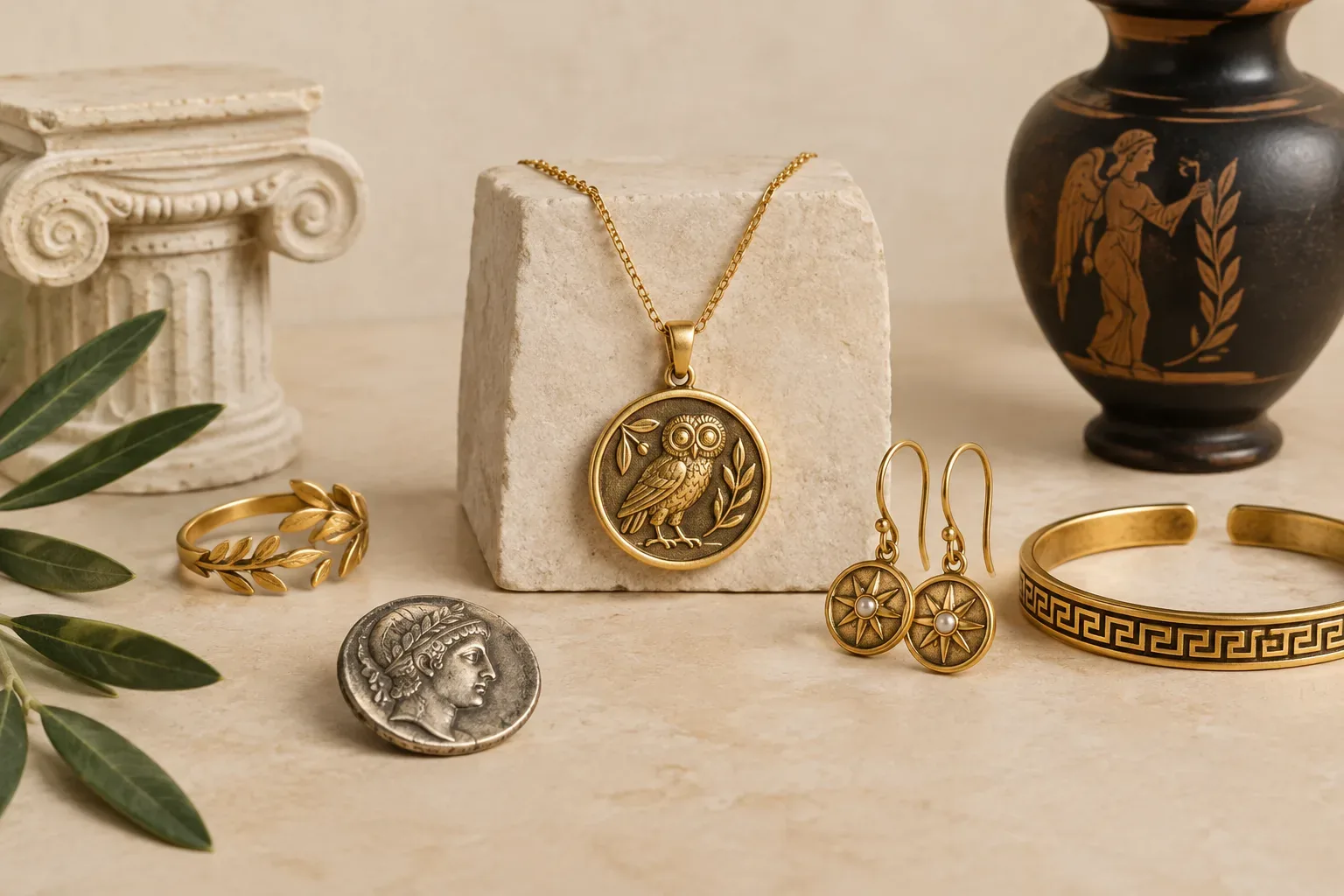
Museum displays and reference guides identify recurring forms across objects. Geometric motifs such as the meander or Greek key, vegetal motifs such as palmettes, animal forms including birds and marine life, and human or mythic heads are among motifs recorded in collections. When a particular motif appears with an inscription or in a documented ritual context, museum notes will link it to that use; where that link is absent, curators typically describe the motif's formal or stylistic role rather than impose a single symbolic meaning. This approach is reflected in Victoria and Albert Museum materials that emphasise style and social context over universal symbolism.
Similarly, gemstones and organic materials are described in their material and trade contexts. Museum resources on gemstones explain how color, rarity and the technical ability to set or drill particular stones influenced their use in jewellery. Ancient pieces in collections show combinations of gold work with various inlaid stones and beads; museums use those objects to explain techniques and the visual effects intended by ancient jewellers. The Victoria and Albert Museum’s A–Z of Gemstones is a useful reference for identifying stones, their historical associations in collections and how they were used in decorative objects.
How motifs and gemstones appear in ancient and modern jewellery
In ancient contexts the same motifs appear in a range of object types: necklaces and bead strings, pendant amulets, finger rings and signet rings, hair ornaments and earrings. Museum collections show that motifs were adapted to fit different formats; a small mythic head might be used as a pendant on a necklace or as the bezel of a ring. Contemporary jewellery makers draw on these forms in similar formats—pendants, signet-style rings, and brooches—often simplifying or stylising motifs to suit modern tastes while referencing the historical source.
Gemstones in ancient jewellery were set, inlaid or drilled for stringing; in modern reproductions the same stones may be faceted, cabochon-cut, or replaced with synthetics. Museums record the physical techniques of setting and stringing, and modern makers sometimes replicate those techniques for authenticity or aesthetic preference. When buying modern pieces inspired by ancient motifs, look for clear descriptions that note whether a motif is a historical reproduction, a modern reinterpretation, or merely inspired by ancient forms.
Practical and respectful selection and gifting guidance
If you are choosing or gifting jewellery that references ancient Greek symbols, begin by distinguishing three things: the object's nature (ancient original, authenticated antiquity, or modern reproduction/inspired design), its provenance and documentation, and your personal or the recipient's intended meaning. When an object is presented as ancient or archaeological, request provenance documentation and conservation records; museums and reputable dealers will provide contextual information. When the piece is a modern design inspired by ancient motifs, choose clear labelling that respects the original culture and avoids claiming false antiquity.
For everyday wear or gifting, consider the recipient's sensitivity to cultural heritage. A motif with funerary archaeological contexts may be meaningful as a remembrance symbol for some people and uncomfortable for others. Explain the difference between documented uses and contemporary readings when you present the gift. If authenticity, investment, or museum-quality fabrication matters to you, consult specialists and ask for certificates; for straightforward aesthetic gifts, a modern reinterpretation that credits its inspiration can be appropriate and responsible.
When assessing gemstones and materials, ask about treatments, imitations and disclosure. The Federal Trade Commission recommends that sellers disclose treatments, synthetics and imitation materials. Request information on whether stones have been heat-treated, dyed, filled, or replaced with lab-grown versions. Good dealers will answer these questions and provide a written statement of the material details, which helps you make an informed choice whether you prioritise historical authenticity, visual effect, or budget.
Provenance, authenticity and responsible buying
Museums emphasise recording provenance and contextual information because the archaeological context often determines the best-supported historical interpretations. If an object is advertised as ancient, ask for documentation of legal export, acquisition history and conservation reports. For items lacking clear provenance or that raise concerns about illicit excavation, decline purchase or consult a specialist. If you prefer the look of ancient motifs without the complications of provenance, choose a clearly labelled modern reproduction.
Finally, research helps. Use museum resources to learn how motifs and materials were used historically and to place a design in its proper context. Our related pages on cultural and historical jewellery, how to choose meaningful jewellery, and researching symbols can help you frame your purchase or gift with better-informed respect.
Summary
Ancient Greek jewelry symbols are best understood through objects, contexts and museum interpretation rather than through broad, universal claims. The Victoria and Albert Museum's work on jewellery history and gemstones provides the kind of contextual evidence that helps distinguish decorative practice, status display and ritual use in the archaeological record. When you select or gift jewellery that references ancient Greek motifs, separate documented history from your own modern meanings, check provenance and material disclosures, and choose wording that respects both historical context and contemporary significance.
Frequently asked questions
Were ancient Greek jewelry symbols universally religious?
No. Museum evidence shows symbols served multiple roles—decoration, status display, votive offering or amulet—depending on context. The Victoria and Albert Museum stresses interpreting objects by their archaeological and social contexts rather than assuming a single religious meaning.
How can I tell if a piece is genuinely ancient or a modern replica?
Ask the seller for provenance documentation, conservation records and acquisition history. Museums and reputable dealers provide contextual information. If documentation is missing or unclear, treat the piece as a modern reproduction unless a qualified specialist confirms otherwise.
Is it disrespectful to wear designs inspired by ancient Greek motifs?
Not necessarily. Respectful use includes understanding and acknowledging the inspiration, avoiding claims of false antiquity, and considering the recipient’s or your own cultural sensitivities. Clear labelling helps ensure respectful use.
Do gemstones in modern reproductions match ancient materials?
Sometimes, but often modern pieces use different cuts, treatments or synthetics. Consult museum references for historical materials and the seller for current material details. The Victoria and Albert Museum’s gemstone guidance is a useful reference for historical associations.
What should I ask a seller about treated or synthetic stones?
Follow guidance from the Federal Trade Commission: ask whether stones have been heat-treated, dyed, filled, or are lab-grown or simulants, and request written disclosure. Sellers are required to disclose certain treatments and synthetic origins.
How should I present a gift that references an ancient Greek symbol?
Explain whether the piece is an authentic antiquity, a reproduction, or a modern design inspired by ancient motifs, and share any provenance or contextual information you have. Clarifying the distinction shows respect for the cultural history and helps the recipient appreciate the meaning you intend.
Sources and further reading
- Bedazzled: A History of Jewellery — Victoria and Albert Museum
- An A-Z of Gemstones — Victoria and Albert Museum
- Buying Gemstones, Diamonds, and Pearls — Federal Trade Commission