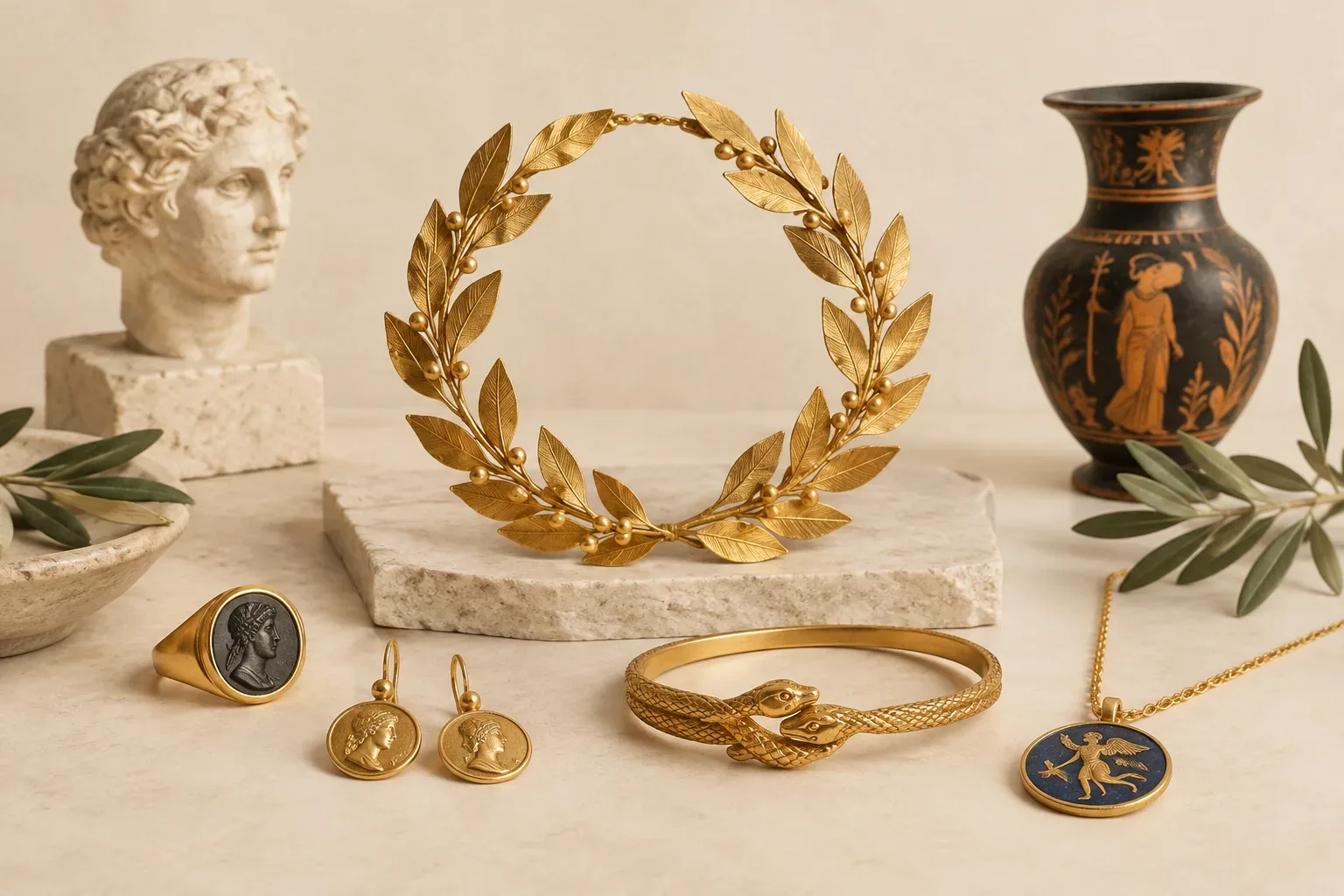
Meaning at a glance
This article explains documented aspects of ancient Greek jewelry history—materials, social uses, and how motifs and gemstones were used—distinguishing museum-backed historical evidence from modern personal interpretations and offering practical advice for selection and gifting.
Quick answer
Explain the documented history and changing contexts of the ancient Greek jewelry history motif, separate cultural or religious evidence from later popular interpretations, and give practical guidance for choosing and wearing the motif in modern jewelry.
What the historical evidence shows
Our understanding of ancient Greek jewelry comes primarily from archaeological finds, burial contexts, and museum collections catalogued and interpreted by institutions such as the Victoria and Albert Museum. According to the Victoria and Albert Museum, jewellery in the Greek world evolved across distinct periods—Bronze Age and Mycenaean contexts, the Geometric and Archaic eras, the Classical period, and the Hellenistic age—with changes in style, technique, and social use reflecting broader cultural shifts.
The V&A emphasizes that jewellery should be read in context: grave goods show how items accompanied the dead; hoards and workshop finds show manufacturing choices; and literary or visual sources sometimes confirm social meanings. These multiple lines of evidence allow historians to reconstruct materials, techniques, and broad social practices without claiming a single, universal meaning for any motif or piece.
Materials and gemstones: what ancient Greeks used
Gold, silver, electrum (a natural alloy of gold and silver), and bronze were principal metal choices for ancient Greek jewelers, with gold being a visible marker of wealth and status in many sites documented by museum collections. The Victoria and Albert Museum’s surveys of jewellery history note how access to metal and the refinement of techniques like granulation and filigree influenced ornament style and who could afford which materials.
Gemstones and organic materials also featured. Semi-precious stones such as carnelian, garnet, and amethyst appear in ancient Mediterranean objects, while pearls and coral were valued when available. The V&A’s A–Z of Gemstones provides context for how specific gems were identified and prized historically. In addition to natural gems, glass paste or faience could be used as a lower-cost substitute, and simple goldsmithing techniques produced effective imitations of more expensive stones.
Status, social function, and daily wear
Museum-backed evidence indicates jewellery functioned across a spectrum of social uses: as everyday personal dress, public display of wealth and civic identity, ceremonial or votive offerings, and as funerary items placed in graves. The Victoria and Albert Museum highlights that jewellery’s role changed with context: a necklace in temple deposits served a different social purpose than the same necklace worn in daily life by a wealthy individual.
Both men and women wore personal adornment in various periods; the type and quantity of jewellery often correlated with social rank, wealth, or social role. That said, archaeological contexts vary by region and period, so careful attribution to a specific era (for example, a Hellenistic tomb versus a Classical domestic assemblage) matters when interpreting status and use.
Documented meanings versus modern interpretations
Where the historical record is clear, museum catalogues and archaeological reports identify uses and likely meanings grounded in context: e.g., funerary jewellery accompanying a burial indicates a role in mortuary practice; votive jewellery in a sanctified deposit indicates a religious offering. The Victoria and Albert Museum stresses that such attributions rely on where and how an object was found, not on contemporary assumptions.
Modern personal interpretations—such as assigning a single spiritual meaning to a motif or claiming that wearing a reproduced ancient symbol will reproduce ancient religious power—are contemporary responses and not automatically supported by archaeological evidence. These personal meanings can be meaningful for the wearer today, but they should be distinguished from historically documented functions.
How motifs, gemstones, and traditions appear in ancient Greek jewellery
Motifs in ancient Greek jewellery appear in a range of media and techniques. Goldsmiths used open-work, granulation, repoussé, and wirework to render floral, geometric, and figural elements. According to the Victoria and Albert Museum’s work on jewellery history, common decorative themes included flora and fauna, stylized geometric borders, and references to mythological or civic imagery; the specific repertoire varied over time and place.
Gemstones were mounted as beads, intaglios, or cabochons and could be set in bezels or drilled and strung. The V&A’s gemstone resources explain that stones were valued for color, translucency, and rarity, and that artisans sometimes used imitative glass or paste when access to natural gems was limited. The physical appearance of motifs and stones—how they are set, strung, or fixed—provides direct material evidence for their intended uses and the techniques available to ancient craftsmen.
Reading an artifact: what to look for
When examining an ancient Greek piece, prioritize provenance (where it was found), archaeological context (grave, temple, hoard, domestic site), and materials and techniques. These features are the primary evidence scholars use to place the object in time and social context, as emphasized in museum studies reported by the Victoria and Albert Museum.
Decoration, wear patterns, and repairs also tell stories: heavy wear suggests daily use; pristine condition in a burial context suggests it was interred new or little-used; votive depositions often include deliberate breakage or placement with other offerings. These are the kinds of material clues that distinguish historically grounded interpretation from later romantic readings.
Practical guidance for choosing or gifting ancient Greek–inspired jewellery
Be respectful of historical context and clear about whether a piece is ancient, a modern reproduction, or inspired by ancient models. If you are buying an actual antiquity, seek reputable dealers or auction houses and ask for documented provenance and any professional authentication; the Victoria and Albert Museum’s approaches to interpreting jewellery underline the importance of context for meaning.
If you are buying modern jewellery inspired by ancient Greek designs, decide whether your priority is historical fidelity, ethical sourcing, or contemporary style. For gemstones and treatments, follow the FTC’s guidance on buying gemstones, diamonds, and pearls: request clear disclosure about treatments, synthetic stones, or imitations; ask for certificates where appropriate; and verify claims about origin or historical replication. This protects both your expectations and the integrity of the piece as a gift.
How to gift respectfully and meaningfully
When giving a piece inspired by ancient Greek jewellery, consider the recipient’s values: do they prefer historical accuracy, or do they value personal symbolism? Be transparent in your card or conversation about whether the piece is an ancient artifact, a faithful reproduction, or simply inspired by ancient motifs. This clarifies whether the gift conveys historical continuity or contemporary sentiment.
If the piece references religious or cultural motifs that retain living significance in particular communities, take care to avoid trivializing those symbols. Research using museum resources and our internal guides—such as How to Research the Meaning of a Jewelry Symbol and How to Choose Meaningful Jewelry: A Practical Gift Guide—can help you choose a gift that is both beautiful and respectful.
Final considerations
Ancient Greek jewellery history is best approached through the actual material evidence: metals, gemstones, manufacturing techniques, and archaeological context. Institutions such as the Victoria and Albert Museum provide the comparative collections and scholarship that anchor our understanding of how jewellery functioned across periods and places in the Greek world.
Modern wearers and gift-givers can responsibly enjoy ancient-inspired designs by distinguishing historically documented facts from modern personal meanings, seeking transparent information about materials and provenance, and following consumer-protection guidance such as that from the Federal Trade Commission when purchasing gemstones and treated materials.
Frequently asked questions
Were ancient Greeks wearing jewelry every day?
Archaeological and museum evidence shows jewellery served multiple functions, including daily personal dress for some people as well as ceremonial, votive, and funerary uses. Whether an individual would wear jewellery daily depended on their social status, occupation, region, and the historical period; museum analyses reflected in collections such as those at the Victoria and Albert Museum emphasize this contextual variation.
What materials were most prized in ancient Greek jewellery?
Gold, silver, electrum, bronze, precious and semi-precious stones, and organic materials like pearls and coral are documented in collections and scholarship. The Victoria and Albert Museum’s resources note that access to materials and advanced techniques affected both the appearance and social value of jewellery across periods.
How can I tell if a piece is genuinely ancient or a modern reproduction?
Provenance, archaeological context, scientific analysis, and expert authentication are key. Ask dealers or auction houses for documentation and look for published museum comparisons. For purchases of gemstones or treated materials, follow FTC guidance about disclosure of treatments and imitation stones.
Do specific motifs have fixed ancient meanings?
Not necessarily. Some motifs are better understood when found in clear archaeological contexts (for example, votive offerings in sanctuaries versus grave goods). However, many motifs likely had variable meanings across time and place. Museum scholarship advises reading motifs in their specific find contexts rather than assuming a single universal meaning.
What should I ask a seller before buying ancient-inspired jewellery?
Ask whether the item is ancient, a reproduction, or inspired by ancient models; request information on materials, gemstone treatments, and provenance; and ask for any available certificates or independent authentication. The FTC recommends clear disclosure about treatments, synthetics, and imitations.
Sources and further reading
- Bedazzled: A History of Jewellery — Victoria and Albert Museum
- An A-Z of Gemstones — Victoria and Albert Museum
- Buying Gemstones, Diamonds, and Pearls — Federal Trade Commission