Meaning at a glance
This guide explains the documented history and changing contexts of ancient Egyptian jewelry motifs, distinguishes museum-evidenced meanings from modern personal or popular interpretations, and gives practical, respectful advice for choosing and gifting revival pieces.
Quick answer
Documented evidence from museums and historical study shows that many designs and materials associated with ancient Egyptian jewelry—such as the scarab, the ankh, inlaid Faience, and the use of gold and certain semiprecious stones—had specific social, funerary, or symbolic contexts in ancient Egypt. Modern revival jewelry borrows those visual elements but often reinterprets them for fashion, identity, or personal meaning. When buying revival pieces, look for clear material and treatment disclosures, credible historical descriptions from the seller, and consider the cultural and religious context before gifting or wearing a design that has ceremonial origins.
What the historical evidence shows (and which periods and cultures it represents)
The surviving archaeological record and museum collections provide the primary evidence used to describe ancient Egyptian jewelry. Institutions such as the Victoria and Albert Museum catalogue examples and explain changing uses of jewelry across time. The term "ancient Egyptian" covers a long sequence of cultures and periods, including the Predynastic and Early Dynastic periods (c. 6000–2686 BCE), the Old Kingdom (c. 2686–2181 BCE), the Middle and New Kingdoms (c. 2055–1069 BCE), and later Late Periods and Ptolemaic eras when Greek influence appears. Motifs and materials evolved across these periods, and meanings could shift accordingly; for example, some symbols were strongly associated with tomb equipment and the afterlife in New Kingdom funerary contexts, while the same motifs could appear in everyday dress in other times.
Museum overviews compiled by the Victoria and Albert Museum summarize how jewelry functions changed with social status, ritual practice, and trade networks. The V&A emphasizes that jewelry has long communicated social rank and identity and that materials and techniques—goldsmithing, inlay, and the use of faience and specific stones—are traceable in the museum record. Use these period labels when sellers claim historic authenticity: a piece inspired by pharaonic New Kingdom forms is not the same as one modeled on Ptolemaic Hellenistic examples.
Separate documented historical meanings from modern personal or popular interpretations
Documented meanings come from archaeology, inscriptional evidence, and curatorial research. For instance, the scarab beetle appears frequently in amulets and as a funerary object in New Kingdom tombs; many museum interpretations link scarabs with regeneration and the sun god in specific ritual contexts. Those attributions are museum or scholarly readings of the archaeological record rather than universal, fixed meanings applied across all ancient Egyptian periods.
Modern interpretations—including New Age, pop culture, or fashion-based meanings—often layer contemporary values onto ancient motifs. These modern meanings are valid as personal or cultural statements today, but they are not the same as the documented uses found in archaeological contexts. When a modern seller claims that a motif will bring "ancient protection" or guarantees a particular spiritual effect, note that such claims are contemporary reinterpretations and not verified by museum evidence.
How motifs, gemstones, and traditions appear in modern jewelry
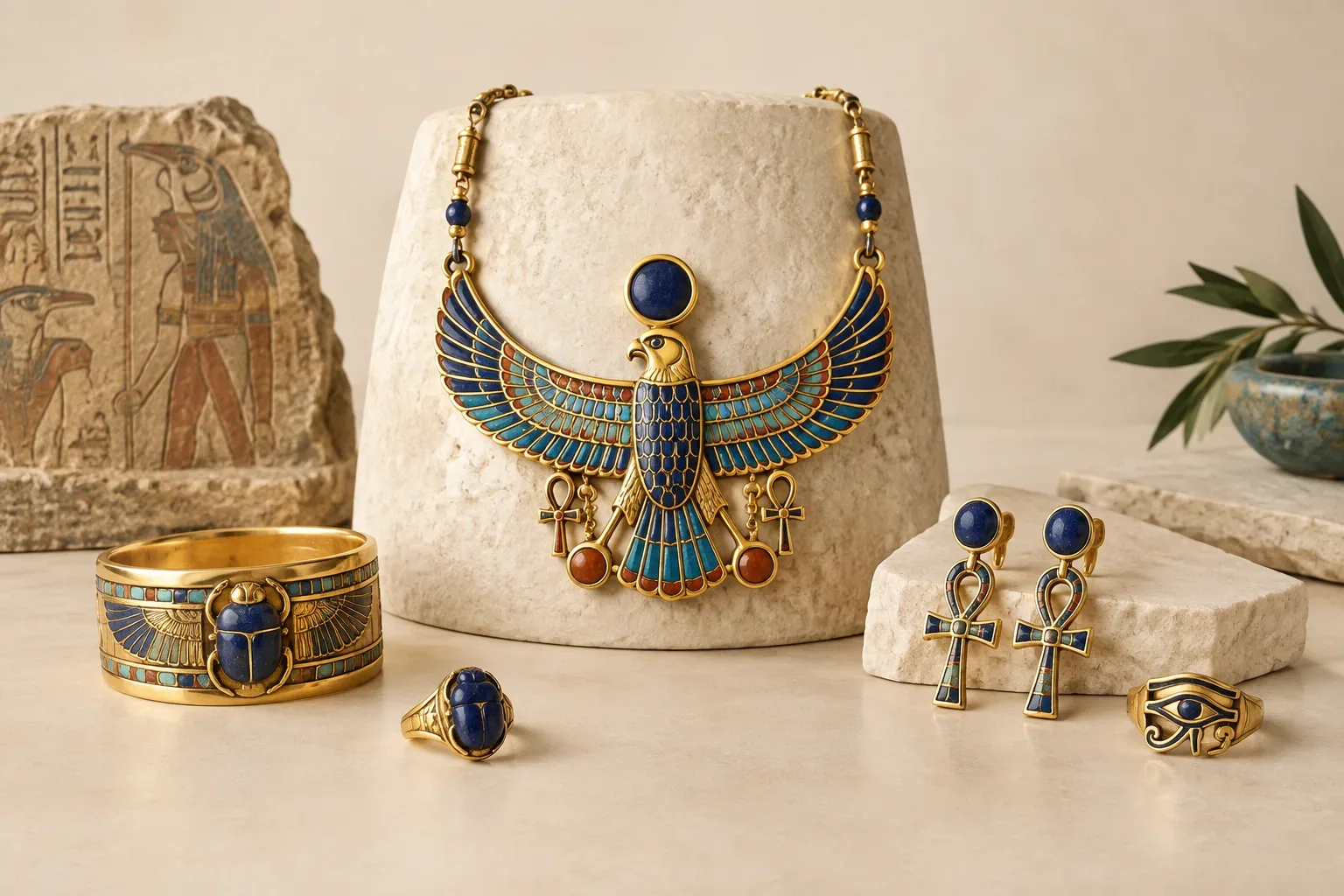
Motifs: Designers borrow visual elements—scarabs, the ankh, winged sun disks, lotus flowers, and deity imagery—and adapt them to necklaces, rings, and bracelets. Historically the ankh is often seen in temple and tomb imagery; in modern pieces it commonly appears as a pendant or charm divorced from its broader religious setting. Recognize whether a design is a stylized reference or a literal reproduction of an artifact.
Materials and stones: Ancient Egyptian jewelry used gold, electrum, faience (a glazed ceramic paste), carnelian, turquoise, lapis lazuli and other stones. The Victoria and Albert Museum's overview of gemstones explains their historical use and how trade routes made certain materials available to Egyptian workshops. Modern pieces may use actual gold and natural stones, lab-grown gems, glass, or enamel to imitate faience. Sellers should disclose whether materials are genuine, treated, or imitations; the Federal Trade Commission sets expectations for disclosure of treatments, synthetic stones, and imitations in gemstone sales.
Techniques and finishes: Revival pieces often mimic ancient techniques such as cloisonné-style inlay, granulation, or repoussé, but modern makers may employ casting, electroplating, or resin casting. A visual similarity does not guarantee the same production method or durability as historical examples in museum collections.
Practical and respectful selection and gifting guidance
Know the context before you buy or gift. If a motif was used in funerary practice or temple ritual in a specific period, consider whether using it as everyday wear could be insensitive to those origins. For some wearers, wearing a historically sacred motif is meaningful; for others, it risks trivializing cultural or religious practices. Ask the wearer if you are uncertain.
Prioritize transparent descriptions. A responsible seller will clearly state the materials (gold karat, silver standard, natural or lab-grown stone), disclose any treatments or enhancements, and describe whether the design is an original reproduction, a stylized revival, or a modern reinterpretation. The Federal Trade Commission guidance on buying gemstones, diamonds, and pearls underscores that disclosure of imitations and treatments is a core consumer right.
Evaluate provenance claims carefully. Modern jewelry marketed as "ancient" or "authentic" should not be assumed to include archaeological material. If a seller claims an object is an excavated artifact, request documentation and be aware of legal and ethical issues surrounding antiquities trade. Many reputable dealers instead sell contemporary pieces "inspired by" ancient models to avoid problematic sourcing.
Choose materials that match intended use. If you plan to wear a piece daily, prefer metals and settings that withstand wear—solid gold or sterling silver over surface-plated alloys, secure stone settings over glued-in stones. If you want a historically faithful look, ask whether the maker uses traditional inlay techniques or modern substitutes.
Consider artisan and cultural attribution. Where contemporary artisans from regions with links to Egyptian heritage or specialized training make revival pieces, supporting them can be a respectful way to engage with the tradition. Conversely, mass-produced representations that flatten or stereotype cultural motifs can feel exploitative to some communities.
Care, authenticity checks, and ethical red flags
Care: Historical materials like faience and some soft stones can be fragile; modern imitations made of glass or resin may behave differently. Ask the seller for care instructions and whether the finish is stable with exposure to perfumes, water, or sunlight.
Authenticity checks: Request material certificates for precious metals and gemstones when available, and ask whether stones are natural, treated, or lab-grown. The FTC guidance encourages consumers to seek clear labeling and to be cautious of vague language like "antique style" that can mask modern manufacture.
Ethical red flags: Be wary of sellers who refuse to discuss materials, provenance, or who pressure buyers with unverifiable historical claims. Also avoid purchasing purported archaeological artifacts without clear legal provenance and documentation; reputable sellers typically avoid trading in undocumented antiquities.
Frequently asked questions
Is it appropriate to wear ancient Egyptian motifs if I'm not Egyptian?
Wearing Egyptian-inspired designs is common and can be done respectfully, but it helps to understand the motif’s origin and context. Some motifs were tied to funerary or religious rites; if a symbol has sacred or ceremonial origins, consider whether wearing it as fashion is appropriate and consult the person you intend to gift if in doubt.
How can I tell if a stone or material is authentic?
Ask the seller for full disclosure: whether the metal is solid or plated, the karat or silver standard, and whether stones are natural, treated, or lab-grown. Request documentation or testing results when available. The Federal Trade Commission advises that sellers must not misrepresent treatments or imitation stones.
Are modern "faience" pieces the same as ancient faience?
Ancient Egyptian faience was a specific glazed ceramic paste used historically. Modern jewelry may imitate its look with enamel, glass, or glazed ceramic. Check the product description to determine the actual material and any care requirements.
How should I care for Egyptian-style jewelry?
Care depends on materials. Solid gold and sterling silver are relatively durable, while inlaid pieces, faience-like materials, and softer stones need gentle handling, minimal exposure to chemicals, and safe storage. Follow seller care instructions and ask how the piece responds to water, perfume, and cleaning.
What are signs a seller is overstating historical claims?
Be cautious if a listing asserts that a modern-made piece is an "authentic artifact" without documentation, or if the seller uses vague appeals to "ancient powers" rather than explaining stylistic inspiration. Reputable sellers describe whether a piece is inspired by a museum object, a period design, or a direct reproduction and disclose materials and methods.
Sources and further reading
- Bedazzled: A History of Jewellery — Victoria and Albert Museum
- An A-Z of Gemstones — Victoria and Albert Museum
- Buying Gemstones, Diamonds, and Pearls — Federal Trade Commission