Meaning at a glance
Explain the documented history and changing contexts of the ancient egyptian jewelry identification motif, separate cultural or religious evidence from later popular interpretations, and give practical guidance for choosing and wearing the motif in modern jewelry.
How museums and scholarship frame identification
Identification of ancient Egyptian jewelry relies on museum cataloguing, archaeological context, and the study of materials and techniques. Collections and exhibitions compiled by institutions such as the Victoria and Albert Museum show how jewelry must be understood in shifting social and technological contexts, not as static symbols. The V&A highlights that jewellery styles, materials and meanings changed over time with fashion, trade, religious practice and funerary needs, so identification combines form, material and find‑spot or provenance to reach a credible attribution.
Periods and cultures to distinguish
When identifying an object as "ancient Egyptian," separate the major cultural phases rather than treating Egypt as a single homogeneous culture. Archaeological and museum records, as summarized in museum overviews, distinguish pharaonic periods commonly grouped as Predynastic, Old Kingdom, Middle Kingdom and New Kingdom; later phases include the Third Intermediate and Late Periods, followed by the Ptolemaic (Greek) and Roman occupations in Egypt. Each phase shows differences in preferred motifs, techniques and materials, and many museum catalogues list items by these conventional period labels to help identification.
Common motifs and what they historically signified
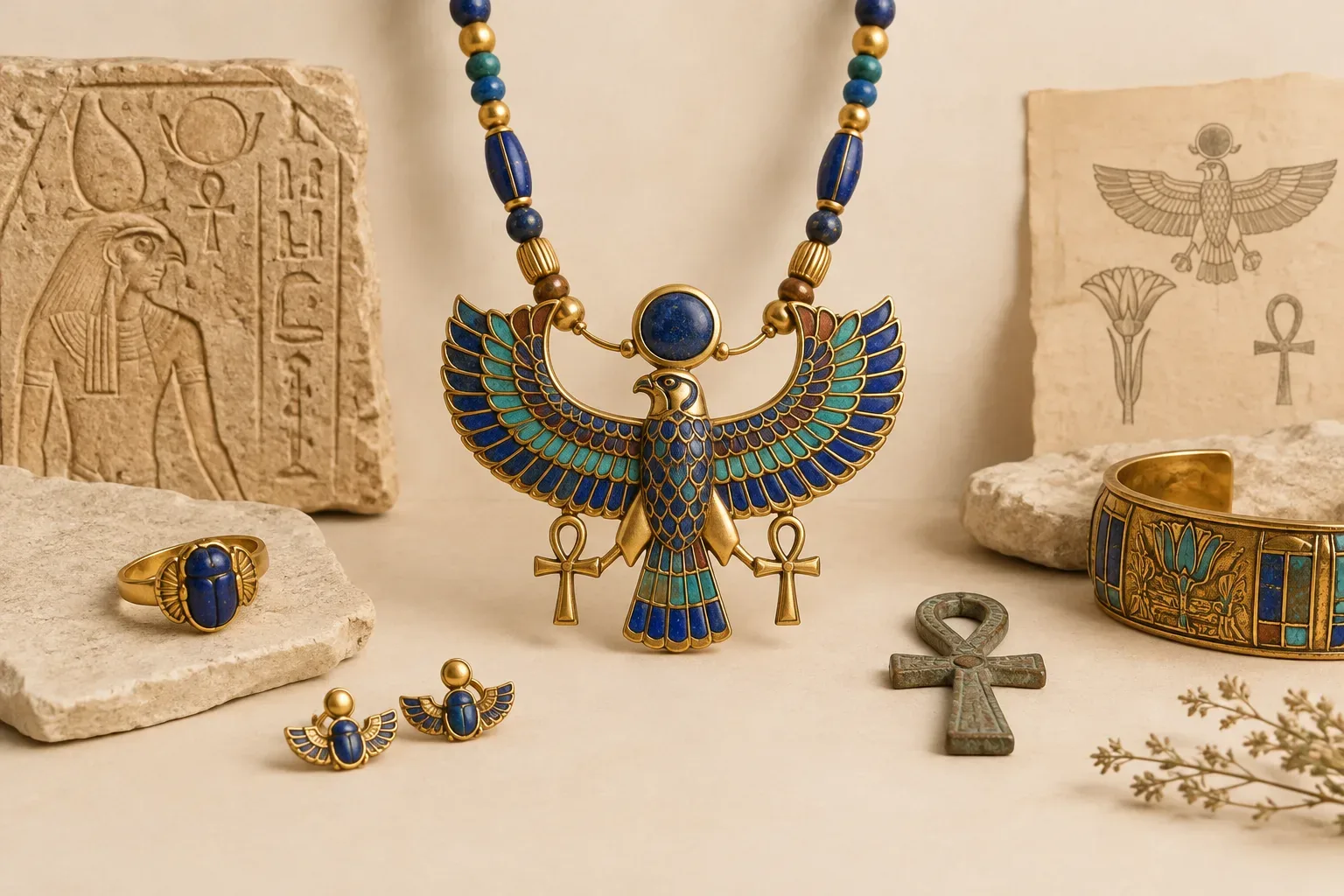
Certain motifs recur in objects labeled "ancient Egyptian" in museum collections and publications. Many of these motifs carried religious, funerary or social meanings within their original contexts, and the V&A and similar institutions document these associations within exhibition narratives. For example, insect and animal images appear frequently on amulets and inlays; stylized plants and the eye motif also appear often. In museums these motifs are usually contextualized as part of ritual practice, status display or funerary assemblages rather than as universally prescriptive symbols.
Materials and techniques to look for
Material analysis helps identification. Museums' gemstone guides show that ancient Egyptian jewelers used native gold alongside traded stones and manufactured materials. Hard stones and imported semi‑precious gems were inlaid or drilled as beads, while glazed and faience elements provided bright, durable color. Surface treatments and evidence of hand‑working, rather than modern milling or casting, help separate ancient objects from modern copies. For buyer protection and accurate labeling, the U.S. Federal Trade Commission recommends clear disclosure of treatments, imitations and synthetic materials when gemstones are offered for sale, which is useful guidance when assessing pieces marketed as "ancient" or "antique."
How motifs, gemstones and traditions appear in jewelry
In original contexts these elements appear in several standard ways. Motifs often occur as small amulets worn on cord or integrated into bead strings and pectorals. Gemstones and glass appear as inlays within collars, beads or scarab seals and were often combined to create surface patterns and strong color contrasts. Techniques such as granulation, filigree and simple riveting are recorded in museum collections as characteristic hand methods rather than modern machine production. Contemporary pieces inspired by ancient models may copy these visual elements but differ in scale, finish and material disclosure, so examination of workmanship and provenance is essential.
Common mislabels and how to spot them
Mislabels fall into several categories. First, modern reproductions styled after ancient motifs are sometimes marketed as "authentic" without provenance or supporting archaeological documentation. Second, 19th‑ and early 20th‑century revival pieces made during periods of heightened Egyptomania are occasionally misidentified as ancient. Third, modern components such as dyed stones, glass paste, and machine finishes may be passed off as ancient materials. To reduce risk, check for documented provenance, scientific analysis or museum accession numbers, and ask sellers about any treatments or reconstructions. The FTC guidance on disclosure of treatments and imitations is a practical standard sellers in many countries should meet.
Separating documented historical meanings from modern interpretation
Documented historical meanings derive from archaeological context, inscriptions, and funerary texts preserved with objects and described by museum catalogues and scholarship. Museums like the V&A present these documented contexts when they can be established. Modern personal or popular interpretations—such as asserting universal luck, protection or spiritual power for a motif worn in every cultural setting—are contemporary readings and not recoverable as universal historical facts. If a buyer or wearer values a motif for a personal reason, that is legitimate, but it should be described separately from the artefact's documented religious, social or funerary role.
Practical, respectful guidance for selection and gifting
If you are choosing or gifting jewelry inspired by ancient Egyptian motifs, start by deciding whether you want an archaeological original, a museum‑quality replica, or a modern design inspired by ancient forms. Originals require verified provenance and conservation history; replicas and inspired pieces should be clearly labeled as such to respect cultural heritage and avoid market confusion. When authenticity is important, ask for written provenance, laboratory reports or museum catalogue references. When authenticity is not the goal, choose contemporary makers who credit the source culture and avoid imagery that the wearer would find culturally insensitive. Also consider durability and disclosure: if a piece uses heat‑treated stones, dyed materials or assembled modern components, request full disclosure in line with FTC consumer guidance to make an informed choice.
How to ask sellers and what documentation to expect
Ask sellers whether the piece has museum provenance, a catalogue raisonné entry, or scientific testing such as X‑ray or compositional analysis. Expect clear statements about any modern repairs, reconstructions or replacements, and insist on disclosure of treatments or synthetic substitutes for stones. For replicas or revival pieces, a reputable seller will label them clearly and describe their maker and date. When buying as a gift, consider the recipient's interest in authenticity, their feelings about cultural use, and whether they prefer a documented antique or an ethically produced inspired design.
When to consult a specialist
Consult a qualified conservator, a museum curator with a relevant specialty, or a reputable independent laboratory when the object is expensive or when provenance is unclear. Museums and major public collections are valuable reference points for comparison, and published museum catalogues are a useful baseline for attribution. For legal and ethical concerns, specialists can advise on export restrictions, cultural property laws and proper labelling for resale or donation.
Frequently asked questions
How can I tell if a piece is genuinely ancient Egyptian or a modern replica?
Look for documented provenance, museum accession numbers, or scientific reports that show excavation context or compositional analysis. Examine workmanship for hand techniques rather than modern machining and ask the seller to disclose any repairs or restorations. Reputable sellers should clearly label replicas and provide full disclosure about materials and treatments in line with consumer guidance such as the FTC’s recommendations.
Which motifs commonly associated with ancient Egypt are safe to wear today, and which need cultural sensitivity?
Many motifs appear in contemporary jewelry as design inspirations and can be worn respectfully when their origins are acknowledged. Avoid commercializing sacred or funerary objects presented as authentic without context. Choose pieces from makers who credit the source culture, and if gifting, consider the recipient’s cultural background and feelings about historical imagery.
Are the colorful stones in Egyptian‑style jewelry usually authentic ancient gems?
Colorful elements in original ancient pieces include natural stones and manufactured materials such as glazed faience or glass. Modern pieces often use dyed or treated stones and glass substitutes. Ask about material testing and treatment disclosure; the FTC’s consumer guidance explains when sellers should reveal treatments and imitations.
What documentation should I request when buying an expensive piece labeled "ancient Egyptian"?
Request provenance documentation, any laboratory analysis, museum or excavation references, and a condition report noting restorations. If the seller cannot provide verifiable documentation, treat a high asking price with caution and consult an independent specialist.
Can a modern pendant with an Egyptian motif carry the same meaning as the original?
Modern wearers may attribute personal meaning to motifs, but such meanings are personal interpretations rather than historical facts. Museums and scholarly sources distinguish documented historical functions of motifs from modern symbolic readings, so describe contemporary meanings as personal or modern rather than as direct continuations of ancient beliefs.
Sources and further reading
- Bedazzled: A History of Jewellery — Victoria and Albert Museum
- An A-Z of Gemstones — Victoria and Albert Museum
- Buying Gemstones, Diamonds, and Pearls — Federal Trade Commission