Meaning at a glance
Explain the documented history and changing contexts of the ancient egyptian jewelry techniques motif, separate cultural or religious evidence from later popular interpretations, and give practical guidance for choosing and wearing the motif in modern jewelry.
What the archaeological and museum evidence shows
Archaeological finds and museum collections document a long record of metalwork, bead-making, and stone inlay in ancient Egypt. The Victoria and Albert Museum describes jewellery as an object class whose materials and styles changed with social context, technology, and contact with neighbouring regions, and traces a material history from early bead strings and simple metalwork through highly worked gold and inlaid collars.
Scholars and curators group Egyptian jewellery production by recognizable cultural periods: pieces attributed to the Predynastic and Early Dynastic phases tend to include beads and simple metal ornaments; Old Kingdom and Middle Kingdom jewellery reflects more sophisticated goldwork and amulet use; New Kingdom jewellery often shows the peak of inlay and elaborate collars; and Ptolemaic and Late Period objets demonstrate continued adoption and adaptation of traditional motifs. Museum descriptions and catalogues note workshop practices, burial assemblages, and the presence of workshops in urban and cemetery contexts, which together form the primary evidence base for technique and use.
Techniques documented by museums and archaeologists
Goldworking: Ancient Egyptian gold was worked by hammering, chasing, and joining to produce thin sheets, wires, and hollow forms. Surfaces were often burnished; decoration sometimes incorporated granulation and applied details. Museum labels and exhibition texts emphasize the continuity of gold as both a practical and symbolic material.
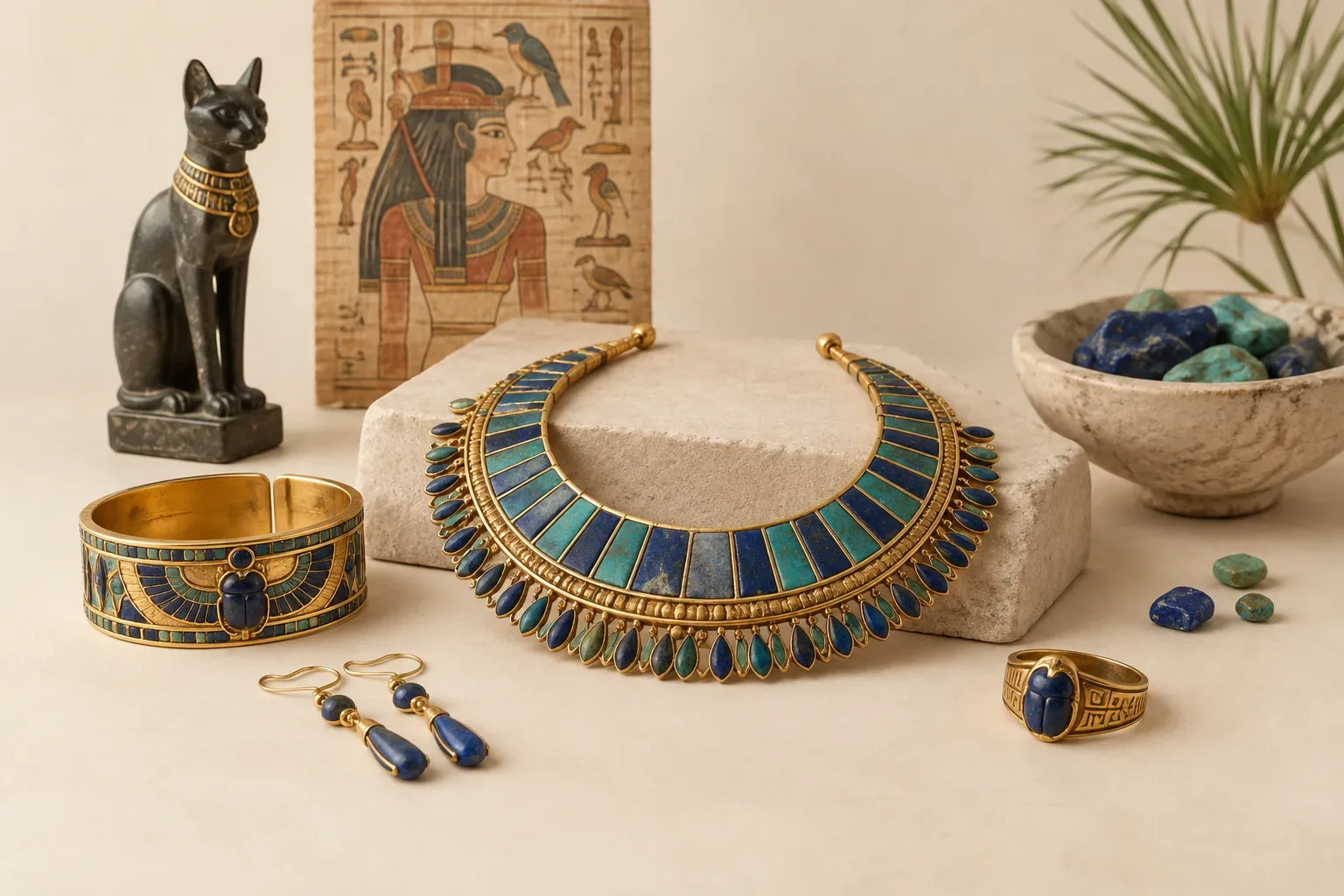
Inlay and cloisonné: Many collars and pectorals use inlay techniques in which metal cells held tesserae of glass, faience, or semi-precious stones. The result appears as the brightly coloured bands and pictorial pectorals that museums often display as characteristic Egyptian outcomes.
Faience and glazed beads: Faience — a non-clay siliceous ceramic with a glazed surface — appears throughout Egypt’s archaeological record as beads, inlays, and small amulets. The Victoria and Albert Museum highlights faience as a cost-effective and visually striking material that complemented expensive stones.
Stone cutting and setting: Harder stones such as carnelian, lapis lazuli, and turquoise were drilled and shaped for stringing and inlay. Gem sources and the technology used to work them are discussed in museum gemstone guides, which note that lapis lazuli, for example, was obtained from distant sources and prized for its deep blue.
Bead-stringing and assembly: Many Egyptian necklaces rely on complex bead strings and composite construction. Collars (wesekh) and multi-strand necklaces show careful attention to proportion, repetition, and symmetry that are as much design decisions as technical outcomes.
Trade networks and material origins
Materials used in Egyptian jewelry demonstrate wide-ranging trade. Museum accounts and gemstone reference guides highlight that key materials came from beyond the Nile valley: copper and gold from Nubian and Sinai sources, lapis lazuli from long-distance trade routes to Afghanistan, and turquoise mined in Sinai and the Eastern Desert. The movement of materials shaped technique, as imported stones required particular cutting and setting approaches.
Trade also introduced technologies and stylistic influences. The presence of similar forms across the eastern Mediterranean and Near East in some periods indicates exchange of goods and ideas; the Victoria and Albert Museum frames jewellery as part of a broader history of social display and cultural contact.
Documented meanings in context — what the evidence supports
Museum documentation and archaeological contexts provide the clearest evidence for how ancient Egyptians used jewellery. Egyptian jewellery frequently appears in burial assemblages, indicating a role in funerary practice and afterlife beliefs. Amuletic forms such as the scarab, the eye motif, and certain animals recur in contexts associated with protection, rebirth, and identity in burial sets, and museums interpret these forms within religious and funerary frameworks based on their find contexts.
Jewellery also signalled rank and office. Inscriptions, iconography on pectorals, and the quality of materials are commonly treated in museum descriptions as markers of social status or royal association. These interpretations come from the objects’ archaeological contexts and associated texts rather than from a single universal meaning.
Later and modern interpretations — how they differ from documented uses
Modern popular culture and contemporary spiritual movements often extend or reassign symbolic meanings to Egyptian motifs. For example, modern wearers may ascribe personal protective or metaphysical qualities to an Eye of Horus pendant in ways not directly provable from archaeological evidence. The Victoria and Albert Museum and similar collection interpreters differentiate between what burial context and inscription evidence show and later symbolic layers applied by other cultures or modern consumers.
It is important to recognize that such modern meanings are contemporary personal or cultural interpretations. They can be meaningful for the wearer, but they are not equivalent to the documented religious or social functions established by the archaeological record.
How motifs, gemstones, and traditions appear in jewellery today
Motifs: Common ancient-Egypt-inspired motifs in modern jewellery include the scarab beetle, the Eye of Horus (wedjat), the lotus, and broad-collar geometry. Contemporary designers often simplify or stylize these motifs for necklaces, rings, and earrings, using them as graphical or emblematic elements rather than literal reproductions.
Gemstones and materials: Lapis lazuli, carnelian, turquoise, and gold are still used to evoke an Egyptian aesthetic. Museum gemstone resources point out the historical associations of these stones; modern makers may substitute glass, dyed stones, or faience-like materials for cost or ethical reasons.
Techniques: Modern makers sometimes use historical techniques—such as inlay, cloisonné, and granulation—in revival pieces. Other modern manufacturing methods mimic the visual effect of ancient techniques while using contemporary tools and alloys.
Practical and respectful guidance for selection and gifting
Buy with provenance and disclosure: If authenticity matters to you, ask sellers for provenance and documentation. Museums and consumer guidance emphasise clear disclosure about material treatments and imitations. The U.S. Federal Trade Commission recommends asking whether gemstones have been treated, dyed, or are simulants, and insists on clear disclosure by sellers.
Decide whether you want an antique, a faithful reproduction, or a modern piece inspired by Egyptian form. Genuine ancient objects should be handled with provenance and legal import documentation; museum and dealer records help confirm legitimate ownership histories. Reproductions and contemporary designs are often the more appropriate, safer, and legally straightforward option for everyday wear.
Respect cultural context: If the motif has sacred or ritual connotations, consider how the recipient perceives it. Choose neutral, decorative motifs if you are unsure whether an amulet or funerary symbol would be welcomed. Gifting a piece with an explicit religious meaning should be done with sensitivity to the recipient’s beliefs and cultural background.
Prioritise quality and sustainability: Look for reputable makers and ask about materials and treatments. The Victoria and Albert Museum’s gemstone guidance can help you identify stones traditionally associated with ancient Egyptian jewellery, while the FTC’s consumer advice helps you evaluate claims about treatments and authenticity.
Care and display: Many historically-based materials (gold, inlaid glass, faience) are durable, but historic techniques can be delicate. If you acquire an antique or a high-quality reproduction, seek professional conservation advice for cleaning and repair and avoid wearing fragile pieces during strenuous activity.
Frequently asked questions
What are the main ancient Egyptian jewellery techniques I should know about?
Key techniques documented in museum research include hammered and chased goldwork, inlay and cloisonné-like construction for collars and pectorals, faience production for beads and amulets, and careful stone cutting and drilling for semi-precious materials. Museums such as the Victoria and Albert Museum summarise these practices in exhibition and object records.
Can I wear authentic ancient Egyptian jewellery?
Authentic ancient pieces do surface in the market but require careful provenance and legal import documentation. Many museums advise that buying antiquities without clear provenance risks supporting illicit trade. For everyday wear, high-quality reproductions or contemporary pieces inspired by Egyptian motifs are usually safer and more ethical choices.
How can I tell if a gemstone used in Egyptian-style jewellery is treated or a simulant?
Ask the seller for disclosure about treatments and for any gemological reports. The U.S. Federal Trade Commission requires sellers to disclose material treatments and whether a stone is a simulant. If in doubt, request an independent gemological assessment.
Are there cultural sensitivity concerns when gifting Egyptian-inspired motifs?
Yes. Some motifs have religious or funerary associations in their archaeological contexts. Consider the recipient’s background and whether a motif is appropriate. When uncertain, choose designs presented as decorative or contemporary interpretations rather than explicitly sacred symbols.
Where should I look for reliable information on ancient Egyptian jewellery?
Start with established museum resources and exhibition texts. The Victoria and Albert Museum’s materials on jewellery history and gemstones provide evidence-based context for materials, techniques, and the changing social meaning of jewellery.
Sources and further reading
- Bedazzled: A History of Jewellery — Victoria and Albert Museum
- An A-Z of Gemstones — Victoria and Albert Museum
- Buying Gemstones, Diamonds, and Pearls — Federal Trade Commission