Meaning at a glance
Documented museum evidence does not show a long, continuous tradition of a specific "Pluto" motif in historic jewelry; instead, changes in motif use and gemstone choices recorded by institutions such as the Victoria and Albert Museum show that the idea of a Pluto-themed pendant or stone is a largely modern phenomenon tied to contemporary astrology, astronomy-inspired design, and personal meaning. This article distinguishes historically documented patterns from modern interpretations, explains how the motif appears in jewelry today, and gives practical guidance for selecting and gifting pieces responsibly.
Short answer
There is no long-standing, museum-documented tradition of a singular "Pluto" motif in historical jewelry; rather, museum records show that motifs and gemstone meanings have shifted with cultural contexts, and the idea of "Pluto jewelry" as a distinct category is a recent, modern development rooted in contemporary interest in planetary symbols and personal interpretation.
What the historical evidence shows
Major museum surveys and exhibitions make clear that jewelry motifs evolve as societies, technologies, and tastes change. The Victoria and Albert Museum's work on jewellery history emphasizes how designs, symbols, and gemstone uses are tied to social and material contexts rather than to single, unchanging meanings. Curatorial summaries such as those in the Victoria and Albert Museum's exhibition material help explain why wholesale claims about "ancient meanings" for a specific modern motif should be treated cautiously (Victoria and Albert Museum).
When scholars and museums catalogue historic pieces, they document motifs that were meaningful in their own periods—religious emblems, dynastic symbols, amulets, talismans, and classical mythological figures appear in many collections. However, the V&A's broad histories and collections do not present a continuous lineage for a specifically "Pluto" motif across ancient, medieval and early modern European jewelry. Museum records instead show how designers borrowed classical and astronomical imagery at different moments, particularly when those ideas entered public consciousness through art, science or fashion (Victoria and Albert Museum).
In short, the historical record housed in museums supports two points: first, that motifs and gemstone uses change with time and context; and second, that modern categories of symbolic jewelry—like 'planet pendants'—are often contemporary responses to modern cultural interests rather than direct survivals of ancient practice (Victoria and Albert Museum).
Separating documented history from modern interpretation
Documented history: Museum documentation shows motifs tied to identifiable historical practices and contexts. For example, gem materials, cutting techniques, and motif popularity are recorded and dated; explanations of gemstone provenance and historical uses are available in institutional resources that cover gemstone identification and context (Victoria and Albert Museum). These records are the appropriate basis for claims about what jewelry meant in a particular time and place.
Modern interpretation: By contrast, the idea that a specific modern symbol—such as a planetary glyph or a stylized emblem associated with Pluto—carries an ancient, universal meaning is largely a contemporary construction. Designers, astrologers, and wearers ascribe meaning to planetary motifs today, and those personal or subcultural meanings are valid as expressions of identity and intent. They should, however, be presented as modern or contemporary meanings rather than as historical facts.
Practical consequence: When you read claims about the "traditional" or "ancient" meaning of Pluto-themed pieces, look for museum or documentary citations. If none are provided, the claimed meaning is likely a modern or personal interpretation rather than a demonstrable historical inheritance (Victoria and Albert Museum).
How the Pluto motif and related ideas appear in jewelry today
Design language: In contemporary jewelry, "Pluto motifs" usually draw from two sources: the iconography of planetary glyphs used in modern astronomy and astrology, and visual cues associated with themes like depth, transformation, and the underworld drawn from classical mythology or poetic language. Designers express these ideas visually—through a simplified planet symbol, an abstract glyph pendant, or pieces that emphasize dark, reflective surfaces.
Gemstones and materials: Modern makers often choose materials to evoke those associations. Dark or iridescent gemstones such as onyx, labradorite, hematite, or blackened silver are commonly used to suggest depth and mystery; lighter accent stones or metalwork can imply cold remoteness or distant light. These are contemporary aesthetic choices rather than museum-documented traditions; institutional resources on gemstones provide historical context for each stone but do not assert a historic tie between any particular gem and a "Pluto" symbol (Victoria and Albert Museum, An A-Z of Gemstones).
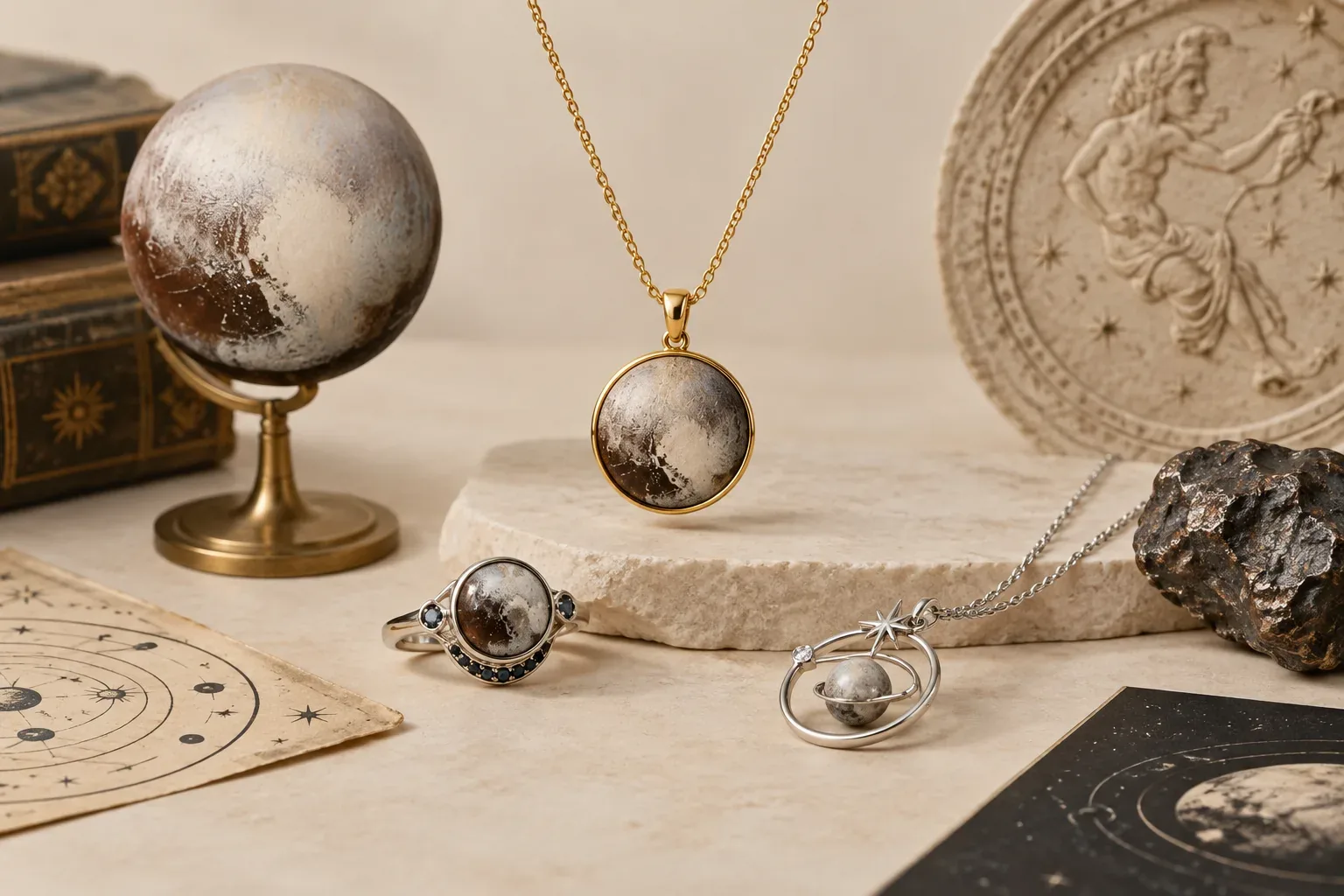
Forms and settings: Pluto-inspired pieces appear as minimalist pendants, signet-style rings, engraved lockets, and layered necklaces paired with zodiac or celestial motifs. Contemporary product listings show how makers market these items as symbols of transformation, rebirth, or personal power—meanings that reflect modern astrological and spiritual vocabularies rather than a fixed historical doctrine.
An example in the current market: Contemporary retailers produce small sterling silver pendants and planetary glyph necklaces explicitly marketed for their transformative symbolism. Such listings are useful examples of how designers and consumers treat the motif today, but they reflect modern commerce and personal symbolism rather than museum provenance. For an example of a current product that illustrates this trend, see the Pluto symbol necklace as a contemporary design example.
Choosing or gifting Pluto-themed jewelry respectfully and practically
Be explicit about meaning: If you give a piece because it symbolizes change, grief work, resilience, or an interest in transpersonal themes, state that intention. Receivers may have different beliefs about astrology or classical mythology; framing the gift as your intention avoids assuming a universal meaning.
Consider cultural and personal context: Some motifs that evoke the underworld or transformation can be sensitive depending on religious or cultural background. Respect the recipient's worldview and ask when unsure. Treat the motif as a modern symbol of personal meaning rather than an unquestioned ancestral tradition.
Choose materials intentionally: Decide whether you want fine materials (solid gold, verified gemstones) or a symbolic fashion piece. When selecting gemstones or treatments, consult reputable guidance on gemstone identification and historical uses for context (Victoria and Albert Museum, An A-Z of Gemstones). For consumer protection and disclosure of treatments, consult official buying guidance such as the Federal Trade Commission's recommendations on gemstones, diamonds, and pearls to ensure you receive full information about treatments, imitations, and origin (Federal Trade Commission).
Try symbolic layering: If the recipient enjoys celestial themes, combine a Pluto motif with a zodiac sign, moon, or locket to create a narrative. If the piece is for a milestone—endings, new phases, or commemorating resilience—consider pairing the jewelry with a short note explaining why you chose the motif.
When in doubt, prioritize craft and clarity: Good workmanship, clear provenance or retailer disclosure, and transparent descriptions of materials and treatments make a piece both more durable and more meaningful to most recipients (Victoria and Albert Museum; Federal Trade Commission).
Buying, care, and authenticity: what to check
Ask for material and treatment disclosures. The Federal Trade Commission recommends that buyers request clear information about whether stones have been treated, whether metal is plated or solid, and whether any imitations are present. Legitimate sellers will provide details and, when appropriate, certification or testing notes (Federal Trade Commission).
Check gemstone identification and historical context. Institutional resources such as the Victoria and Albert Museum's A–Z of Gemstones help you distinguish historically significant stones and understand their changing uses over time. Use trusted references to verify claims about a stone's identity or provenance (Victoria and Albert Museum, An A-Z of Gemstones).
Care and longevity. Choose a metal and setting appropriate to how the wearer will use the piece. Precious metals and well-made settings stand up to daily wear; plated finishes need more care. Follow the maker's cleaning instructions and avoid exposure to harsh chemicals if the piece contains delicate finishes or treated stones.
Prefer makers who explain symbolism. Contemporary designers often include a short statement about the symbolism they intend. Those notes help you understand whether the piece aligns with your intended meaning or gift message.
Conclusion
Pluto-themed jewelry as a distinct, widely attested historical category does not appear in major museum documentation; instead, the motif is best understood as a contemporary design and symbolic choice built from modern astronomy, astrology, and personal interpretation. Museum resources emphasize that motifs and gemstone meanings shift over time, and they provide reliable context for claims about historical usage (Victoria and Albert Museum).
If you are choosing or gifting a Pluto motif, treat its meanings as contemporary narratives you and the wearer share: choose materials and makers who disclose treatments and provenance, respect cultural sensitivities, and phrase your intentions clearly so the piece serves the relationship and purpose you intend.
Frequently asked questions
Is there an ancient or historically documented Pluto symbol used in jewelry?
No single, continuous "Pluto" symbol appears in major museum catalogues as a distinct, historically continuous motif. Museums show that motifs evolve with time and cultural context; modern "Pluto" motifs are contemporary creations rather than ancient survivals.
What gemstones are traditionally associated with Pluto jewelry?
There is no museum-documented, traditional set of gemstones specifically tied to a "Pluto" motif. Contemporary designers often choose dark or iridescent stones to evoke themes of depth or transformation, but those selections reflect modern aesthetic choices rather than historical prescription.
How can I verify the materials and treatments in a Pluto-themed piece?
Ask the seller for written disclosure about metal content, stone identity, and any treatments. The Federal Trade Commission recommends that buyers request clear information about treatments and imitations and seek certification when appropriate.
Is it culturally insensitive to wear Pluto-themed jewelry?
Wearing a Pluto motif is not inherently insensitive, but be mindful of religious or cultural contexts where underworld imagery may have different connotations. When gifting, explain your intention and consider the recipient's beliefs.
How should I gift a Pluto pendant for someone undergoing change?
Explain why you chose the motif—words about transformation, resilience, or a new phase help connect the symbol to your intention. Pairing the piece with a short note makes the meaning personal rather than assuming a universal interpretation.
Where can I learn more about gemstone history and identification?
Institutional resources such as museum articles and compilations of gemstones provide reliable historical context and identification guidance. These are good starting points for research before making a purchase.
Sources and further reading
- Bedazzled: A History of Jewellery — Victoria and Albert Museum
- An A-Z of Gemstones — Victoria and Albert Museum
- Buying Gemstones, Diamonds, and Pearls — Federal Trade Commission