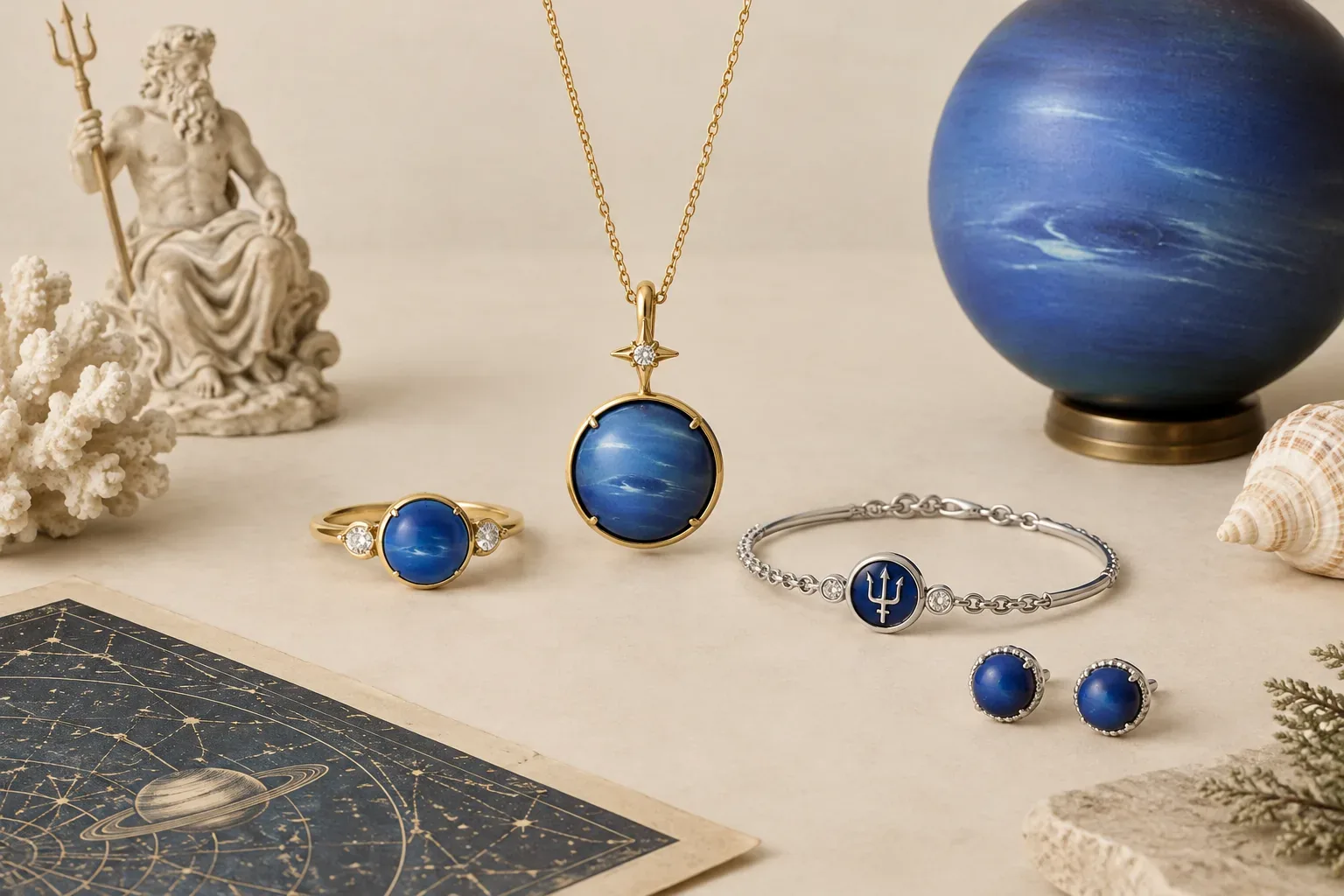
Meaning at a glance
Documented historical evidence for a distinct ‘Neptune’ planetary motif in jewelry is limited; most meanings tied to Neptune as a planet or archetype are modern and shaped by changing tastes in astronomy, astrology, and color symbolism. When choosing or gifting Neptune-themed jewelry, treat historical claims and personal meanings separately, verify materials and treatments, and select designs that respect the recipient’s cultural and spiritual context.
Quick answer
In short: documented historical evidence for a long-standing, distinct Neptune planet motif in jewelry is sparse; the motif as we now understand it is primarily a modern development that draws on astronomy, astrological symbolism, and the longstanding use of blue-green materials to evoke water and mystery. The article explains what is supported by museum scholarship about jewelry’s changing motifs, separates older documentary evidence from later personal or spiritual readings, and gives practical buying and gifting guidance.
What the historical record actually shows
Museum scholarship emphasises that jewellery motifs and their social meanings change over time as fashion, technology, science, and belief systems shift. The Victoria and Albert Museum notes that jewellery history is best read as a record of changing social contexts, materials, and techniques rather than a fixed set of universal symbols. That approach means we should be cautious attributing a single, continuous meaning to any planetary motif without direct documentary evidence.
Specifically for planetary motifs, surviving objects and museum catalogs show that many celestial designs we consider “astrological” or “astronomical” today—sunbursts, stars, and crescent moons—have clear historical antecedents. However, direct, well-documented uses of Neptune as a named planetary motif in pre‑modern jewellery are not prominent in the broad surveys of jewellery history. The rise of jewellery explicitly referencing modern planets tends to track later developments in public interest: growing popular engagement with astronomy and astrology and the expansion of mass-produced jewellery in the 19th and 20th centuries, contexts museums use to explain motif changes.
Separating documented history from modern interpretation
Documented historical meanings come from surviving objects, maker records, and contemporary descriptions. For many older pieces, museums like the V&A document how materials, motifs, and techniques signalled social status, mourning, love, religious affiliation, or national identity. When a planetary motif is present in historic jewellery, curators look for maker’s notes or design programmes to interpret meaning rather than projecting later ideas back onto the object.
Modern personal and spiritual interpretations—for example, linking a Neptune pendant to dreams, intuition, or oceanic empathy—are valid as contemporary meanings but are not the same as historical evidence. These readings are often products of late 19th–21st century occult revivals, modern astrology communities, and contemporary jewellery designers who intentionally combine cosmic imagery with spiritual language. Treat such modern symbolism as contextual and personal rather than universally documented.
How the Neptune motif and related imagery appear in jewelry
Designers and makers signal Neptune in jewelry in several common ways: by using trident or wave motifs that culturally reference the Roman sea god Neptune and by employing blue‑green palettes and planetary glyphs used in modern astrology. Contemporary pendants and charms sometimes combine a stylised trident, the planetary glyph for Neptune, or abstract wave forms to create an immediate visual link to sea, mystery, or the planet itself.
Because explicit historical Neptune motifs are mainly modern creations, you will often find them in mass-produced astrology lines, artisan silverwork, and contemporary handmade pieces rather than in museum collections of older fine jewellery. Museums document broader uses of celestial motifs across periods, which explains why jewelers today feel comfortable adapting planetary imagery for new symbolic purposes.
Gemstones, color, and material traditions that suggest Neptune
Historically, colours and specific gemstones have been used to evoke water, the sea, and the sky. Museum resources on gemstones explain that blue and green materials—such as aquamarine, turquoise, and other teal or blue stones—have long been chosen to suggest watery or marine associations because colour is an immediate visual shorthand. Jewelers designing Neptune‑themed pieces commonly use these stones for their evocative colour rather than because of a historical, planet‑specific tradition.
When assessing stones, note that museums and gem guides stress the importance of identifying a stone by its accepted name and understanding its treatment history. The Victoria and Albert Museum’s gemstone guide describes historical contexts for gems and their changing popularity in decorative arts, while consumer protection guidance highlights that treatments and imitations are a common part of the modern gemstone market.
Authenticity, treatments, and buyer protection
Treatments, enhancements, and imitations are widespread in the gemstone market. The U.S. Federal Trade Commission recommends asking sellers for clear information about whether a gemstone has been heat‑treated, dyed, irradiated, filled, or is a simulation, and to request any available testing or certification. For Neptune‑themed pieces that use colour to evoke meaning, confirm whether the hue is natural or the result of treatment, since that affects value and long‑term care.
If provenance or historical authenticity matters to you, museums show that documentation from makers, retailers, or laboratory reports is essential. For contemporary pieces that intentionally signal Neptune, maker statements about inspiration are valuable for understanding whether symbolism is a designer’s narrative or a claimed historical lineage.
Practical guidance for selecting or gifting Neptune jewelry
Start by clarifying what you want the piece to mean to the recipient. If you wish to convey modern ideas such as imagination, intuition, or a love of the sea, choose designs with clear visual cues—wave forms, blue‑green stones, or the modern planetary glyph—and consider a maker who describes that inspiration. If historical authenticity is important, look for documented provenance or pieces in museum collections and be cautious about statements that claim antique ‘Neptune’ symbolism without evidence.
Respect cultural and religious contexts. Avoid presuming that a celestial motif has the same significance for everyone, and if you are uncertain about spiritual connotations for your recipient, prefer neutral design cues or ask them. For a meaningful gift, choose a comfortable scale and metal that suits everyday wear, confirm any gemstone treatments with the seller, and consider engraving a short note that explains why you chose the motif—this makes a modern symbolic intent explicit and personal.
Care and longer-term ownership considerations
Caring for Neptune‑themed jewelry follows standard practices for the materials used. Silver should be stored to minimise tarnish and cleaned with appropriate cloths; softer blue‑green stones may require gentler cleaning and storage to prevent scratches. If a piece contains treated stones or composite materials, follow the seller’s care instructions and avoid harsh chemicals.
If resale or future valuation is a concern, keep any certificates, receipts, or treatment disclosures provided at purchase. Museums and gem authorities emphasise documentation as part of an object’s story; for contemporary symbolic pieces, documentation preserves the maker’s stated meaning alongside technical details about materials.
Final thoughts
Neptune planet jewelry meaning today is largely a contemporary construction that borrows from a long visual language of celestial and marine imagery. Museums remind us to read jewellery as culturally situated objects: motifs change and gain new meanings over time. When choosing or giving Neptune‑themed jewelry, separate well‑documented historical facts from newer spiritual or personal interpretations, check material disclosures, and select a design that matches the wearer’s aesthetic and cultural comfort.
Frequently asked questions
What does 'Neptune' jewelry typically symbolize?
Contemporary Neptune jewelry commonly evokes themes associated with the sea, mystery, imagination, and planetary or astrological ideas; these meanings are modern interpretations and not a single documented historical symbolism. Museums caution that motifs gain and change meaning over time, so contemporary symbolic language often reflects recent cultural interests.
Is Neptune jewelry a historical religious symbol?
There is no broad documentary evidence that a Neptune planetary motif functioned as a unified religious symbol across cultures. Museums treat celestial and marine motifs individually and look for specific provenance before assigning religious or ritual meaning.
Which gemstones are used to suggest Neptune themes?
Designers commonly use blue and green stones—such as aquamarine, turquoise, or other teal/blue gems—to suggest sea and sky. Museum gemstone guides explain that colour has long been used to evoke certain associations, but the choice is primarily aesthetic and symbolic rather than evidence of a historical planetary tradition.
How can I verify whether a stone in Neptune jewelry is natural or treated?
Ask the seller for full disclosure about treatments and any available laboratory certification. U.S. Federal Trade Commission guidance recommends that sellers disclose treatments such as heating, dyeing, irradiation, or filling, and buyers request documentation if provenance or authenticity matters.
Is it appropriate to gift Neptune jewelry to someone who follows astrology?
If the recipient identifies with astrological symbolism, a Neptune motif may be meaningful. Ensure the design and materials align with the recipient’s tastes and ask about any spiritual or cultural sensitivities beforehand. If uncertain, choose an elegant, neutral form or include a short engraved note to explain your intention.
Do older museum pieces often have planetary motifs like Neptune?
Museums document many celestial motifs historically, but explicit, named Neptune motifs are more commonly a modern phenomenon. Curatorial literature emphasises that motif usage reflects changing social contexts, and clear attributions require documented provenance.
Sources and further reading
- Bedazzled: A History of Jewellery — Victoria and Albert Museum
- An A-Z of Gemstones — Victoria and Albert Museum
- Buying Gemstones, Diamonds, and Pearls — Federal Trade Commission