Meaning at a glance
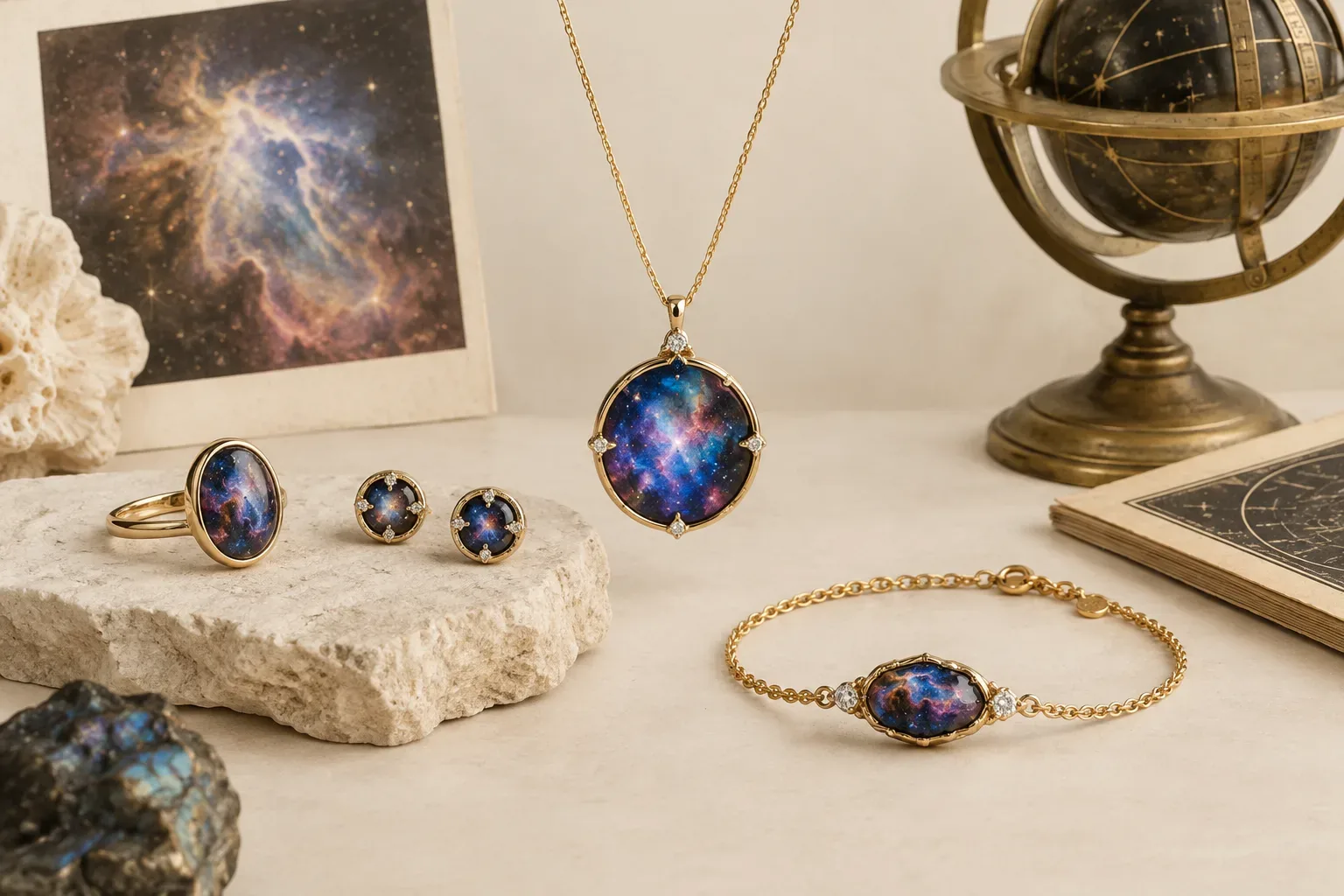
Nebula jewelry meaning is primarily a modern, aesthetic and personal symbolism rooted in telescopic and artistic imagery rather than a continuous ancient religious motif; documented changes in jewelry practice and gemstone use show how makers have borrowed cosmic ideas to express wonder, transformation, and connection.
Direct answer — the short thesis
Nebula jewelry meaning, as documented, is largely a modern designation applied to decorative motifs and gemstones that evoke the cloud-like, colorful forms seen in astronomical imagery. Museums and curators who survey jewelry history show that meanings of decorative motifs shift over time and that makers borrow scientific and poetic images to suit contemporary tastes; therefore references to 'nebula' in jewelry are best understood as recent aesthetic and personal interpretations rather than an unbroken historical or religious symbol from antiquity.
Historical evidence, by period and culture
Surveying jewelry from a museum-historical perspective makes one clear point: ornamental patterns such as spirals, starbursts, clouds and swirl designs have existed in many cultures, and their meanings have varied with context. The Victoria and Albert Museum (V&A) places these visual changes within social and technical histories and emphasizes that jewellery’s meanings are not fixed but change with fashion, technology, and social use. The V&A’s overview of jewellery history explains how motifs are adopted, adapted, and reinterpreted across periods and societies.
In pre-modern periods and across many cultures, jewel-like decoration often used geometric, vegetal, and celestial motifs (for example stars and suns) to convey status, protection, or alignment with cosmological ideas. These motifs are documented by museum collections and curatorial work as varied in meaning according to place and belief systems, but those sources do not record a widely shared religious symbol that corresponds exactly to the modern notion of a 'nebula.'
From the 19th century forward, shifts in technology, natural science and visual culture increased public familiarity with telescopic images and atmospheric phenomena. In later historical periods, including the Victorian and 20th-century eras documented by institutional surveys, designers began to borrow more directly from scientific and natural imagery. The V&A’s histories of jewellery note how technological advances, new gem materials, and changing tastes produced new visual languages in jewellery, which is the context in which 'nebula' as an expressly cosmic aesthetic emerges in modern design.
Documented history versus modern personal interpretations
It is important to separate two kinds of claims. Documented history, as established by museum research and curatorial catalogs, shows which motifs existed in a given place and how makers and wearers described them. The V&A materials included in the museum’s histories and gemstone guides provide that documentary backbone: they trace the use of certain motifs and gemstones, and they emphasize changing social meanings over time.
Modern personal interpretations are the meanings contemporary wearers assign to a piece. The label 'nebula' is often applied by modern designers, retailers, and wearers to pieces that visually resemble cloudlike swirls, diffuse color fields, or star-sprinkled compositions. Those meanings—such as cosmic wonder, personal transformation, creativity, or the vastness of possibility—are contemporary narratives layered onto decorative forms rather than meanings that can be traced continuously through multiple historical cultures.
How the nebula motif, gemstones, and techniques appear in jewelry
Designers evoke nebulae in several material ways. One approach is motif: using openwork swirls, cloudlike enamel fields, or star-and-comet settings that read visually as 'celestial' or atmospheric. These forms can be direct visual allusions or abstracted suggestions intended to capture a diffuse, otherworldly look.
A second approach is material and color. Certain gems and materials—historically and today—have been chosen to create nebula-like effects. The V&A’s 'An A–Z of Gemstones' explains how specific stones have optical effects and cultural histories that make them suited to evocative designs; stones with play-of-color, iridescence, or internal shimmer (for example opal or labradorite among many choices) are frequently used because they can appear clouded, holographic, or starlit in the way a nebula image does.
Contemporary makers also use modern techniques such as layered glass (including dichroic glass), colored resin with embedded glitter or metallic flakes, and complex enameling to imitate the diffuse textures and layered color fields of astronomical photography. Star accents, pavé settings, and asymmetrical compositions often accompany these materials to complete the 'nebula' impression.
Historically produced pieces that look nebulous are usually best understood as using traditional decorative vocabularies—swirls, clouds, and star motifs—rather than attempting to reproduce scientific imagery. The museum record shows those decorative languages are longstanding, while the explicit intent to reference nebulae is a more recent, design-driven choice.
Practical guidance for selecting and gifting nebula-inspired jewelry
Begin with the recipient: consider whether they value scientific or poetic references, whether they prefer subtle motifs or literal imagery, and whether they have sensitivities to particular metals or treatments. A piece that reads as 'nebula' to an astronomy enthusiast may be appreciated for its literal reference to space imagery; to someone who prefers metaphor, the same piece may instead signify change or creativity.
Ask sellers clear questions about materials and treatments. The Federal Trade Commission’s guidance on buying gemstones, diamonds, and pearls stresses the importance of disclosure: ask whether gems are natural, treated, assembled, or simulated; request written confirmation of metal stamps and treatment histories; and keep receipts that describe materials. That practical scrutiny helps avoid surprises and preserves the piece’s intended meaning for the recipient.
Match scale and wearability to the recipient’s lifestyle. Nebula-like pieces can be bold statement pendants or small, subtle stud or band accents. Consider daily wear versus occasional wear when choosing metals and settings; stones with strong optical effects sometimes require protective settings if worn daily.
Consider provenance, craft, and conservation. If the piece is vintage, check condition and any past repairs against museum standards for care; if it’s modern, ask about maker practices and whether the item is handmade or mass-produced, as these details affect both durability and the narrative you present when gifting.
Frame the meaning when you give the gift. Because modern nebula symbolism is often personal, a short note explaining why you associate the piece with a particular idea—a moment of change, a shared memory of stargazing, or a wish for creative growth—will anchor the wearer’s personal meaning while leaving room for their own interpretation.
Final considerations
If you are researching an older piece that looks 'nebula-like,' use established museum catalogs and gem references as a starting point; the V&A’s materials on jewellery history and on gemstones are useful for identifying historical motifs and material properties. Remember that museum documentation emphasizes shifting social contexts: a decorative cloud or swirl motif in one era may have signified protection, status, or fashion rather than an astronomical reference.
In short, 'nebula jewelry meaning' today is chiefly a modern lens applied to decorative traditions. It is a legitimate and evocative way to name a design, but it should be presented as contemporary or designer-driven symbolism unless specific provenance or maker documentation proves otherwise.
Frequently asked questions
Is nebula jewelry an ancient symbol?
There is no single, continuously documented ancient symbol called a 'nebula.' Museum scholarship shows that decorative cloud, spiral and star motifs exist across many cultures, but the explicit label 'nebula' for jewellery designs is a modern application tied to contemporary visual culture and astronomical imagery.
What gemstones look most like a nebula?
Stones with internal play-of-color or iridescence—such as certain opals or labradorite—and materials like dichroic glass or layered enamel are often used to suggest a nebula’s diffuse color fields. For historical and identification context, see V&A’s A–Z of Gemstones.
How can I be sure a 'nebula' piece is natural and not simulated?
Ask the seller for clear disclosure about whether gems are natural, treated, assembled, or simulated. The Federal Trade Commission recommends requesting written information about treatments and checking metal stamps and receipts to confirm the materials.
How should I gift nebula-themed jewelry?
Match the scale and language of the piece to the recipient’s taste, explain your intended meaning in a note, and confirm materials and care instructions so the piece’s story and condition are preserved for the wearer.
Where can I learn more about historic motifs that look celestial?
Start with museum overviews of jewellery history and curated gemstone guides, such as the V&A’s resources, which document how motif meanings and gem use change over time and place.
Sources and further reading
- Bedazzled: A History of Jewellery — Victoria and Albert Museum
- An A-Z of Gemstones — Victoria and Albert Museum
- Buying Gemstones, Diamonds, and Pearls — Federal Trade Commission